

The Congress continues its campaign against the India-US trade deal, criticising the Modi government, saying it has put the country’s self-reliance and national interests at risk. However, the principal Opposition party hasn’t defined its strategy to mobilise the country’s farmers — the community it deems will be “worst hit” by the deal.
Recently, Congress raised significant concerns about the VB-G RAM G Act, introduced by the NDA government after abolishing the erstwhile MGNREGA Act. The party called for a nationwide 45-day ‘MGNREGA Bachao Sangram’ to protect the “legacy Act of UPA rule.”
However, it has been more symbolic and apart from customary speeches, it hasn’t galvanised into anything significant.
The party has been vocal that the government wants to do away with MGNREGA, as states now have to allocate 40 per cent of their own budgets to projects under the scheme.
New attack on trade deal
Today, the Grand Old Party added another dimension to its counter against the trade deal with the US. It said the deal will now open India to genetically modified (GM) crops which it said would affect the purity and gene pool of seeds existing in the country. Also, the party said the deal would be disastrous for farmers, particularly those involved in cotton production nationwide, especially those in Maharashtra, Gujarat, Telangana, Uttar Pradesh, Rajasthan, Andhra Pradesh, and Karnataka.
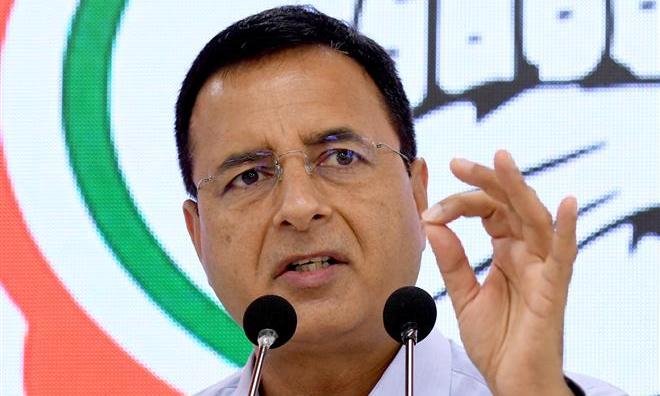
The party argues that the deal would open Indian markets to the import of US cotton. The apprehension was expressed by senior Congress leader and MP Randeep Surjewala in a presser today. Surjewala made the statement in response to the recent comments made by Union Minister Piyush Goyal, who said India will import cotton from the US too at zero import duty in response to the US-Bangladesh deal signed on February 6, 2026.
“Where would the country’s farmers who grow cotton find buyers?” questioned Surjewala, while also referring to the deal between Washington and Dhaka.
He said it is a “double whammy” for both farmers and the textile industry in the country, given that India has a cotton trade with Bangladesh amounting to USD 2.7 billion annually, with raw material for Dhaka’s ready-made industry sourced from Delhi.
Also Read: ‘Betrayal of Indian farmers’: Rahul Gandhi asks 5 questions on US trade deal
Surjewala argued that such a move would effectively eliminate Bangladesh as a buyer of Indian cotton, dealing a blow to domestic farmers. At the same time, he warned that Bangladesh would be able to manufacture and export cheaper garments to global markets, potentially hurting India’s textile sector, given that the country is a major hub for textile production.
Referring to Commerce Minister Piyush Goyal’s remarks, Surjewala said the government had signalled that it may increasingly procure cotton from the United States in the future — a shift he claimed would be detrimental to India’s farming community.
Surjewala’s assertion today echoes Leader of the Opposition (LoP) Rahul Gandhi’s speech in the ongoing session of Parliament. He claimed the trade deal is a “death knell” for farmers and “sell out” of the country.
‘All talk, no action’
The party has been raising the issue for the past several weeks. Given that it concerns farmers — and recalling how sustained protests by the farming community compelled the Modi government to repeal the three farm laws — the party believes the matter could help it galvanise mass support and mount a challenge to the power corridors in Delhi.
However, so far the party seems to be only raising the issue. It has not so far chalked out a strategy to hit the ground. Though Rahul met with farmers’ unions affiliated to the party recently, apart from pressers and statements, the party hasn’t been able to build a momentum on the ground, much like its MNREGA protest, which has been lacklustre and symbolic only.
“The deal is a compromise with the country’s national interest and self-reliance. Almost 72 crore livelihoods of the country have been put at risk,” Surjewala said today.
He said the deal is tilted towards the US, who through the deal will be able to land its surplus grains in India including corn, soyabean, red sorghum, millets, fruits and other crops.
Also Read: India-UK FTA set for April rollout after ratification
The Opposition party also cornered the Modi government over the White House statement released on 6 February 2026, which clearly forbade India from importing crude oil from Russia with the caution that in case New Delhi would purchase crude oil from Moscow, Washington would levy high tariffs on New Delhi again.
“This is going to impact 52 per cent of the country’s energy needs. India earlier sourced around 40 per cent of its crude oil from Russia and 11 percent from Iran, both at relatively cheaper rates. Imports from Iran were stopped earlier. Now, we are going to follow the US diktat,” he said.
He added that as the world’s third-largest consumer of crude oil, India may now have to import crude from US-controlled Venezuela. “At the very least, we should purchase it at par rates, if not at cheaper prices,” he said.
However, Surjewala was unable to clearly outline what concrete steps the principal Opposition party would take to galvanise mass support against the trade deal, which it has described as a “compromise.”

Comments are closed.