

The national capital is hosting what is being described as the largest AI summit of the Global South, bringing together heads of state from 20 countries, top global technology leaders and over two lakh delegates at Bharat Mandapam. The multi-day summit, scheduled till 26 February, features more than 800 AI products and participation from leading technology companies including Google, OpenAI, Microsoft and Amazon. India has positioned itself as a key AI voice of the Global South, highlighting investments under the IndiaAI Mission and progress on indigenous foundation models.
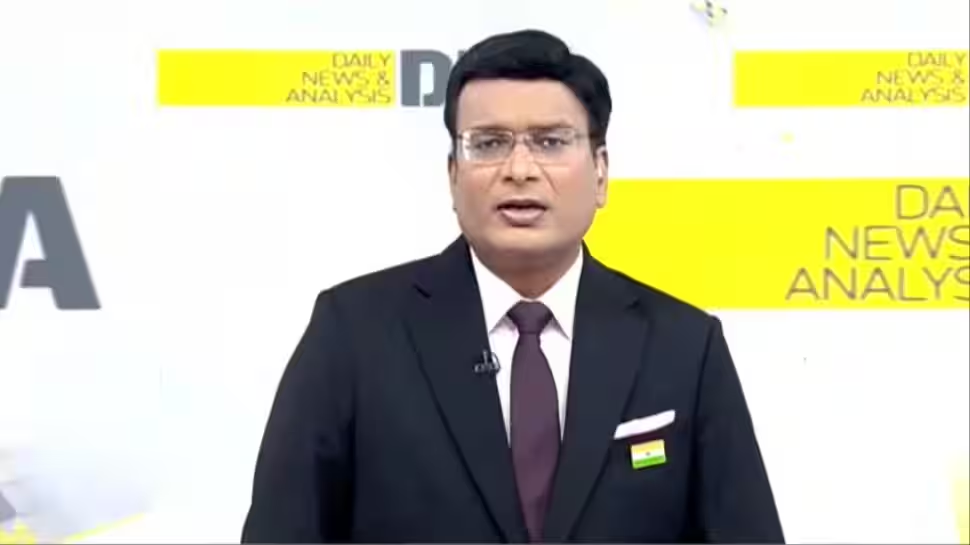
In today’s episode of DNA, Rahul Sinha, Managing Editor of Zee News, conducted a detailed analysis of the summit, contrasting India’s push to use Artificial Intelligence for public welfare with concerns over the alleged misuse of emerging technologies by extremist elements in the region. The program examined how AI is shaping national competitiveness, governance, security and economic growth.
#DNAFriends | #DNA #DNAWithRahulSinha #NewDelhi #AI #India @rahulsinhatv pic.twitter.com/i4UoAgHSuU— Zee News (@ZeeNews) February 16, 2026
Add Zee News as a Preferred Source
Prime Minister Narendra Modi inaugurated the expo and reviewed various technology showcases. The summit’s theme — “People, Planet and Progress” — marks a shift from earlier global AI meetings that largely focused on risks and regulation. Here, discussions are focused on applying AI to improve daily life, promote inclusive development under the “AI for All” vision, and frame future global norms for responsible deployment.
Union IT Minister Ashwini Vaishnaw addressed concerns around deepfakes, emphasizing the need for trusted and accountable technology systems. Several Union ministries have set up pavilions demonstrating AI-led governance reforms. The Panchayati Raj Ministry, for instance, showcased tools aimed at detecting irregularities and reducing corruption at village and block levels — areas that have previously ranked high in corruption perception surveys.
Healthcare innovations are a major attraction. Companies are presenting AI systems capable of detecting serious diseases such as cancer through early-stage analysis of X-rays and scans, potentially reducing treatment costs and expanding access to rural areas. AI-enabled telemedicine, rapid report analysis and drug discovery platforms are also on display.
In agriculture, AI-driven tools that assess soil health and weather data are being demonstrated to guide farmers on crop selection and irrigation timing, potentially boosting productivity and income. Traffic management systems, fraud detection platforms and digital governance solutions are also part of the exhibition, signaling a broader administrative transformation.
Global data underscores AI’s growing strategic importance. Private investment in AI rose by nearly 45 percent in 2024. The Oliver Wyman Forum estimates that AI could add $20 trillion to global GDP by 2030. The World Economic Forum’s Future of Jobs report projects that while AI may displace 83 million jobs, it could also create around 70 million new roles, reflecting a major workforce transition.
AI’s role in defense and security is also expanding. Reports indicate its use in military targeting systems in conflicts such as Gaza and the Russia-Ukraine war. India has also integrated AI capabilities into defense operations, with DRDO showcasing related technologies at the summit.
According to recent global assessments, the United States ranks first in overall AI leadership, followed by China, with India placed third. India’s AI market, valued at ₹11,773 crore in 2025, is projected to reach approximately ₹12 lakh crore by 2032 and potentially ₹153 lakh crore by 2035. Surveys indicate that 62 percent of Indian employees use AI regularly, while 83 percent use it on a weekly basis.
The summit has also drawn international political attention, with French President Emmanuel Macron expected to attend. As global economies race to integrate AI into core sectors, India’s strategy emphasizes accessibility, local-language innovation and affordable deployment.
The broader debate, as highlighted in the analysis, revolves around direction and intent — whether advanced technologies are harnessed for development and human welfare or diverted toward destabilizing activities. The Delhi AI Summit, organizers say, aims to establish India not only as a technological power but as a responsible stakeholder shaping the future of artificial intelligence.

Comments are closed.