
As US eyes Iran strike, ‘Islamic NATO’ buzz returns – Is a new military axis forming? | world news

Washington: As the United States increases its military presence ahead of a possible strike on Iran, discussion around forming an Arab-Islamic military alliance similar to NATO has returned to regional debate. The idea of a collective security bloc of Muslim nations first gained attention in September 2024, when Turkish President Recep Tayyip Erdoğan called for unity against what he described as expanding Israeli threats.
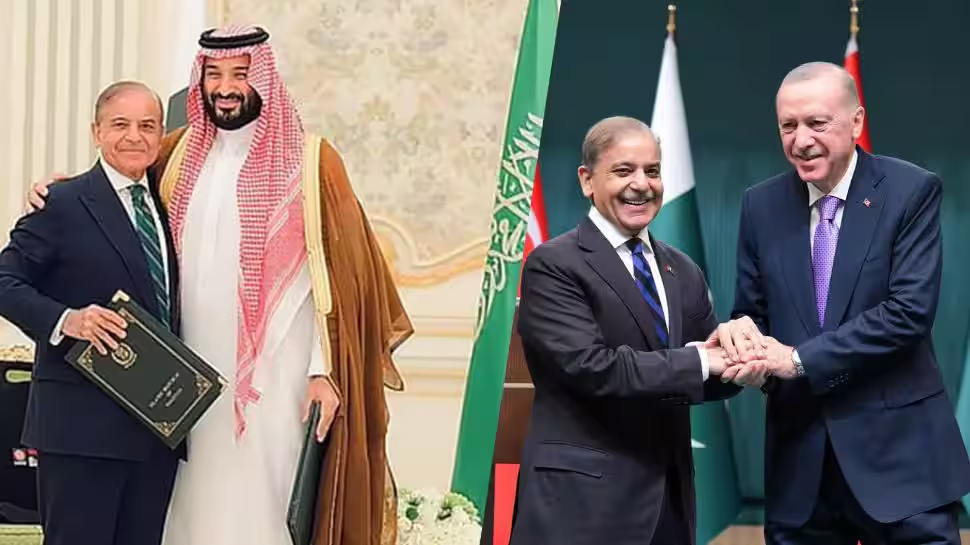
A year later, in September 2025, Pakistan’s defense minister publicly supported the creation of an “Islamic NATO”, adding political weight to the proposal. Momentum around the concept grew after Pakistan and Saudi Arabia signed a defense cooperation agreement on September 17 last year.
Erdoğan’s recent visits to Saudi Arabia and Egypt have further intensified speculation across Arab media about whether groundwork is being laid for such an alliance.
Add Zee News as a Preferred Source
While some analysts believe the diplomatic outreach indicates movement toward a structured coalition, others caution that Riyadh has shown no formal intent so far to build a military bloc with Turkey and Pakistan. The practicality of forming such an alliance is also under scrutiny.
Regional reporting suggests that any future grouping could include Turkey, Egypt, Saudi Arabia, Pakistan and Indonesia. London-based newspaper Rai al-Youm reported that Erdoğan’s visits to Riyadh and Cairo appeared to be aimed at exploring a political and military partnership centered on the three countries, with scope to widen participation later to Pakistan and Indonesia.
Turkish media outlets have also pointed to the rise of a regional agreement among Turkey, Egypt and Saudi Arabia, driven by closer political ties and converging policy views. Some observers interpret these developments as growing regional understanding rather than evidence of a finalized alliance.
Arab defense observers view the warming ties between Cairo, Riyadh and Ankara as marking a new phase of political cooperation built on shared interests and conflict management. Even so, they say that coordination has not so far evolved into a comprehensive strategic coalition. Security experts believe that closer Egypt-Turkey engagement could still serve as the base for a broader Arab-Islamic alignment capable of addressing regional instability.
The idea of a joint alliance has resurfaced repeatedly in recent months, especially after Israel’s military operations in Gaza and the brief but intense 12-day confrontation with Iran. Regional commentary has suggested that a coalition involving Saudi Arabia, Egypt, Pakistan, Turkey and Qatar could help restore strategic balance and reinforce collective security during periods of conflict.
Some experts describe the possibility as historically significant, arguing that such coordination could counter competing regional power projects. Turkish analysts stress that matching Israel’s military capabilities would demand long-term investment, integrated planning and deep operational cooperation.
Geopolitical anxieties also influence the conversation. Commentators point to American and Israeli contingency planning against Iran’s nuclear program and regional reach as a factor influencing Turkish security thinking. Israel’s trilateral partnership with Greece and Cyprus has increased Ankara’s strategic concerns. It has also strengthened calls within Turkish policy circles for closer regional coordination.
Turkey’s diplomatic messaging has increasingly focused on unity and cooperation rather than formal bloc politics. In the lead-up to Erdoğan’s recent visits, domestic media had heavily discussed the idea of a “Muslim NATO”. The emphasis has since moved toward building regional cohesion.
Turkey’s foreign ministry has advocated the creation of a forum designed to strengthen trust and stability among neighboring states, drawing comparisons to the gradual evolution of the European Union. Pro-government media portray the proposed alignment as a potential game-changer that could limit Israel’s regional ambitions.
Recent diplomatic messaging also shows growing policy alignment among Turkey, Saudi Arabia and Egypt on issues tied to Iran, Syria, Gaza and Palestine. Military cooperation has followed political engagement. Turkey has expanded defense ties with both Cairo and Riyadh. This includes military equipment exports worth $35 million to Egypt and plans to establish ammunition production lines there. Saudi Arabia has also shown interest in Turkey’s fighter jet program as an investor and potential buyer.
Despite rising engagement, there are major obstacles. Efforts to form joint Arab or Islamic defense structures have historically struggled to move beyond declarations. Many past agreements were never fully implemented and were largely symbolic. In several instances, signatory states later found themselves in direct or proxy conflicts with one another.
Analysts say trilateral coordination among Turkey, Egypt and Saudi Arabia has improved but still falls short of a binding strategic alliance. Differences persist on political transitions, regional governance models and conflict approaches.
Former Egyptian diplomats believe resistance from the United States and Israel could complicate any attempt to formalize the bloc. Turkish analysts also warn that lobbying networks in Washington may already be working to slow or block such a formation.
Researchers tracking Arab-Eurasian security trends assess that the most realistic outcome may be a flexible coordination mechanism rather than a rigid institutional alliance. A loose security understanding, built on shared interests and situational cooperation, appears more achievable in the near term than a fully structured military organization modeled on NATO.

Comments are closed.