
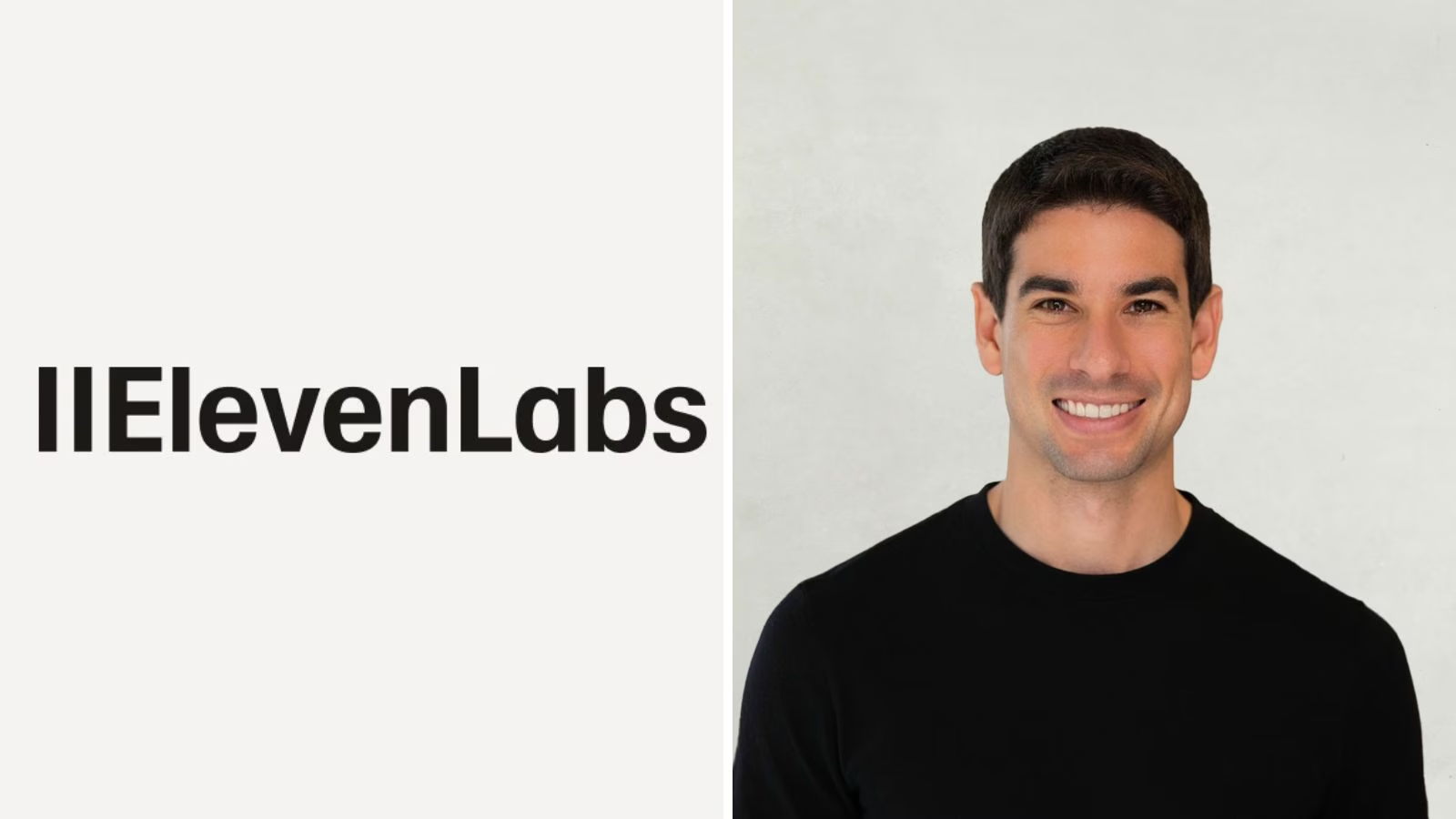
India will shape global AI governance, says ElevenLabs’ head of global affairs Alex Haskell

India has emerged as more than just a growth market for ElevenLabs; it has become a testing ground for voice AI technology that influences its global strategy. On the sidelines of the AI Impact Summit 2026, Alex Haskell, general counsel and head of global affairs at ElevenLabs, sat with indianexpress.com to explain how the world’s fourth largest economy is helping shape the future of generative voice AI.
For ElevenLabs, India was never an afterthought. “We grew up as a global company from day one,” Haskell explained. “Given that the company was founded on the belief that all information and all content should be accessible to everybody, India was such a natural place that our co-founders, Mati Staniszewski (CEO) and Piotr Dąbkowski (CTO), felt the technology could make an impact.”
Haskell shared that the founders’ own experience growing up in Poland without access to information in their native tongue shaped their vision. “They don’t want that to be the case anymore. For that reason, India is just such a natural place for us to focus and expand since the early days.”
The scale of ElevenLabs’ Indian operations is massive. According to Haskell, Indian e-commerce giant Meesho alone processes 60,000 calls daily using the company’s voice AI technology. This volume has pushed ElevenLabs to develop infrastructure that benefits customers worldwide. “Whenever we as a company need to serve that sort of volume and ensure we have safe, secure, trustworthy, always-reliable infrastructure in place, we grow our muscles in ways that help us serve other customers all around the world,” Haskell said. “There’s no doubt that the work we do with Meesho is making us better elsewhere.”
It seems India’s linguistic diversity has also driven product innovation. The ElevenLabs team highlighted how code-switching between English and Hindi among tier-two and tier-three city customers has led to the development of customised solutions. “That’s actually a use case that was developed in India,” they noted, stressing how local challenges drive global product improvements.
Balancing innovation with safety
At a time when generative AI tools are facing increasing scrutiny over potential misuse, ElevenLabs takes an uncompromising stance on safety. “We do not view safeguards, guardrails, and the safety measures that we need to have in place to serve our customers as in conflict with innovation or company growth,” Haskell emphasised. “Trust, safety, and security are foundational for us, and they always have been.”
The company employs a multi-layered approach to prevent misuse, including its No-Go Voices feature that prevents the cloning of celebrities, politicians, and other high-profile individuals. “There are many platforms out there that offer voice cloning where you could clone PM Modi’s voice, but not on ElevenLabs. Not possible. It could never happen at all,” Haskell asserted, adding that the list is updated almost daily as new individuals become potential deepfake targets.
This vigilance seems to stem from the company’s philosophy on self-regulation. “You just cannot wait for a country to tell you to do X and be safe, or do Y and not be safe,” Haskell argued. “We’re operating on the forefront of AI, the forefront of audio AI. We are extremely well-positioned to know how our tools can be misused and to develop the technologies internally to prevent misuse. We’re better positioned than governments in that respect.”
At the same time, navigating the global regulatory landscape presents significant challenges for companies. While acknowledging this, Haskell said, “the constantly evolving landscape of new regulations within states, within countries, and between countries, and keeping up with all that while ensuring that we are always staying 100 per cent compliant is arguably my biggest day-to-day focus”. The solution? “The more uniformity we have across regulation, the lower that challenge will be.”
When asked about his advice for Indian policymakers, Haskell offered his cogent advice. “Uniformity and stability in regulation. We’re not the kind of company that asks not to be regulated. We just want uniformity and stability so that as we grow here, we’re able to comply with the governance regime in a way that doesn’t inhibit our ability to grow.”
India and global AI governance
Looking ahead, Haskell believes India can lead in establishing AI governance norms. “India is such an important and powerful market that if you’re a company like us, you want to be in India,” he said. “Given how big India is, if we’re building technology to comply with Indian governance, that’s going to influence the technology that we’re providing in other places. India can be a real leader in governance that doesn’t just impact how companies like us operate here but impacts how companies like us operate everywhere.”
Beyond commercial applications, the excutive also spoke about ElevenLabs’ Impact Program that offers free voice restoration technology to individuals who have lost their voice due to accident or illness. “It’s remarkable the degree to which that restores dignity and restores a sense of self in people who have unfortunately lost their voice,” Haskell reflected.
As voice AI technology continues on its rapid ascent with releases such as the V3 Expressive Mode model, ElevenLabs remains focused on perfecting the final details. “The incremental research breakthroughs that continue to happen within this company on a weekly, on a monthly basis are incredible and will make our voice products more valuable to people in India and elsewhere for a long time.

Comments are closed.