
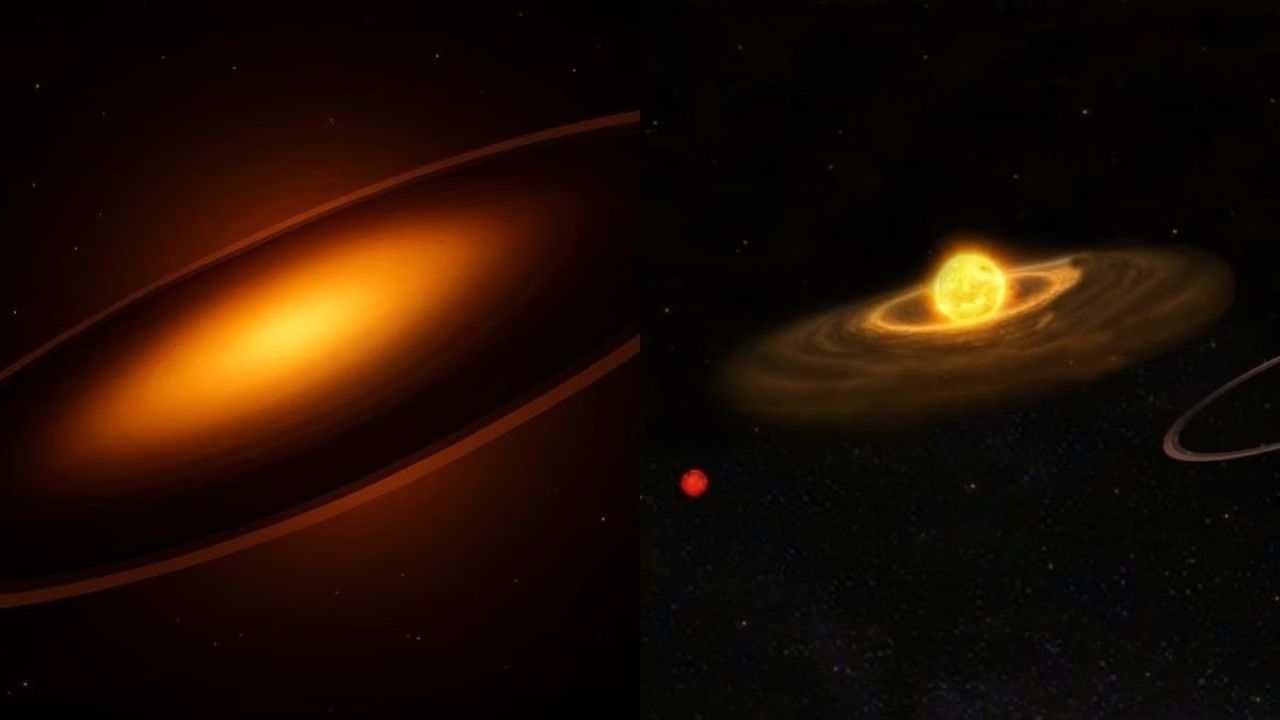
After the sun, the moon, now even the stars are eclipsed; Scientists experienced a wonderful astronomical sight

- After sun, moon, now also star eclipse
- An extremely rare event recorded by astronomers
- What exactly did you see?
Astronomers have reported a very rare phenomenon about the star ‘ASSASSN-24FW’, which is about 3,000 light years away. Over a period of about nine months, the star gradually dimmed and then returned to its original brightness. Scientists from the Inter-University Center for Astronomy and Astrophysics (IUCA) in Pune have participated in this important research and this study has been published in the scientific journal Monthly Notices of the Royal Astronomical Society.
Astronomy Discovery: The strange secret of the universe! Inverted solar system discovered in space; Even scientists are surprised
In this research Dr. Sarang Shah, Jonathan Marshall (affiliated with Academia Sinica) and Ashish Mahabal (California Institute of Technology) participated. According to scientists, this star is slightly heavier than the Sun and almost twice the size. The star continued to decelerate for about 200 days from late 2024 to mid-2025. Its brightness had dropped to about 97 percent. At first it was speculated that there might have been some change in the star; But the study revealed that the star is stable. So it turned out that the event was not caused by the star, but by a large sub-stellar object that passed in front of it.
According to the researchers, this object is probably of the ‘brown dwarf’ type and has a massive and dense ring system around it. As the outer part of these rings is thin, no loss of light is felt at first; But the star’s brightness decreased markedly as the solid came into contact. Such eclipses require a perfectly straight line between the star, its companion, and Earth, so such events are extremely rare.
A check of historical records shows that the star also dimmed in 1937 and 1981. This information comes from the ‘Digital Access to a Sky Century’ project, which digitizes old photographic plates at the Harvard College Observatory. This indicates that such an event occurs approximately every 43 years and also highlights the importance of preserving old scientific records.
The change in this star was first detected by the All-Sky Automated Survey for Supernovae. This initiative is run by The Ohio State University. Also, the system ‘Asteroid Terrestrial-Impact Last Alert System’ also helped in monitoring. According to the scientists, this discovery can provide more information about sub-stellar objects, the rings that form around them and how such systems are formed. In the future, this star will be studied more deeply with the help of large telescopes and many mysterious questions in astronomy are being revealed.
Cosmic Wonder: Such a sight will never be seen again! ‘These’ rare events in February will be a treat for astro-enthusiasts; See if it will be seen from India?

Comments are closed.