
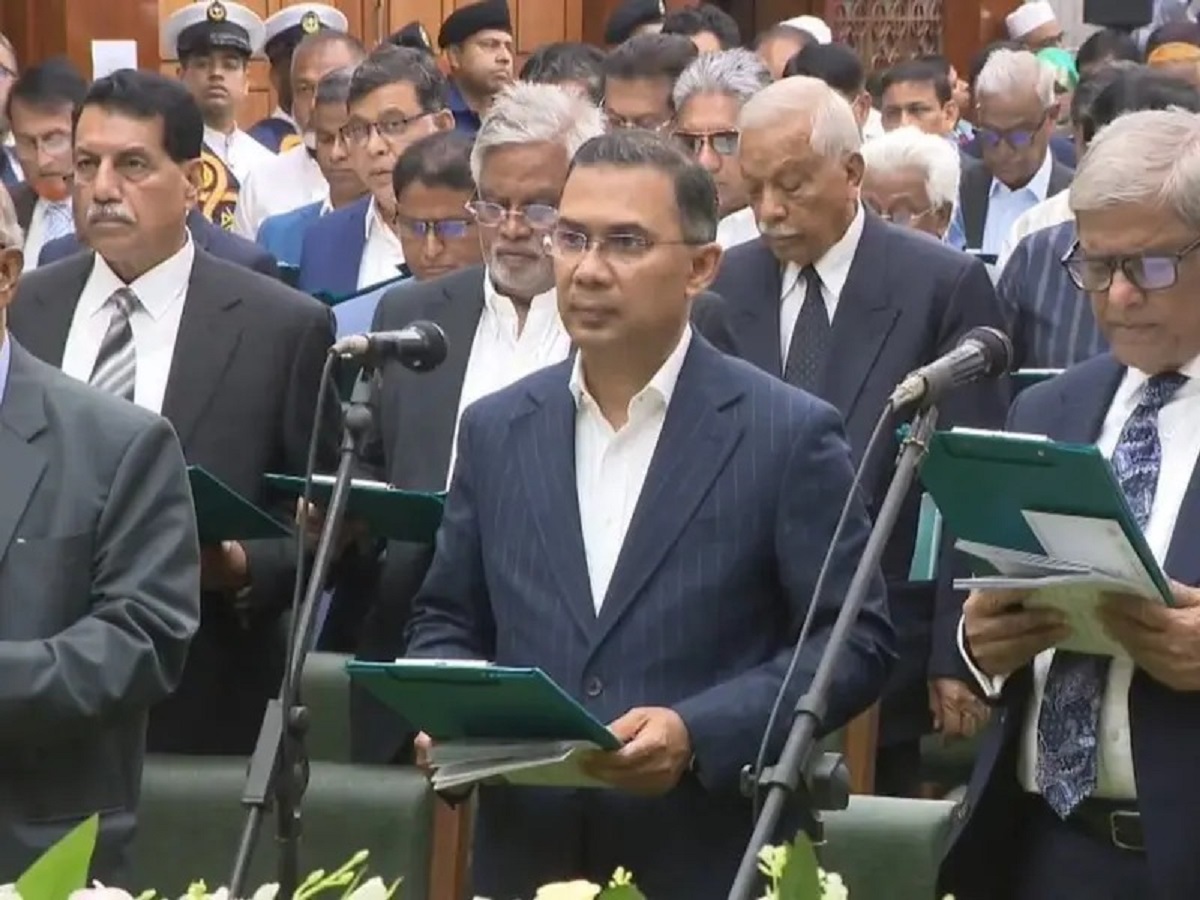

Bangladesh Nationalist Party (BNP) chief Tariq Rahman took oath as Prime Minister on Tuesday (February 17) after two years of political uncertainty in Bangladesh. Tariq Desh, who returned from 17 years of exile and led his party to a landslide victory in the general elections held on February 12, is about to take power amid grappling economic and political challenges. Meanwhile, Jamaat-e-Islami has boycotted the swearing-in ceremony of Tariq Rehman.
In the elections held on 299 seats, Tariq Rehman led BNP won a clear majority by winning 212 seats. The turmoil following the overthrow of former Prime Minister Sheikh Hasina helped the BNP achieve this lead. With the swearing in of Tariq Rahman, Bangladesh has got a male Prime Minister after 37 years.
However, on the day of the swearing-in ceremony, the Jamaat-e-Islami-led opposition boycotted the ceremony. The controversy was over the fact that BNP MPs did not take oath as members of the Constitutional Reform Council. The Jamaat and the NCP have warned that if reforms are not implemented they will take to the streets and hold demonstrations similar to those held during Sheikh Hasina’s tenure to oust her from power.
The biggest challenge before Tariq Rehman is to restore stability in the country and carry forward the reconstruction process after violent Islamist protests. Along with bringing the economy back on track, they will also have to take decisive steps on political reforms. The mandate for change in constitutional and democratic institutions comes under the July Charter drawn up by Muhammad Yunus, head of the interim administration. This charter was approved in a referendum coinciding with the national elections.
Political instability has also affected the economy of Bangladesh. The economy, which witnessed rapid growth during the Awami League rule, has been hit by recent uncertainties. In such a situation, economic revival will be a priority for the new government.
On the foreign policy front, improving Dhaka-New Delhi relations is also on the important agenda. There was tension in bilateral relations during the interim rule. The presence of Lok Sabha Speaker Om Birla at the oath ceremony and Prime Minister Narendra Modi congratulating Tariq Rehman on his victory is being seen as a sign of possible softening of relations between the two countries.
Along with Tariq Rehman, his council of ministers also took oath. The cabinet includes 25 ministers and 24 ministers of state, including two technocrats. One Hindu and one Buddhist MP have also been given a place in the cabinet. Analysts believe that under the leadership of Tariq Rahman, Bangladesh stands at a turning point, where political reforms, economic stability and regional balance will be tested simultaneously.
Also read:
Foreign exchange reserves decreased, fall in gold prices also had an impact
India AI Impact Expo a powerful confluence of imagination and innovation
Sunil Gavaskar and Kapil Dev’s appeal on Imran Khan’s health

Comments are closed.