
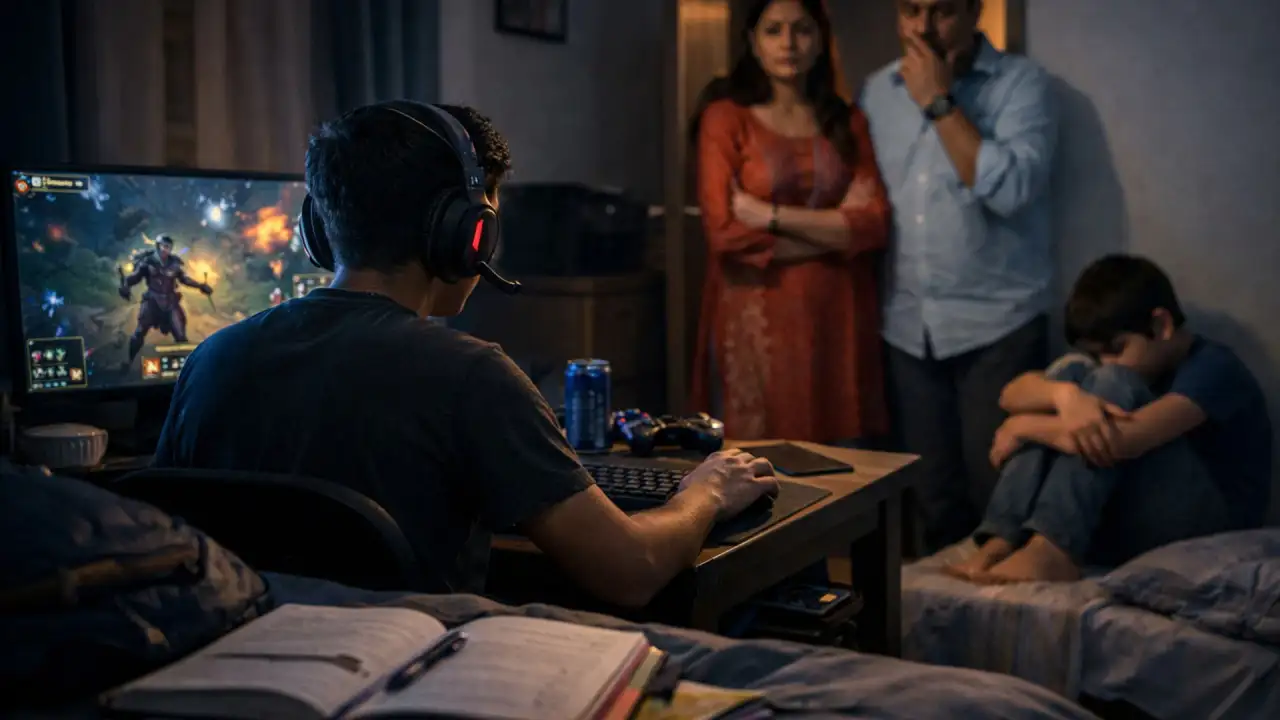

Concern over children’s mental health
New Delhi: In recent times, concerns have increased across the country regarding online gaming and the mental health of children. A senior expert at the National Institute of Mental Health and Neurosciences (NIMHANS) has warned that excessive gaming can often be a sign of deep psychological sensitivity.
In the last 15 days, several such cases have been reported from different states in which children have been seen facing problems like being left alone for long periods of time, absenteeism from school, disrupted sleep and emotional distancing due to excessive gaming.
advice for parents
Some schools in Delhi-NCR and South India have issued advisories for parents. Child welfare counselors have handled cases where minor children have become deeply entangled in task-based and reward-based online games.
Attention to psychological risks
The tragic death of three minor sisters in Ghaziabad has further intensified this debate. The administration is investigating all aspects, but reports of deep involvement in an online task-based game have focused attention on the psychological risks of digital mediums.
Professor at NIMHANS and doctor in-charge of India’s first tech-de-addiction center ‘SHUT Clinic’, Prof. Manoj Kumar Sharma said that such cases are not just a result of excessive screen time.
development of digital identity
“Children can develop a very strong digital identity, which sometimes supersedes their real (offline) identity. Prolonged isolation and distance from school increases their vulnerability,” he said.
Research and Academic Training
Pro. According to Sharma, gaming sometimes becomes a ‘coping mechanism’ for children. “Real-world interactions are replaced by digital environments,” he said. NIMHANS, an ‘Institute of National Importance’ under the Ministry of Health and Family Welfare, Government of India, is a leading center in the field of mental health and neurosciences.
The institute provides treatment, research and academic training in psychiatry, neurology, neurosurgery, psychology and related brain sciences.
The need for balanced digital habits
Pro. Sharma explained that many online games use psychological triggers, such as rewards for completing tasks and a series of consecutive achievements. “What initially appears to be mere entertainment can gradually develop into an intense and addictive pattern,” he said.
They warned that problematic gaming could also be linked to depression, anxiety and suicidal thoughts. Along with this, problems like lack of sleep and mood fluctuations are also associated. Experts believe that recent incidents indicate that the problem is not limited to screen time alone, but is linked to the psychological immersion that digital platforms create.
NIMHANS has consistently emphasized on early identification, active involvement of parents and balanced digital habits.
Amidst the increasing discussion on digital regulation and awareness, Prof. Sharma’s warning is a reminder that when digital identities start taking over real-life relationships, it becomes vital to intervene early.

Comments are closed.