


After finishing her work at a factory in the Tan Dinh Industrial Park in Bac Ninh at 5:15 p.m., while colleagues head home for dinner or stay late to work overtime, accountant Phuong Thi Tuyet, 34, rushes to her Chinese class.
She has to travel more than five kilometers to a Chinese language center, where the class is from 5:45 p.m. to 7:45 p.m., and she grabs a quick pastry to reach there in time.
The classroom is always full, mostly with people already working at Chinese-owned companies.
Workers attend a Chinese class after work in northern Vietnam. Photo by Huong Huong |
Tuyet, who works for a bathroom equipment manufacturer, has been studying basic Chinese since September 2025, attending three evening classes a week with the goal of obtaining HSK 4 certification, equivalent to an intermediate level.
“I want to be able to speak directly with my boss and colleagues in Chinese without having to rely on an interpreter,” the mother of two says to explain her motivation.
In two years as a general accountant she has mainly been communicating with her Chinese managers in basic English. When she needs to explain professional matters or documents to them, she does so through an interpreter.
Though she has never made a mistake or misunderstood instructions because of this, she often feels insecure and unable to express her ideas due to the language barrier.
At times, when managers or technical staff from China want to discuss work, she relies on Google Translate or ChatGPT. Sometimes, not fully understanding what they mean, she has no choice but to stay silent.
She initially tried to teach herself online in the evenings, but with limited success.
In September 2025 she decided to pay nearly VND10 million (US$385) to the language center to have structured guidance, learn vocabulary and practice listening and speaking with teachers.
Many of her classmates are team leaders, line supervisors or office staff from nearby industrial parks, all with similar goals as her.
The mushrooming of Chinese factories in northern Vietnam is causing huge demand for workers proficient in Chinese. Last year the number of jobs requiring candidates to know Chinese surged by 1.5 times from 2024 and double the 2023 number to nearly 13,000, according to the 2025 Salary Report by recruitment platform Joboko.
In comparison, demand for Korean- and Japanese-speaking workers grew by only around 20%.
These roles typically involve operational responsibilities and direct interaction with Chinese executives.
The salaries for employees proficient in Chinese are 10-40% higher than for those in the same jobs but without foreign-language requirements.
Chinese companies are willing to pay more to address communication and operational challenges as they expand production in Vietnam.
Joboko forecasts this trend will continue for at least three more years, prompting many workers to seek to improve job prospects and incomes.
In the early days Tuyet often felt exhausted, having spent eight hours at work before attending evening classes and returning home to care for her children.
Besides, the logographic Chinese script was difficult to memorize and write.
But she did not give up and decided to make time to study on her own twice a day before going to bed and after waking up early in the morning.
At work, she practices whenever possible through conversations with Chinese colleagues, reading documents and participating in work chats.
At first her sentences were hesitant, but gradually became more natural. After nearly five months of learning and reaching around HSK 3 (elementary level), she no longer hesitates to speak directly with managers without waiting for an interpreter.
Her work has also become smoother as she can increasingly understand and communicate in Chinese.
Late last year Tuyet received a pay rise. While she refuses to disclose details, she says it exceeded anything she had imagined.
“The money, time and effort were not wasted. If I had known earlier, I would have started studying sooner.”
She adds that she plans to introduce Chinese to her fifth-grade daughter alongside English.
Many younger workers are on board.
Tran Thi Thuy Duong, 26, of Hanoi has learned English, Korean and Japanese, and began teaching herself Chinese in mid-2025.
She recognized its job potential after interpreting at a conference on northern foreign-invested enterprises. With Chinese companies pouring investment into Thai Nguyen, Bac Ninh and surrounding areas, she believes “job opportunities requiring Chinese will soon surpass Korean ones.”
She notes that learning a language is often related to increasing investments from the countries of their origin. Thus, Japanese and Korean were once dominant, but Chinese is now clearly on the rise.
Some of her friends, after years of working with Koreans, have added Chinese to their skills and moved to Chinese-owned companies.
 |
Tran Thi Thuy Duong interprets at a workshop of an FDI company in northern Vietnam. Photo by Nguyen Hai |
While teaching Korean, Duong is studying Chinese on her own through online textbooks. In less than six months she has reached HSK 2, can handle basic communication and is now working toward HSK 4 or 5.
Her main income still comes from Korean-related work, but she has begun working as a tour guide and salesperson for Chinese.
She aims to move further up the ladder, interpreting for enterprises, working in office administration and selling cosmetics, fields she says are flexible and offer multiple income sources at a time.
Interpreters’ salaries are currently VND20-30 million a month, and she says workers who master a foreign language alongside a specialized skill can earn up to 1.5 times more.
“No matter how the job market changes, having another language is never unnecessary.”
Nguyen Thi Chung, head of training at Huong Huong Foreign Language Center in Bac Ninh, an area surrounded by electronics factories largely funded by Chinese FDI, says enrollment in Chinese classes has steadily increased by some 30% year on year on average in recent years.
Most students are recent or soon-to-be university and college graduates, administrative, office and accounting staff, or team leaders and production-line supervisors seeking pay raises and promotions, she says.
After four years working as a Chinese-language interpreter in the corporate sector, the 32-year-old teacher said the growing shortage of Chinese-speaking talent has forced companies to change their recruitment strategies.
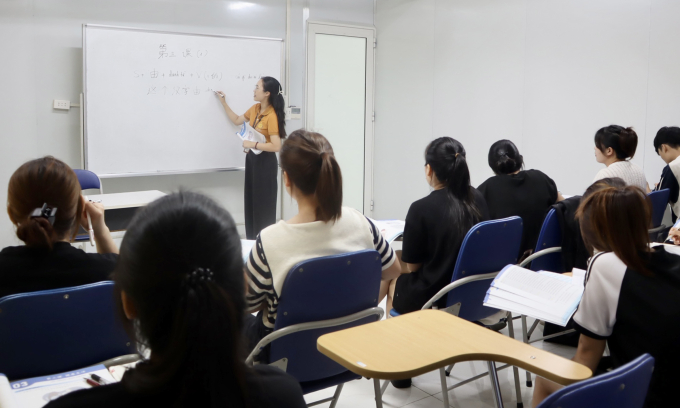 |
Nguyen Thi Chung teaches a Chinese class for adults at Huong Huong Foreign Language Center in Bac Ninh Province, northern Vietnam. Photo by Huong Huong |
Previously, production management positions were often held by Chinese nationals, and employers mainly recruited Vietnamese candidates who had graduated with degrees in Chinese.
However, as production expands, more roles are now being opened to Vietnamese workers, particularly positions that require direct communication with company owners or involvement in production operations. As a result, candidates with both professional expertise and language skills are increasingly prioritized during interviews.
This labor shortage has also reshaped job-seeking behavior.
Many recent graduates delay entering the workforce to study languages, strengthening their CVs and chances of higher salaries.
Even without experience, graduates with Chinese skills can earn VND12-18 million a month even without working overtime.
Workers with experience, those already employed at Chinese-owned companies, account for more than 50% of total enrollment, Chung says.
They typically have basic English skills and enroll directly in HSK 4 exit-level courses to work directly with senior Chinese managers, and most opt for evening classes which they can attend after work, she says.
“This group is often the main target of corporate recruiters.”
While many want fast-track training, mastering any language requires a solid foundation, from pronunciation and basic grammar to specialized vocabulary, she says.
Besides, the workplace itself is the best environment for practicing speaking a foreign language, she adds.

Comments are closed.