
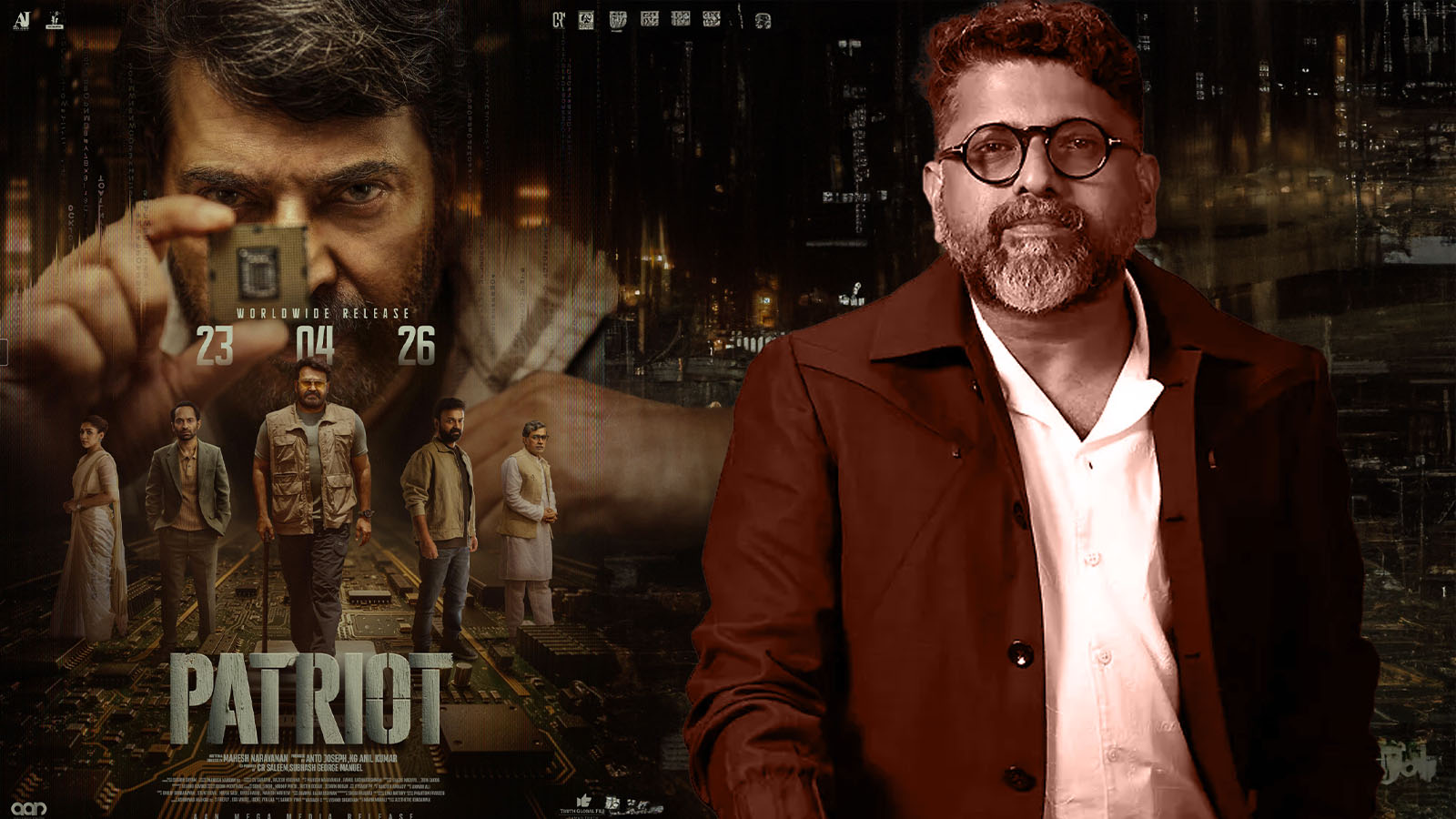
Mahesh Narayanan on Patriot and how a filmmaker understands politics as human struggle

Malayalam filmmaker Mahesh Narayanan is ready with his next film Patriot, a political thriller written and directed by him, which releases in theatres on April 23. The film brings together Malayalam cinema’s legendary duo, Mammootty and Mohanlal, in lead roles — a collaboration that has already generated significant anticipation. Produced by Anto Joseph and K.G. Anil Kumar, the film features a strong ensemble cast, including Fahadh Faasil, Kunchacko Boban, Nayanthara, Darshana Rajendran, and Revathi.
“Set against the charged atmosphere of political conspiracies, hidden agendas, and shifting power dynamics, Patriot explores themes of ambition, loyalty, betrayal, and sacrifice. For me, the narrative aims to function both as social commentary and as an engaging cinematic experience,” says Narayanan, in a conversation with The Federal at the recently concluded 17th edition of the Bengaluru International Film Festival (BIFFes). Speaking about his writing process, Narayanan says, “I first imagine the final image of the film and only then do I begin writing. Otherwise, I cannot move forward. That image may evolve later, but it has to exist in my mind. I also write with the audience in mind. My aim is to keep them engaged so that they never feel disconnected.”
Describing Patriot as a commercial film, Narayanan says, “While writing the script, I felt a special personal connection to the story. It began to feel like my own, and it gradually took on different shapes. When I shared the idea with Mammootty, the project evolved further. Once he came on board, Fahadh, Kunchacko, and Lal Sir joined as well.” He adds that the film reflects a conscious move away from star-driven filmmaking towards prioritising the story. “I felt I was attempting something different, something shaped by a new cinematic language emerging within me.”
‘Cinema is a director’s medium’
On casting Mammootty and Mohanlal together, he adds, “I did not cast them simply because they are stars. I approached them because they were right for the story I wanted to tell. They come to the set as dedicated artists. It is a coincidence that these stalwarts are coming together after 19 years.” The last full-length feature in which the two actors appeared together was the 2008 ensemble blockbuster Twenty: 20. Although Mohanlal made a cameo appearance in Kadal Kadannu Oru Maathukutty (2013), they have not shared screen space in any major film since 2008.
Narayanan made his debut in the Malayalam film industry with Take Off, a critically acclaimed and compelling film based on the rescue of Indian nurses trapped in Tikrit, Iraq, in 2014. It garnered multiple accolades, including the Special Jury Award at the 48th International Film Festival of India (IFFI) and Kerala State Film Award: Narayanan won the award for Best Debut Director. His technique of storytelling shaped the Malayalam cinema, and Narayanan asserts that “cinema is a director’s medium”. However, he also argues that actors, especially star actors, pick up different kinds of filmmakers. They want their films in the pattern of these new directors. For example, Rajinikanth wants his story to be made in Pa. Ranjith style and accepts whatever his ideas are.
Also read: The Federal Exclusive: ‘C U Soon’ a big hit; Mahesh Narayanan ecstatic
Before becoming a director, Narayanan had been a well-established film editor in Malayalam cinema since 2006. He is known for editing films such as Traffic (2011), Beautiful (2011) and Vishwaroopam (2013). He made his writing debut with Mili (2015). During the COVID-19 lockdown, while the world was grappling with the pandemic, he directed C U Soon, adhering strictly to social distancing norms. Released on Amazon Prime, the film captured the imagination of cinephiles. Shot in just 22 days, without songs or conventional commercial elements, and filmed entirely on an iPhone, the 90-minute feature was not merely an experiment but an immersive and radical cinematic experience. It was widely appreciated for its dynamic visual language.
Malayalam cinema and the OTT surge
“It was a time when theatres were shut, and more than 50 films in Kerala were lying unreleased. The Malayalam industry did not have enormous financial reserves. That was when I gathered the courage to write a script, roped in a popular actor who backed the project as a producer, and assembled a small cast and crew of around 50 people,” he says. “C U Soon was shot in a residential building in Kochi. Apartments doubled up as film sets, offices, production hubs, and living spaces for the cast and crew. “The film helped provide wages for many workers whose only source of income was cinema,” he adds.
Mahesh Narayanan with producer Kunchacko Boban, Mammootty and Mohanlal. Photo: IMDB
The pandemic, paradoxically, marked a resurgence for Malayalam cinema. With theatres closed for months, the industry took to OTT platforms, which led to increased revenues, wider international reach, and critical acclaim for its consistently high-quality content. “When I made C U Soon, it was a completely different situation. My geography is completely computer screen and writing the story itself was a difficult process,” he adds.
Talking about the evolution of Malayalam cinema after the pandemic, the filmmaker observes, “Minimalistic narration really counts, and that has always been the strength of the Malayalam film industry. I mostly rely on that. During the COVID-19 period, I felt films in the style of Hrishikesh Mukherjee would work. But I later realised that those films are better suited to OTT platforms. It is not just about the story you tell; it is about how you narrate and craft it. In Malayalam cinema today, anything conventional is not working. The audience evaluates the strength of the content and wants to know what is new in it. As filmmakers, we must be able to offer that.”
Has Malayalam cinema changed in the post-pandemic era? “Yes,” he says. “After the pandemic, audiences want something with a clear unique selling point. I believe strongly in identifying and communicating that point, especially since there are too many releases every week now. According to a study, even a cinephile can watch only about 20 films of their choice in a year, while the Malayalam industry produces over 200 films annually. After the pandemic, audiences are also gravitating towards genre films.”
On making political films
Most of his characters are morally complex. Is that intentional? Narayanan, who cites Vittorio De Sica — a key figure of post-war Italian Neorealism known for Bicycle Thieves (1948) — as a major influence, “I am drawn to grey areas because people themselves are rarely absolute. All of us carry shades within us; no one is purely good or entirely bad. Circumstances shape behaviour. That is why the characters in my films — whether protagonists or antagonists — exist in those in-between spaces. They are neither fully black nor white. Sometimes I explain why a character acts in a certain way, but there does not always have to be a clear justification. No one is born evil. As an editor, I tend to compress multiple thoughts into a single moment, and in that process, I travel closely with my characters.”
Also read: Kalamkaval review: Mammootty’s Cyanide Mohan turn powers a tight serial-killer thriller
Narayanan has directed several acclaimed films, including C U Soon, Take Off, Malik, and Ariyippu. He also handled cinematography for “Sherlock,” an adaptation of a short story by M.T. Vasudevan Nair in an anthology streaming series. Ariyippu, which he wrote, directed, and edited, received critical acclaim for its stark and realistic portrayal of migrant labourers and was screened at the Locarno Film Festival. He also produced Thalavara (2025), with his friend Akhil Anilkumar directing the project. The film follows a young man’s journey towards self-acceptance as he navigates life with vitiligo, a chronic autoimmune skin condition.
On making political films, Narayanan asserts, “Every idea has an expiry date. Whatever is personal is also political. That is why I revisit my screenplay every six months. Stories must evolve with time.” He sees cinema as a form of resistance. Yet he acknowledges that every viewer interprets narratives differently. “Most of my films have faced censorship issues, even abroad. I strongly believe every filmmaker should have the freedom to tell the story they want.”
Recalling a visit to Iran for a film festival, he remembers raising concerns regarding filmmaker Jafar Panahi. Local filmmakers, however, urged him to understand the geopolitical situation beyond a Western prism. “That made me realise that everyone sees situations through their own lens. We must try to look through multiple prisms to understand a problem,” he says.
“A filmmaker understands politics as human struggle. I believe anything personal eventually becomes political. There must be freedom for filmmakers to make films without fear, just as novelists, poets, critics, and playwrights do. Ultimately, we are not making documentaries; we are making feature films about human struggle within changing socio-political and economic contexts. It is a fictional interpretation. People should accept it as a feature film, as stated in the disclaimer. Audiences need to evolve to a point where they can think about a film beyond politically driven reactions and counter-statements,” he argues.
On drawing from reality
On bringing reality into cinema, he says: “I want to be loyal to the source, to reality, and to the characters. But cinema is not the truth. It is fiction, a constructed lie. I must be aware that I am telling a lie, but it should be a lie that remains close to reality. I try to convey what moves me most intensely in a particular incident.”
Mammootty and Mohanlal in a still from Patriot
“As filmmakers, we draw characters from reality. If something happens to a person, there is always a reason. Sometimes that reason may be just one line or a single situation, but it cannot be ignored because it deeply defines the character. When handling multiple characters, filmmakers often abandon some midway. That is a common mistake. I wanted a culmination for all the characters — a philosophical, rational culmination. I wanted the circle to close, to feel complete,” he adds.
Recalling an anecdote from Tamil Nadu politics, Narayanan cites an incident during an election period when a film starring M.G. Ramachandran faced political opposition. M. Karunanidhi reportedly responded by saying he did not believe party workers would turn “turncoats” because of a film. “If that were the case, we might as well disband the party,” he is said to have remarked, suggesting that cinema and politics function in different spheres.
Also read: How honouring Mohanlal, Shah Rukh Khan seeks to restore faith in the National Awards
For Narayanan, however, cinema must constantly reinvent itself or risk losing relevance. Creative freedom, he insists, is essential for authentic storytelling. Fifteen years after his debut as an editor, he remains cautious about taking on too many roles at once. His editing style mirrors his writing: crisp, precise, and disciplined. On entrusting direction to another filmmaker, he says it does not trouble him. “The director I choose will be part of my team. Our sensibilities are aligned. For all of us, it becomes a learning experience.”
Asked whether he still enjoys cinematography, he smiles. “I am still learning cinematography from my colleagues. Cinema is one field where you can earn while you learn.” He adds that if he writes a script and hands it over to another director, he does not feel the need to be present on set. “Once, a cinematographer friend told me it was a good time for me to learn cinematography. It became an opportunity to work with friends and learn at the same time.”
What advice does he have for young independent filmmakers drawn to minimalism? “Start by writing an idea you are passionate about communicating to the audience. Tell the complete story through visuals, not through theory. A lack of visual clarity can weaken the filmmaking process and ultimately result in an essay rather than a cinematic narrative,” says the filmmkaer.
As a prominent voice in the Malayalam industry, Narayanan also responds to the Hema Committee Report, the landmark 2024 document that exposed widespread sexual harassment, gender discrimination, and exploitation in the Malayalam film industry. The Hema Committee was constituted by the Kerala government in 2017 following a high-profile assault case. The three-member panel, led by Justice Hema, submitted its findings in 2019, detailing a toxic work environment and the prevalence of a “casting couch” culture, which led to renewed calls for legal reform.
“I blame the Kerala government for not disclosing the contents of the report immediately after its submission. I deeply appreciate some of my female colleagues who showed immense courage. Even with anonymity assured to protect them, they fearlessly spoke about the heinous treatment they endured in the industry over the years. This is not a problem limited to Malayalam cinema; it is a pervasive reality across Indian cinema. That is why the findings of the report are significant for the current film ecosystem in the country,” he says.
“Unfortunately, the government sat on the report for five years without taking action. Even now, it is not too late. It is time for stakeholders in the Malayalam film industry to stand in solidarity with their female counterparts. They must stop the blame game and the passing of responsibility. A firm and stringent resolution is necessary to address the issue. It must reach a healthy culmination, like the climax of a film,” Narayanan concludes.

Comments are closed.