
Could US and Israel launch a weeks-long war on Iran? Here’s what latest reports say | world news

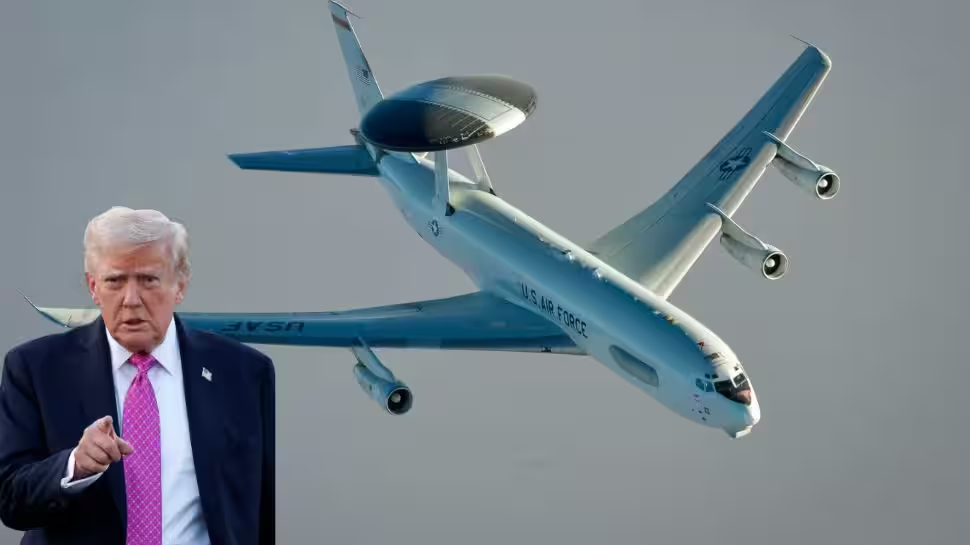
Tensions in the Middle East appear to be escalating again, as the United States has deployed a large portion of its airborne early-warning fleet to Europe and the region around Iran. Reports indicate that Washington has deployed approximately 40% of its E-3 Sentry AWACS fleet, the Air Force’s flying radar and battle-management aircraft, which analysts view as significant evidence of increased readiness. The Air Force’s flying radar and battle-management aircraft provide 360° surveillance up to 250 miles, directing fighters, tankers, and interceptors in jammed environments.
Also, open-source defense reporting shows that a US Air Force KC-46A “Pegasus,” a modern aerial refueling tanker that serves as a flying fuel station, is crossing the Atlantic with six F-22 Raptors from the 1st Fighter Wing at Langley Air Force Base, Virginia, further illustrating the scale of US air movements.
The developments come as Axios reported that the United States may be preparing for a major clash with Iran, potentially with Israel’s support. According to the report, Washington is considering a campaign that could last weeks, rather than a quick, limited operation like the one previously conducted to capture Maduro.
Add Zee News as a Preferred Source
US military build-up in the region
Washington has increased pressure on Tehran while steadily expanding its military footprint in the region. The buildup reportedly includes the deployment of two carrier strike groups to the Middle East, with the USS Abraham Lincoln already on station and the USS Gerald R. Ford en route. They are supported by more than a dozen warships operating in the Persian Gulf and Arabian Sea.
In addition, more than 50 fighter jets, including F-22s, F-35s, and F-16s, have recently arrived, reinforcing the hundreds of aircraft already positioned at sea and at regional bases. Air defense assets such as THAAD and Patriot missile systems have also been deployed to strengthen protective capabilities.
Flight-tracking data since late January indicates that more than 250 US cargo flights have delivered weapons, equipment, and supplies into the region, underscoring the scale and pace of the ongoing military buildup.
Background: The 2015 nuclear deal collapse
Current tensions can be traced back to the collapse of the 2015 Joint Comprehensive Plan of Action (JCPOA), agreed between Iran and major world powers, including the United States. Under the deal, Tehran limited uranium enrichment to 3.67% and reduced its stockpile to 300 kilograms. The agreement began to unravel in 2018 after the Trump administration unilaterally withdrew the United States, setting the stage for years of escalating friction between Washington and Tehran.

Comments are closed.