
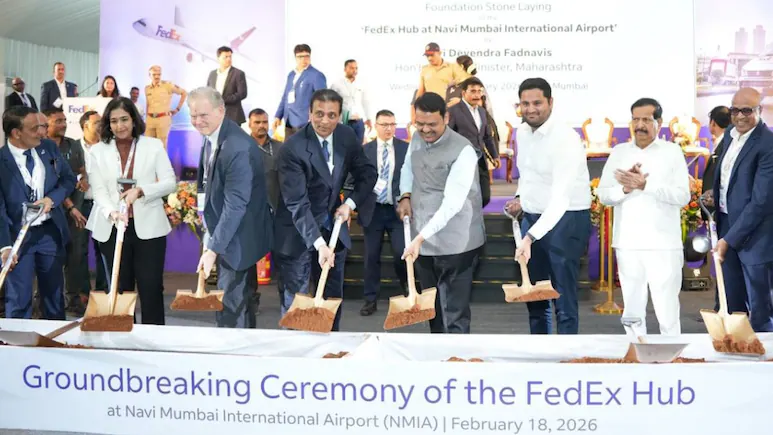

Global logistics leader FedEx has announced a major investment of over Rs 2,500 crore to build a state-of-the-art fully automated air cargo hub at Navi Mumbai International Airport (NMIA), signalling a significant boost to India’s logistics and trade infrastructure. The groundbreaking ceremony for the facility, developed in partnership with Adani Airport Holdings Ltd (AAHL), was attended by senior officials including Maharashtra Chief Minister Devendra Fadnavis and top executives from FedEx and AAHL. The investment is expected to transform India’s air cargo capabilities while strengthening its position as a global trade gateway.
The proposed cargo hub, which will cover 300,000 square feet, is designed as a regional consolidation and redistribution centre connecting India with key global markets such as Southeast Asia, West Asia, Europe, and the United States. By integrating cutting-edge automation technologies with the airport’s multimodal infrastructure including proximity to major seaports and industrial corridors — the project is projected to enhance logistics efficiency, reduce transit times, and support faster goods movement across regions.
Strategic Expansion of India’s Logistics Infrastructure:
FedEx’s Rs 2,500 crore investment represents one of its largest commitments in India’s logistics sector, reflecting confidence in the country’s economic growth and evolving trade landscape. The new hub will be equipped with advanced automated sorting systems, dimensional scanning, high-speed screening technology, and dedicated aircraft parking bays. These features will allow the facility to handle simultaneous inbound and outbound shipments, improving routing flexibility and transit time predictability especially for high-value and time-sensitive goods such as electronics, engineering products, pharmaceuticals, and perishables.
During the inauguration event, FedEx CEO Raj Subramaniam emphasised the long-term nature of the investment, highlighting that the move aligns with broader shifts in global supply chains and supports India’s role in diversified trade networks. “Establishing this hub at NMIA allows us to integrate global network strength with India’s fastest-growing trade corridor, providing greater certainty, speed and efficiency to customers,” he said. The facility is designed to serve as a major air freight node, positioning Navi Mumbai as a central logistics hub for both domestic and international cargo flows.
The new facility will also leverage NMIA’s unique advantages, such as its multimodal infrastructure, proximity to the Jawaharlal Nehru Port, and robust road and industrial connectivity factors that are expected to enhance the airport’s competitive edge as a major logistics gateway. According to Jeet Adani, Director at AAHL, the convergence of sea-air connectivity and multimodal transport infrastructure makes Navi Mumbai a strategic choice for such a large-scale cargo investment. He described the project as part of a planned effort to develop the airport as an integrated logistics centre rather than just a passenger terminal.
Integration With Global Trade Networks:
The Navi Mumbai freight hub is part of FedEx’s global expansion strategy and strengthens its place in the international logistics ecosystem. This investment signals a significant expansion of FedEx’s physical infrastructure in India, where the company already has a technological base in Hyderabad and services that connect numerous trade corridors. The company, which handles millions of shipments every day and operates hundreds of freighter services worldwide, sees the new hub as a critical node in its network that will connect regional supply chains to global demand centers.
Industry experts believe that the hub not only enhances India’s internal logistics capacity but also supports broader re-globalisation trends, where diversified supply routes and resilient infrastructure are increasingly valued by multinational corporations and global freight providers. With cutting-edge automation and scalable capacity, the facility is expected to cater to both scheduled cargo airline services and freight consolidation operations, ensuring seamless integration with global logistics systems. This will also facilitate direct connections between Indian exporters and key international markets, helping reduce reliance on traditional transshipment hubs and potentially lowering logistics costs for freight forwarders, carriers, and exporters alike.
Outlook and Future Prospects:
Although the initial phase of cargo operations is expected to handle a moderate volume of goods each year, subsequent phases will increase capacity and capabilities, strengthening the hub’s position as an important component of India’s logistics infrastructure. In the long run, when the facility expands to accommodate several million tonnes per year, NMIA might become Asia’s main air cargo gateway, on par with other major logistic hubs across the world.
FedEx’s investment in Maharashtra and India shows considerable international trust in the country’s growth prospects and logistical possibilities. The initiative is consistent with national policy objectives of improving trade facilitation, accelerating infrastructure development, and expanding export competitiveness. As global supply chains evolve, significant investments in logistics infrastructure are viewed as critical to India’s continued presence in the global commerce scene.FedEx’s plan to invest more than Rs 2,500 crore in a fully automated cargo hub at Navi Mumbai International Airport is a significant milestone in India’s logistics sector. The project is projected to improve regional trade connectivity, create job opportunities, and support the country’s long-term economic and trade growth.

Comments are closed.