
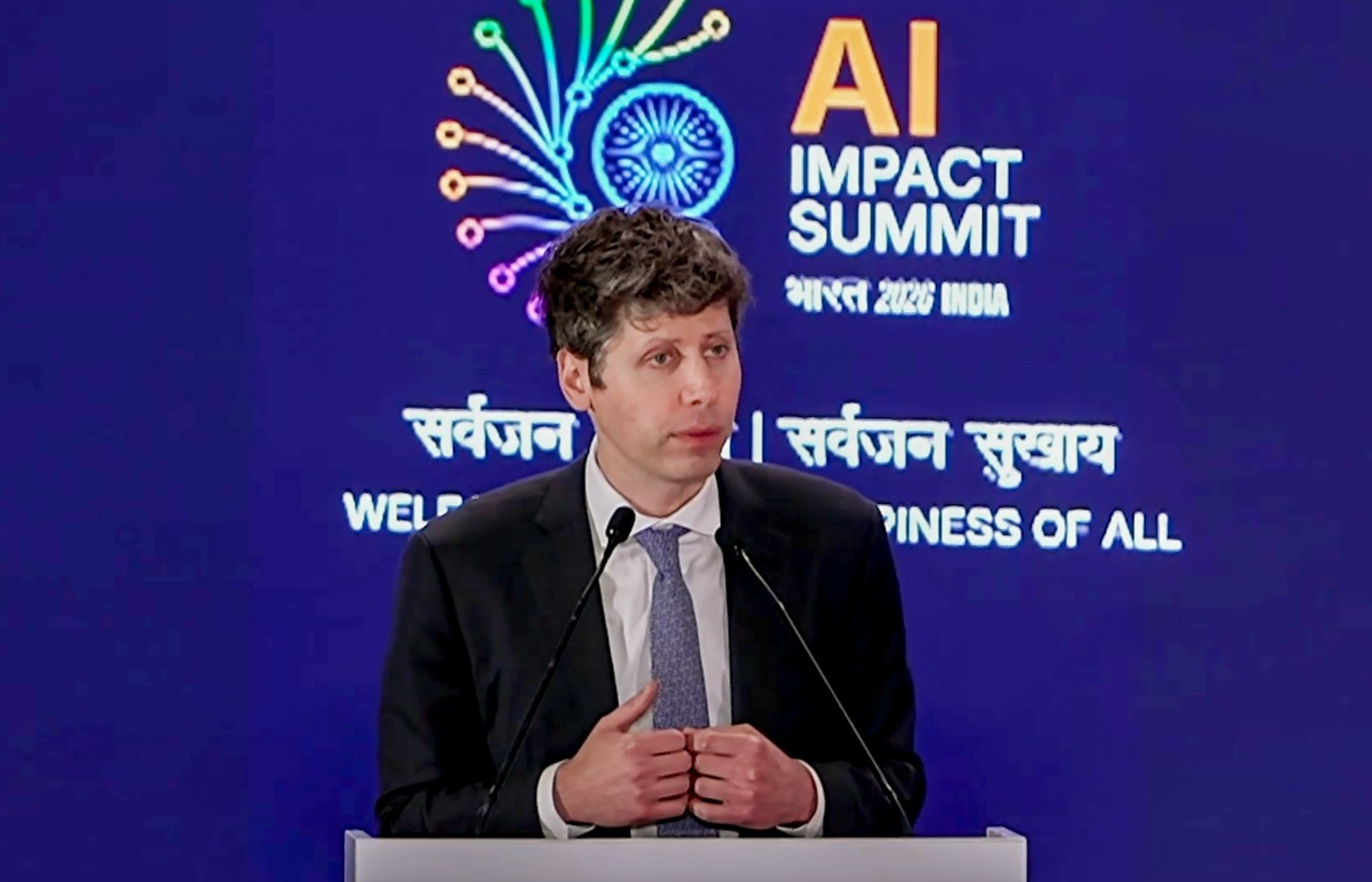

New Delhi, Feb 19 (PTI) “What’s happening in India with AI is really quite amazing”. That was the verdict from OpenAI CEO Sam Altman on Thursday as he signalled a major vote of confidence in India’s tech landscape.
Altman praised India’s current “conviction” to invest across the entire AI stack.
Highlighting the rapid adoption of tools like Codex, which he expects to become the world’s largest market “pretty quickly”, Altman signalled that India’s tech ecosystem is on the verge of a massive, AI-driven entrepreneurial explosion.
“What’s happening in India with AI is really quite amazing. The country’s conviction to invest in everything from the infrastructure layer to the model layer to the application layer on top, and the rapid adoption of the tools by people here is really quite something,” he said.
India is the fastest-growing market for Codex, he said in a reference to OpenAI’s specialised artificial intelligence system designed specifically for computer programming.
“Someone told me, I think it’ll be the biggest Codex market in the world pretty quickly. I don’t know what this is going to mean for the country, but I don’t know of any country that is adopting AI with more vigour or faster, and my sense is there will be, at a minimum, an incredible new generation of startups very quickly,” he said.
On when Stargate can be expected to expand to India, Altman said, “That is more of India than us, but we like to see it happen fast”.
To a question of India’s big AI infrastructure with a big line up of USD 100 billion investments in pipeline and whether OpenAI would be open to partnering with India in a bigger way, Altman said, “We would love to”.
On India’s regulations on AI labelling and its dialogue with industry on age-gating, Altman believes different countries will try different approaches, and there will be learnings from what works and what doesn’t.
“And I suspect we’ll move more towards global standards. But even then, it will never be all the same everywhere…in different countries, people will try different things. I suspect different countries will say…total ban on social media for young people, partial ban, no ban at all. And we’ll observe how it goes over time,” Altman said.
For AI, it would be something similar.
“People will say, if content is used as an AI tool for assistance at all, it comes to AI content. Other countries will say it makes no difference. Some people try something in the middle. And this is like one thing I like about national serenity in different countries,” he said.
Altman expects AI to have a big impact on “current kinds of jobs”.
” (For) Many jobs, it’ll be a partial impact. Some jobs will change entirely, and new jobs will be created completely,” he said.
New technology and new kinds of jobs emerge quickly, he said, adding that this is also the reason why the reskilling question is so hard.
“But I think right now, we’re in a period where saying exactly what the most, the best jobs are going to be in another 10 years feels very hard. There are skills like resilience, adaptability, fluency, with AI tools, for sure, it is a good idea,” he said, adding that “I think everybody does need to learn to get good at using AI tools”.
Addressing the potential cognitive impact of AI on students, Sam Altman recalled how teachers “panicked” when Google first launched, warning students that their “brains are going to rot” because there was “no point to teach history” if facts could be looked up instantly.
Ultimately, Altman observed that “the system adapted” as society realised that brainpower could be used in “some different way”, while tools handled basic information retrieval.
“It’s very important to learn how to think. And there are things that I learned, like learning to write an essay, even if today I might use ChatGPT…I’m glad I learned the old-fashioned way, because I learned something about how to think, and it is still useful to me. And if we don’t make any changes to the way that we teach and evaluate our students, maybe they will do too much cognitive offloading into ChatGPT or whatever,” he said.
Looking toward the future, Altman said people will have AI tools, emphasising the need to come up with new ways to teach, challenge and evaluate students.
“…assume they have the tools, but still make them think and be creative and figure out how to stretch their brain. I have no doubt we can do that. When the tools get better, the expectations have to go up,” he said. PTI
(Except for the headline, this story has not been edited by The Federal staff and is auto-published from a syndicated feed.)

Comments are closed.