
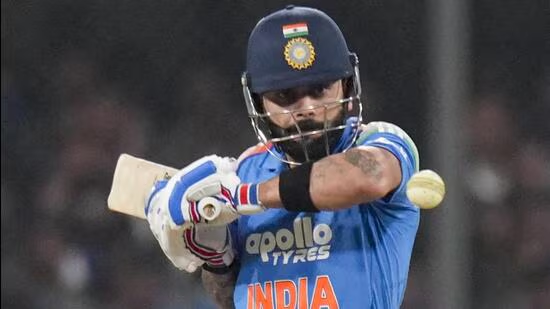

New Delhi: There was a time, not very long ago, when no matter the format India were playing, Virat Kohli and Rohit Sharma were effervescent and ever-present. They could lord it over five days of Test cricket, waltz through the 100 overs of an ODI and turn it up for a Twenty20 match.
They weren’t alone either. Around the world, South Africa’s A B de Villiers, Australia’s David Warner, New Zealand’s Kane Williamson and a few others were doing the same or trying to do it. To some, all-format success defined greatness in the modern era.
To be able to straddle all three formats successfully was not for the meek. It required mental strength and a drive that increasingly few cricketers (and even fewer batters) have.
Take for instance, the Indian team that is playing the T20 World Cup. Abhishek Sharma, Ishan Kishan, Tilak Varma, Suryakumar Yadav, Shivam Dube — good batters all but none of them get a look in for the Test team. Specialists, yes. All-format, no.
This isn’t a trend limited to India alone. While we still have many bowlers led by Jasprit Bumrah, Pat Cummins and Josh Hazlewood hitting the right lengths across formats, the batters are struggling to do the same.
As South African batter Ryan Rickelton said in an interview to ESPNCricinfo last year: “I grew up wanting to be a Test player and thought that in T20 you can just whack a few. But T20 cricket is flipping hard. It’s different, but it’s harder. With T20s, there’s a lot more pressure on every delivery. In Test cricket, you can bide your time, work your way through it at a lower intensity.”
A lower intensity but the demands are different too. The idea that you might have to fend off Bumrah or Hazlewood over a 7-8 over spell is very different from having to survive just 1-2 overs in which you also have the license to attack.
Once you are away in T20 cricket, you don’t need to rein it in. But Test cricket is all about the ebb and flow. The conditions change, as do the motivation levels of the bowlers. While patience is scoffed upon in T20 cricket, it is a virtue in Tests.
Kohli’s final Test tour was against Australia and throughout the tour, he kept nicking the ball outside the off-stump. The weakness had been there for a while and the right-hander had been working on it but the Aussies wanted to probe and test him in that area.
“We’ve got pretty set plans on how we want to bowl to him,” pacer Scott Boland had then said. “He sort of feels like he leaves a lot and then he wants to play the ball once he gets in. So once he gets in, we just want to switch our lines a little bit to fifth stump and it’s working at the moment.”
Different formats, different battles, different challenges… and now, different players too. There have been calls for specialisation, so in a sense, it isn’t anything wrong. But it just robs the game of that little bit of magic.
So how did Kohli, who spent over 3,200 days as a No. 1 ranked batter across formats, do it?
“Cricket is a game of execution,” he said in 2024. “I like to keep things very, very simple. I am not a big stats guy and I have never really watched the analysis of any bowler’s wrists positions because that guy might do something different on the day.
“I have to adapt. I have to trust my own eyes and instinct, react to the ball and find the best solutions in any situation possible. I don’t think a computer analysis can tell you the situation you are going to be in. It can’t prepare you for that. Finding solutions is a very, very in-the-moment process. I have based my cricket on the basics of the game. I keep my game very similar in all three formats and for me, it is just playing cricket at a different tempo.”
And it is in Kohli’s words that the aspiring all-format players might find a clue. A solid technique is the base. Once that is in place, you can adapt. This is also true for Bumrah, who is the first bowler to attain the number one ranking in the ICC Men’s Player Rankings across all three formats.
In the long run, the basics matter. But in the shortest format, perhaps only madness does.
T20 prioritises strength — see the difference in how Chris Gayle the Test cricketer looked in comparison to the T20 version. But the key is finding the balance and that is becoming increasingly difficult now. The demands from T20 cricket have never been as extreme, the strike-rates are moving consistently upward and it feels like a very different game from Test cricket now.
There is also the case of Test cricket not having the same allure it once did. Tweaking technique or temperament for Test cricket might throw one off for the more lucrative T20 leagues. And that simply can’t be done anymore.
The severity of the challenge may make many think twice but for some stars of the new generation like Harry Brook and Shubman Gill, it may be precisely the thing to lift them to a higher level. After all, who wouldn’t want to walk in the footsteps of the greats… who wouldn’t want to rule regardless of the format?

Comments are closed.