
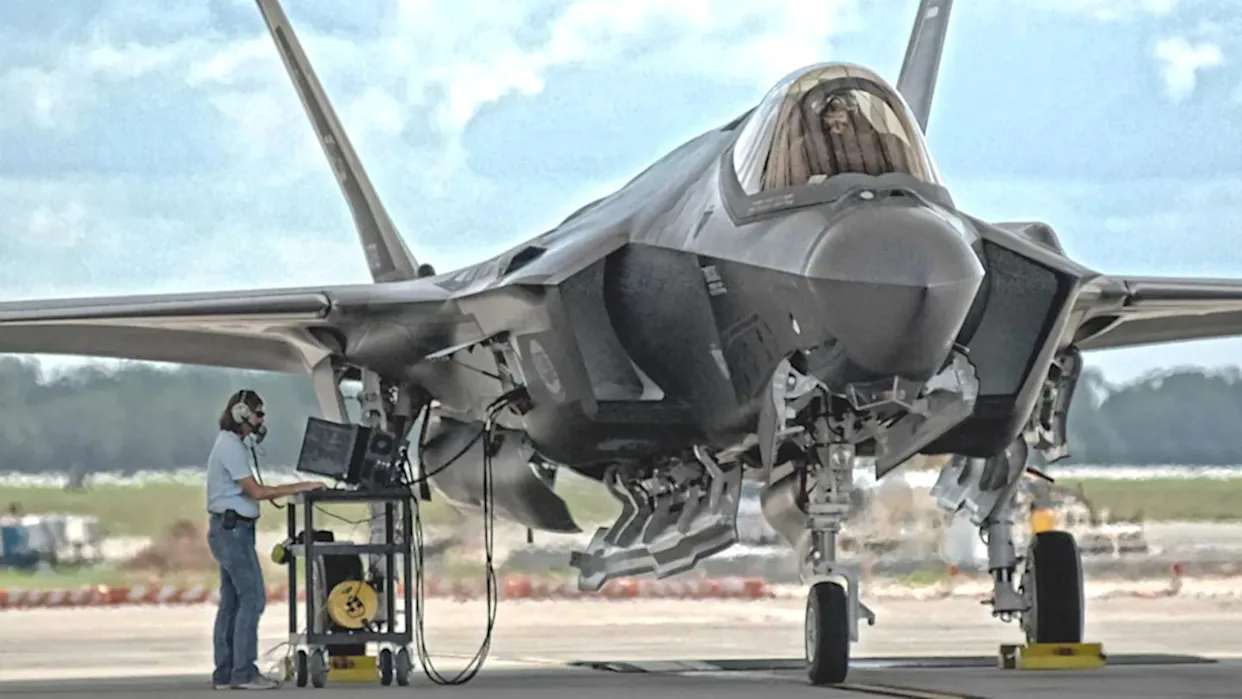

A striking comment from the Netherlands’ defense leadership has reignited a sensitive debate in Europe about who ultimately controls the software powering the continent’s most advanced fighter jets.
Gijs Tuinman, the Dutch state secretary for defense, suggested during a recent podcast interview that the Lockheed Martin-built F-35 could theoretically be modified in a way comparable to “jailbreaking” a smartphone. His remarks were made on the Dutch program Boekestijn and De Wijkaired by BNR Nieuwsradio, during a discussion about Europe’s dependence on the United States for military technology.
The question posed to Tuinman centered on a hypothetical but politically charged scenario: if Washington were to distance itself from European allies or restrict support, would countries operating the F-35 be able to maintain or update the aircraft’s software on their own?
In responding, Tuinman emphasized that the F-35 program is not solely an American enterprise. He described it as a deeply integrated international project involving multiple allied nations. The United Kingdom, for instance, supplies critical engine components through Rolls-Royce, and various European countries manufacture parts and systems used across the global fleet.
While acknowledging the complexity of the aircraft’s software ecosystem, Tuinman implied that operators may not be entirely powerless if faced with a breakdown in cooperation. His off-the-cuff comparison to jailbreaking an iPhone quickly made headlines, largely because it touched on a longstanding concern within parts of Europe: digital sovereignty over U.S.-made defense platforms.
A Fighter Jet Built on International Cooperation
The F-35 Lightning II is widely regarded as one of the most sophisticated combat aircraft ever produced. Developed by Lockheed Martin, it serves as the backbone of airpower for several NATO members and allied nations. Countries including the Netherlands, the United Kingdom, Italy, Norway, and others operate or have ordered the jet.
From the outset, the program was structured as a multinational collaboration. European defense firms manufacture major components, and allied governments have invested heavily in production, training, and long-term sustainment. This shared industrial base has often been cited as a strength of the program, binding transatlantic partners together.
Tuinman’s argument appears to rest on that mutual dependence. If supply chains and manufacturing are shared, he suggested, then influence and leverage are shared as well. In other words, the United States also relies on its partners to keep the broader F-35 ecosystem functioning smoothly.
Centralized Software and Maintenance Systems
Despite its multinational production model, the F-35’s software management remains highly centralized. For years, updates and maintenance data were coordinated through a system known as the Autonomic Logistics Information System (ALIS), designed to handle everything from diagnostics to mission planning support. Although ALIS has since evolved into newer systems, the principle remains the same: software updates are distributed in controlled, coordinated packages across the fleet.
These updates are critical. The F-35 is often described as a “flying computer,” with much of its capability defined by code rather than hardware alone. Sensor fusion, stealth optimization, weapons integration, and communications all depend on tightly managed software environments.
This structure has led some European policymakers to worry about the degree of influence Washington might hold. While there is no public evidence of a remote disabling mechanism, concerns have periodically surfaced about whether access to updates or support could be restricted under extreme political circumstances.
Cybersecurity Experts Urge Caution
Ken Munro, a cybersecurity specialist and founder of the British firm Pen Test Partners, offered a more grounded perspective on the idea of “jailbreaking” a military aircraft.
Munro noted that while complex systems can contain vulnerabilities, comparing a fifth-generation stealth jet to a consumer smartphone oversimplifies the reality. Smartphones like Apple’s iPhone are widely available for testing and experimentation. Researchers around the world routinely analyze them, looking for security flaws or ways to bypass restrictions.
By contrast, access to an F-35 is tightly controlled. Only authorized military personnel and contractors can physically interact with the aircraft or its core systems. That dramatically reduces the likelihood of independent researchers discovering and publicizing exploitable weaknesses.
The limited access cuts both ways. On one hand, it reduces the risk of public exploits. On the other, it means there is no broad civilian research community stress-testing the system the way consumer electronics are routinely examined.
Israel’s Special Software Arrangement
One country has already demonstrated that variations in software control are possible within the F-35 framework. Israel negotiated a unique agreement allowing it to integrate certain domestically developed systems into its F-35I variant. That arrangement was reached through formal agreements with the United States and Lockheed Martin.
Israel’s case shows that flexibility can exist—but only through structured cooperation rather than unilateral action. Whether other European nations could secure similar arrangements would depend on diplomatic negotiations rather than technical improvisation.
Broader European Concerns About Autonomy
Tuinman’s comments also come in the wake of earlier controversy sparked by Joachim Schranzhofer of the German defense firm Hensoldt. In remarks to the German newspaper Bild, Schranzhofer suggested that concerns about potential remote control mechanisms in U.S.-supplied aircraft were not unfounded.
Although no evidence has emerged to confirm such fears, the discussion intensified debates about Europe’s reliance on American military technology—especially amid geopolitical uncertainty and shifting U.S. foreign policy priorities.
Some countries have responded by reevaluating procurement strategies or increasing investments in domestic and European defense projects. The underlying theme is not necessarily distrust, but a desire for greater resilience and self-reliance.

Comments are closed.