
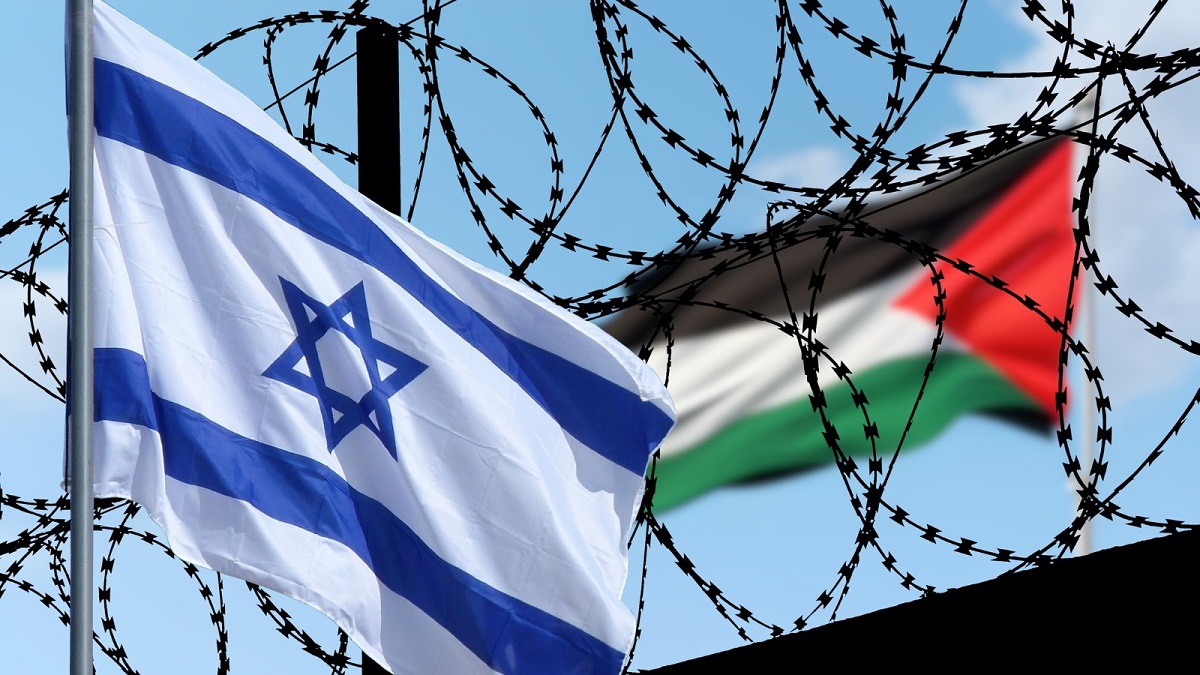

Questions being raised over India’s signing of a joint statement criticizing the expansion of Israeli settlements in the West Bank, senior diplomats have clarified that the move is a continuation of India’s traditional Palestine policy and not an indication of any policy change ahead of Prime Minister Narendra Modi’s upcoming visit to Israel. Initial media reports claimed that New Delhi abstained from signing the statement along with 85 other countries. However, diplomatic sources say that the language of the joint statement matches India’s official position, so it was not possible to stay away from it.
The joint statement said, “We reject all measures aimed at changing the demographic composition, character and status of the Palestinian territories, including East Jerusalem, occupied since 1967. Such measures violate international law, undermine ongoing efforts to achieve peace and stability in the region, run counter to a comprehensive plan, and jeopardize any hope of reaching a peace agreement that ends the fighting.”
This stance is in line with earlier statements by India’s Ministry of External Affairs. Officially, India has been saying, “India supports a negotiated two-state solution, which will lead to an independent, sovereign, prosperous and independent State of Palestine, living in peace with Israel, within secure and recognized borders.”
India has repeatedly clarified that its support is based on “relevant UN resolutions, the Madrid Principles, the Land for Peace principle, and the Arab Peace Initiative”. Mention of the ‘Madrid Principles’ and ‘Land for Peace’ indicate support for a solution based on the 1967 borders, which is also reflected in the language of the joint statement.
Senior diplomats say that if India had not signed it, it would have signaled a deviation from its traditional position, which would not have been considered appropriate just ahead of the Prime Minister’s visit to Israel.
Former Foreign Secretary Nirupama Rao also said that at the UN “strong voting patterns in favor of Palestine existed in the UN, along with quiet negotiations with Israel, long before full diplomatic relations.” India established full diplomatic relations with Israel in 1992, while maintaining its position of support for Palestine.
Historically, Yasser Arafat had urged India to recognize Israel in the late 1980s, when the PLO itself recognized Israel under UN Security Council Resolutions 242 and 338.
According to diplomatic sources, the delay in signing should not be given undue importance. Every line of any joint statement is carefully reviewed, especially when a high-level visit by the Prime Minister is proposed. PM Modi’s visit to Israel is scheduled on 25th and 26th of this month.
Even before this, on June 12, 2025, India had abstained from voting on the United Nations General Assembly resolution demanding immediate ceasefire in Gaza. On 12 September 2025, India supported the New York Declaration, which supported a two-state solution, while Israel opposed it.
The joint statement contains no punitive provisions and is not considered a legally binding treaty. This is being seen as a symbolic sign of global dissatisfaction. Analysts believe that Israel will see this move only as a continuation of India’s traditional policy, and not as any diplomatic message. Thus, India’s move is in line with its long-term pro-two-state solution policy, in which it has maintained strong ties with Israel while also maintaining support for the legitimate rights of Palestine.
Also read:
The mystery of Area 51 will be solved; Trump orders to make files related to UFO public
Karnataka: Stone pelting on Shiv Jayanti procession as soon as it reached the mosque; SP Siddharth Goyal injured
BLA released new video of captured Pak soldiers; Pakistan again embarrassed

Comments are closed.