
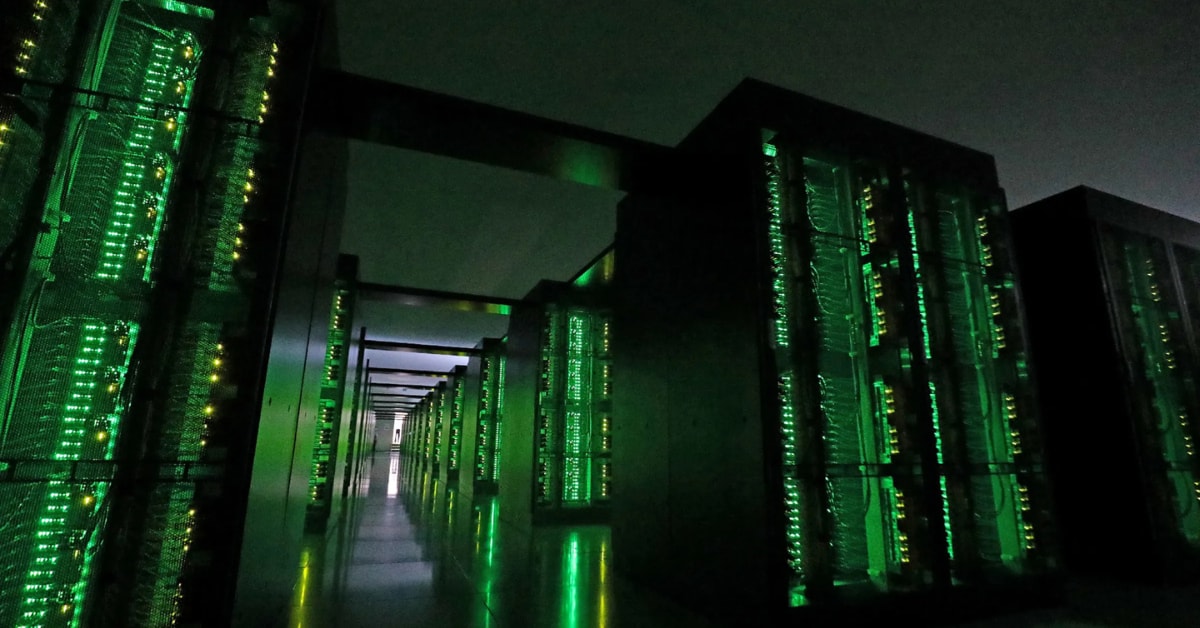

MEA said that the supercomputer cluster will be open for access to both public and private sector entities for research, application development, and commercial use
G42, along with US-based AI chipmaker Cerebras, Mohamed Bin Zayed University of Artificial Intelligence and C-DAC, will deliver the project
The 8 exoflop capacity is almost 19X compared to the combined peak 410 petaflop compute capacity of the country’s two flagship AI supercomputers AIRAWAT and PARAM Siddhi-AI
On the final day of the India AI Impact Summit 2026, the Centre for Development of Advanced Computing (C-DAC) finalised a term sheet with UAE-based tech company G42 to deploy a supercomputer cluster in India.
In an official statement, the external affairs ministry (MEA) said that the finalisation of the term sheet commences the deployment process. The ministry added that the supercomputer cluster will be open for access to startups as well as other public and private sector entities for research, application development, and commercial use.
Elaborating more on this, G42 said that it will partner US-based AI chipmaker Cerebras to set up a “national-scale” AI supercomputer in India with a peak compute capacity of eight exaflops. G42 said that it will also partner with the Mohamed Bin Zayed University of Artificial Intelligence (in Abu Dhabi) and C-DAC to deliver the project.
The proposed supercomputer cluster will be hosted in India and will operate under the country’s governance frameworks. Additionally, all data processed by the supercomputer will remain within the country.
“Deploying this system in India marks a significant step forward in the country’s computational capacity and sovereign AI initiatives. It will accelerate training and inference for large-scale models, enabling researchers and developers to build AI tailored to India’s needs,” said Cerebras chief strategy officer Andy Hock.
The project has also been envisaged to lower barriers to AI innovation and enable breakthroughs in areas such as healthcare, agriculture and education.
Once operationalised, the project will mark a big step forward for the Indian AI ecosystem. The proposed eight exaflop (or 8,000 petaflop) capacity is almost 19X compared to the combined peak 410 petaflop compute capacity of the country’s two flagship AI supercomputers AIRAWAT and PARAM Siddhi-AI, both hosted at C-DAC Pune.
The collaboration is also expected to bring the latest version (released in December 2025) of G42’s open-source Hindi-English LLM NANDA 87B, featuring 87 Bn parameters, to the country.
For the uninitiated, supercomputers provide the immense computational power necessary to train complex AI models, while AI, in turn, optimises the performance of these computing systems. Even the current breed of large language models (LLMs) rely on supercomputers, specifically massive clusters of GPUs.
The agreement between C-DAC and G42 was signed during Abu Dhabi’s crown prince Sheikh Khaled bin Mohamed bin Zayed Al Nahyan’s two-day visit to the country to attend the AI Impact Summit.
However, the project was jointly announced by Prime Minister Narendra Modi and UAE President Sheikh Mohamed Bin Zayed during the latter’s visit to India in January this year.
The development came on the same day as IT services major Tech Mahindra, in partnership with NVIDIA, rolled out its new Hindi-first LLM focused on education at the summit. Besides, the event also saw the launch of multiple sovereign models.
Sarvam AI unveiled its 105 Bn- and 30 Bn-parameter LLMs, while BharatGen launched its 17 Bn multilingual foundational model. Gnani.ai also debuted its voice cloning/text-to-speech system, optimised for Indian languages and applications.

Comments are closed.