
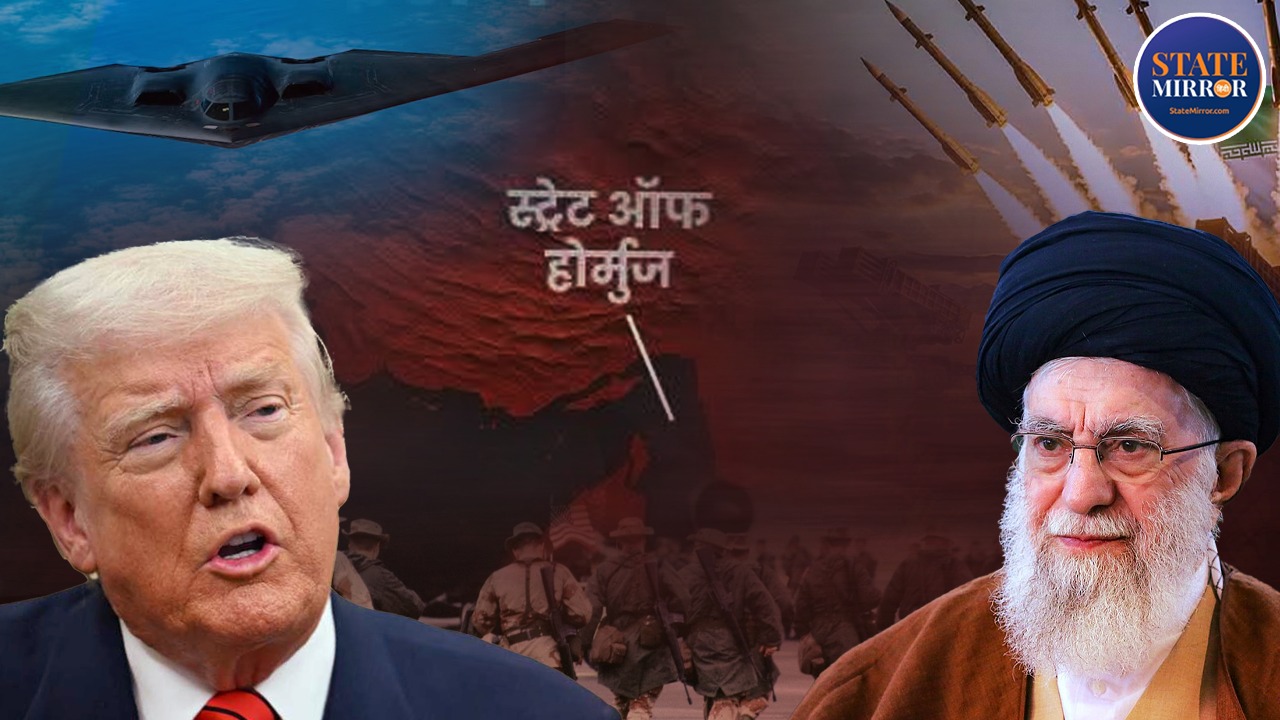
What is the fear before the attack? Missiles, oil and the game of superpowers. Iran US Tension Explained

Amidst the increasing tension in the Middle East, the question remains the same, what? America Will it attack Iran directly? On one hand, Iran’s missile power, nuclear program and control over strategic sea routes are at stake, while on the other hand, America’s military presence and global leadership credibility is at stake. But before the attack, the fear is not only of military conflict, but also of the impact of oil markets, regional wars, interference of superpowers and domestic politics. This is why iran It is not just a matter of two countries, but of global balance.
What is the root cause of stress?
The conflict between Iran and the United States has its roots in the 1979 Islamic Revolution, nuclear programs, and competition for regional influence. America considers Iran’s nuclear program and its proxy networks (Hezbollah, Houthi, Iraqi militia) as a threat. Whereas Iran considers American military presence in the countries of the Middle East as a challenge to its sovereignty and security.
1. America vs Iran: Whose war preparations are stronger?
Amidst the increasing tension in the Middle East, the question arises that if America and Iran come face to face, whose preparation will prevail? Statistics show that America is ahead in military budget and technology, but Iran’s missile-drone strategy and proxy network war can complicate the matter.
The US defense budget is $850 to 900 billion while Iran’s is $20 to 30 billion. America has 13 lakh active military forces and Iran has 6 lakh, which also includes IRGC soldiers. America has 11 lethal aircraft carriers. Iran has zero. America has more than 13,000 total military aircraft, while Iran has 300 to 400. America has several ranges of ballistic missiles, while Iran has about 3000 regional range missiles. The US has nuclear weapons, 5,200+ warheads. Whereas Iran does not officially have any program. The ally network with the super power is NATO, Asia-Pacific, while Iran’s ally is its proxy group: Hezbollah, Houthi Movement. When it comes to maritime power, Iran is no match for America. America has a global blue-water navy. Iran has only the territorial Strait of Hormuz, which it can close in case of war.
Overall, America has military bases in more than 70 countries. There are 11 aircraft carriers. Has nuclear capability to attack from land, sea and air. In contrast, Iran’s missile-drone focus is regional level. Iran has control over the Strait of Hormuz. That is, America has a techno-military edge in a direct conflict between America and Iran, but Iran can increase regional costs through “asymmetric strategy”.
2. Why are US military bases in danger in the Middle East?
America has military bases in 11 countries including Qatar, Bahrain, Kuwait, Iraq, UAE, Saudi Arabia, Jordan, Syria. These bases come within the missile and drone range of Iran. In particular, there is a large US naval and air force presence in Qatar and Bahrain, which could become primary targets against Iran in the event of a conflict.
3. What is the geopolitical significance and risk?
The Middle East is the global center of energy supply for the entire world. About 20% of the world’s oil passes through the Strait of Hormuz. Conflict here means global energy crisis. Iran’s geographical position makes it important in sea routes and regional strategic balance.
4. How might the risk of regional war increase?
If there is a direct attack between America and Iran, then countries like Israel, Lebanon, Iraq, Yemen and Syria can get involved in it. Iran can give an indirect response through proxy militias, due to which the conflict may not remain limited but turn into a regional war. If this happens, Iran will not desist from attacking 11 countries including Qatar, Bahrain, Kuwait, Iraq, UAE, Saudi Arabia, Jordan, Syria. All these countries are in the missile range of Iran.
5. Why the instability regarding Iran’s nuclear program?
Iran’s nuclear program is under international monitoring. Tension increased after America’s withdrawal from the Joint Comprehensive Plan of Action in 2018. Western countries claim that Iran has increased the amount of enriched uranium. However, Iran denies making nuclear weapons.
6. What could be the economic impact if there is a war?
Any major conflict between America and Iran can lead to a sharp rise in the prices of crude oil. Global stock markets, shipping routes and supply chains will be affected. America may also have to face defense spending, oil inflation and domestic economic pressure.
7. What is Iran’s military capability and counter-power?
Iran is estimated to have more than 3,000 ballistic missiles, whose range ranges from 300 to 2,000 kilometers. Also, drone technology and cyber capabilities are part of its asymmetric war strategy. Compared to the traditional army, it depends more on ‘hit and run’ and proxy models.
8. Will China and Russia support Iran?
China and Russia will maintain strategic relations with Iran if the US starts a war. Will support Iran. Although both countries can avoid direct military intervention, indirect help through diplomatic support, weapons technology or economic cooperation is possible. This is because, if America attacks Iran, China and Russia can take revenge from America for Ukraine.
9. America’s domestic politics and ‘war fatigue’
After the Afghanistan and Iraq wars in America, ‘war fatigue’ has been seen among the public. A long and costly war could increase domestic political pressure. During election years, any administration remains cautious about major military operations.
10. What is the strategy of “deterrence”?
Deterrence means ‘stopping power’, in which both sides demonstrate their military power and stop the other from attacking. Both America and Iran are working on a policy of showing strength while avoiding direct war. So that full-scale war can be avoided, but strategic pressure remains. America wants Iran not only to stop its nuclear program. Also stop your missile program. Iran is not ready to stop the missile program at any cost. This is the reason for the latest dispute between the two.
Iran’s ballistic missile Trump Why the threat?
Iran has the world’s largest missile storage, which contains thousands of ballistic and cruise missiles. These missiles are solid fuel, which can be launched quickly. The estimated ranges of the main missiles possessed by Iran are as follows.
1. Dezful
It is a short-range ballistic missile of Iran, whose range is about 1000 kilometers. It can easily target neighboring areas like Iraq and Gulf countries. Dezful is powered by solid fuel, which helps it launch faster.
2. Fatah-1, Haj Qasem and Khyber Shakeen
These are of medium range, with a reach of up to 1400 kilometers. It can reach countries like Saudi Arabia and United Arab Emirates (UAE). Fatah-1 is said to be a hypersonic missile, which can dodge enemy missile defense systems.
3. Hajj Qasem and Khyber Shakeen
Haj Qasem and Khyber Shakan also have advanced technology, designed for precision strikes. These missiles have been developed by Iran’s IRGC (Islamic Revolutionary Guard Corps).
4. Emad and Ghadr-1
Emad and Ghadr-1 missiles are more advanced, with a range of 1700 kilometers. The range of Gadar-1 is from 1600 to 1950 kilometers. These can reach distant targets like Israel and Jordan. Emad is considered an improved version of Shahab-3, which has better accuracy and guidance system. Gadar-1 is also liquid fueled and can carry a heavy warhead, which makes it lethal. These missiles are a key part of Iran’s medium-range ballistic program.
5. Khorramshahr and Sejjil
The Khorramshahr and Sejjil missiles are Iran’s longest range, with a reach of up to 2000 kilometers. It can cover the entire Middle East and is capable of carrying 1500 kg warhead. Khorramshahr-4 has recently been deployed, which is housed in an underground ‘missile city’. Sejjil is a two-stage solid fuel missile, which can be launched rapidly. These missiles are important for Iran’s defense. Can pose a threat to American and Israeli bases.
Major US military bases in range of Iran
According to the AFP map, American bases are spread across the Middle East. These bases are home to American soldiers, planes and ships. Iran’s missiles can reach them. A dozen countries including Qatar, Iraq, Kuwait, Bahrain, UAE, Syria, Jordan, Saudi Arabia, Oman and Yemen come under its jurisdiction.
1. Al Udeid Air Base Qatar
It is the headquarters of the American Central Command. More than 10,000 American soldiers are present here. It is the target of Iran’s 1400 km range missiles.
2. Ain Al-Asad Air Base Iraq
The main American base in Iraq was first attacked by Iran. This military base is within the range of Iran’s 1000 km missile.
3. Camp Arifjan and Ali Al Salem Air Base Kuwait
This American military base is the center of its army’s equipment and aircraft. Iran can easily target this base located in the Gulf.
4. US Naval Support Activity Bahrain
This base located in Bahrain is the base point of the American Fifth Fleet. This is the headquarters of the ships. It is in Iran’s 1400 km missile range.
5. Al Dhafra Air Base UAE
It is the center of American intelligence and fighter planes. Iran’s missiles with 2000 km range can reach here.
6. Other bases
US bases in Syria, Tower 22 in Jordan, Prince Sultan Air Base in Saudi Arabia, areas near Oman and Yemen are also US military bases, which are within the 2000 km missile range of Iran. The special thing is that more than 50 thousand American soldiers are deployed in these areas.
These American military bases are a direct threat from Iran’s missiles. Especially in the oil and gas fields. If attacked, America has missile defense systems, but due to the large number of missiles of Iran, the challenge is big for it. Iran has warned that American bases are its target.
Why is Trump unable to muster the courage to attack?
Because of Iran’s missile capability, America is not able to muster the courage to attack Iran. Although this does not seem to be the whole picture, it is a strategic calculus where the cost to the US of a direct attack may outweigh the potential benefits.
Does Iran have ICBM missile with range up to 10000 KM?
According to wion News, Iran has the largest missile stockpile in South-West Asia. In the year 2022, General Kenneth McKenzie of the US Central Command admitted that Iran had more than 3,000 ballistic missiles. Their range ranges from 300 kilometers to 10,000 kilometers. These include Shahab, Qiyam, Fateh, Raad, Zolfaghar, Dejful, Gadra, Imad, Khorramshahr or Ali etc. It also said that it is difficult to estimate the total missile capability of the Islamic Republic of Iran.
Since 2015, it had set a self-imposed missile strike limit of 2,000 kilometers, but recent reports show that it has gone far beyond this self-imposed limit. Recently, Iran claimed that it has tested its first intercontinental ballistic missile, which is capable of reaching the East Coast of America. According to Defense Security Asia, which cites sources like Tasnim and Fars News Agency, the missile has a range of up to 10,000 kilometers. This test was done towards the Siberian Sea. Reportedly, Iran had already taken permission from Russia for flying from above.
Why is Trump’s popularity less than Biden’s?
According to a recently released Harvard CAPS/Harris survey, 51% of American voters believe that Trump’s work is worse than Biden’s. However, 49 percent voters are with Trump. Another survey Rasmussen reports said that 48 percent voters consider Biden better. Only 40 percent voters have described Trump as better. Whereas 8 percent believe that the work of both has been almost the same. According to the YouGov/Economist survey, 46 percent of Americans say that Trump is doing a bad job. Biden was better than him.
That means, due to aggressive policy and tariff policy, Trump’s popularity has become less than Biden’s. Trump wants to save his nose. America is no longer a bully because of Trump. NATO is out of his hands, China is his enemy. Russia is also busy digging America’s grave. African countries are becoming free from American pressure. Many Latin American countries have also indicated not to accept American pressure. India has dominance in the Indian Ocean and is being surrounded by China in the South China Sea. Most importantly, NATO countries will never support Iran if it starts a war against it. In such a situation, if there is a war with Iran, whatever will happen to Iran, but the back of America’s economy will be broken.

Comments are closed.