
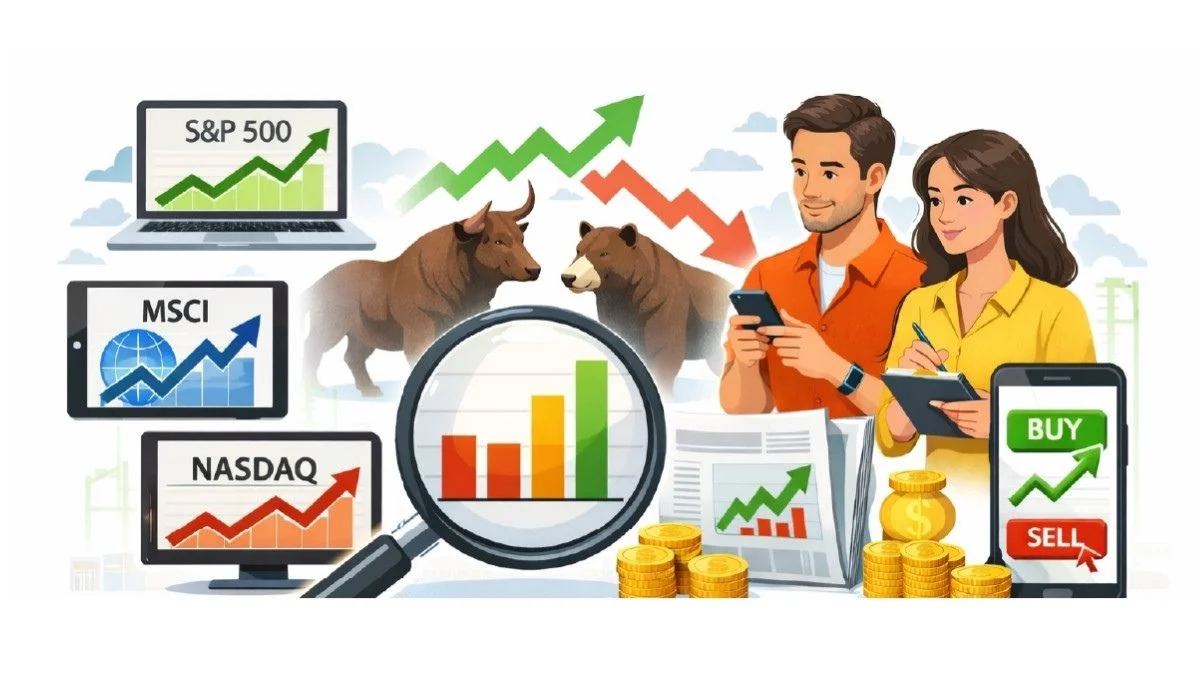

For retail investors, market benchmarks act as a compass in the often complex world of investing. They provide a snapshot of overall market direction, economic sentiment, and sector performance. When investors search for Nifty 50 today, they are not just looking at a number—they are trying to understand what the broader market is signaling. Similarly, movements in Bank Nifty offer deeper insights into the health of the financial sector and the economy at large.
Understanding how these benchmarks function and what they indicate can help retail investors make informed decisions and avoid emotional reactions.
What Are Market Benchmarks?
The market benchmarks refer to indices that monitor the performance of a set of specific stocks. The selection of these stocks depends on their capitalization in the market, liquidity and sector representation.
Benchmarks are used in a number of ways:
- Supervise general market performance.
- Compare stock returns.
- Determine portfolio performance.
- Reveal investor sentiment.
Retail investors do not need to examine hundreds of stocks individually but they can use benchmarks as an overview of how the market does.
Why Nifty 50 Matters to Retail Investors?
The Nifty 50 is one of the most widely followed equity indices in India. It represents 50 large, liquid companies across major sectors of the economy.
Investors who observe Nifty 50 today are able to know:
- Performance of large-cap stocks on a large scale.
- The activity of institutional investors.
- The economy with sectoral balance.
- Long-term and short-term direction trend.
The index provides a wide perspective of the economic power since it comprises firms in the banking, IT, energy, FMCG and other industries.
Daily Movements and Market Sentiment
Daily fluctuations in benchmarks reflect how markets react to news, economic data, corporate earnings, and global cues.
For example:
- A good increase of Nifty 50 today can reflect positive investor feeling or intense institutional purchases.
- A fall can be a sign of risk aversion, profit booking, or uncertainty in the world.
Daily percentage changes are usually used by the retail investors to determine the optimistic or cautious mood of the market.
Role of Bank nifty as a Sector Indicator
The broad indices give the general performance whereas sectoral indices offer details. Of particular importance is bank nifty, a tracking stock that follows the top banking stocks, the reason being that financial institutions are in the middle of the economic activity.
Bank Nifty movements may indicate:
- Alterations in the expectations of credit growth.
- Change of interest rate perspective.
- Belief in the growth of the economy.
- Market liquidity conditions.
When Bank Nifty beats the index of stock market at large, this may indicate good confidence in the financial sector. On the other hand, low performance can indicate issues of asset quality or slowing of businesses.
How Retail Investors Should Interpret Benchmark Signals?
Retail investors are not to interpret benchmarks separately. Instead, they should analyze:
- Direction of the trend in weeks or months.
- Volume participation
- Contribution of the sector to index movement.
An example is that today Nifty 50 may shoot up but without many stocks working on the increase, the surge could not be wide. Conversely, the momentum is usually higher when there is a broad involvement in sectors.
The Long-term Trends vs the Short-term Noise
Among the greatest complications facing the retail investors is how to differentiate between the short-term volatility and long-term trends.
Short-term movements can be impelled by:
- Global market swings
- Policy announcements
- Quarterly earnings
Long term trends however reflect:
- Economic growth trajectory
- Business profitability cycles.
- Structural reforms
Investors are being advised to look at the long term trends and not on the day to day changes in Nifty 50 today.
Performance Comparison Tools: Benchmarks
Benchmarks assist investors to judge the efficiency of their portfolios.
For example:
- When a specific portfolio does not perform well in comparison with Nifty 50 over a period of time, it might be time to rebalance.
- The exposure to financial sectors can be evaluated by comparing returns with Bank Nifty.
Investment discipline and accountability are enhanced by using benchmarks as a point of reference.
Global Influence on Domestic Benchmarks
Domestic benchmarks are not isolated from global markets. International economic data, interest rate changes, commodity prices, and geopolitical events often influence Nifty 50 and Bank Nifty movements.
It should be known to retail investors that:
- Volatility in the world may bring local markets into the picture.
- Flows of currency can have an effect on certain sectors.
- Index swings may increase with flows of foreign institutions.
Learning this interdependence will allow one to avoid responding excessively to short-term fluctuations.
Risk Management Benchmark Awareness
Risk management is facilitated by tracking the market standards. In case of persistent weakness of indices, asset allocation may be re-evaluated by investors. Rebalancing can help avoid risk concentration during bullish periods of strong bullishness.
Retail investor awareness Benchmarking assists:
- Have diversified portfolios.
- Adjust exposure gradually
- Keep on track with long-term objectives.
This is a better strategy compared to being an impulse trader.
Law: Avoiding Common Benchmark Misinterpretations
The new entrants have a lot of assumptions that increasing indices can be a sure-footed guarantee of profit or falling markets are to be avoided at all costs. In reality:
- Long term opportunities can be offered by market corrections.
- The increase in indices can continue to conceal risk-specific to the sector.
- Sustainability of the trends does not necessarily show short-term spikes.
Understanding the broader context behind Nifty 50 today reduces emotional decision-making.
Conclusion
Market benchmarks play a crucial role in guiding retail investors through the complexities of equity markets. Tracking Nifty 50 today provides a snapshot of overall market sentiment and large-cap performance, while Bank Nifty reveals sector-specific signals tied to financial stability and economic growth.
By interpreting these benchmarks thoughtfully—focusing on trends rather than daily noise—retail investors can strengthen decision-making, manage risk effectively, and build confidence in their long-term investment journey.

Comments are closed.