
Artemis II mission postponed? NASA identifies fresh anomaly before March launch world news

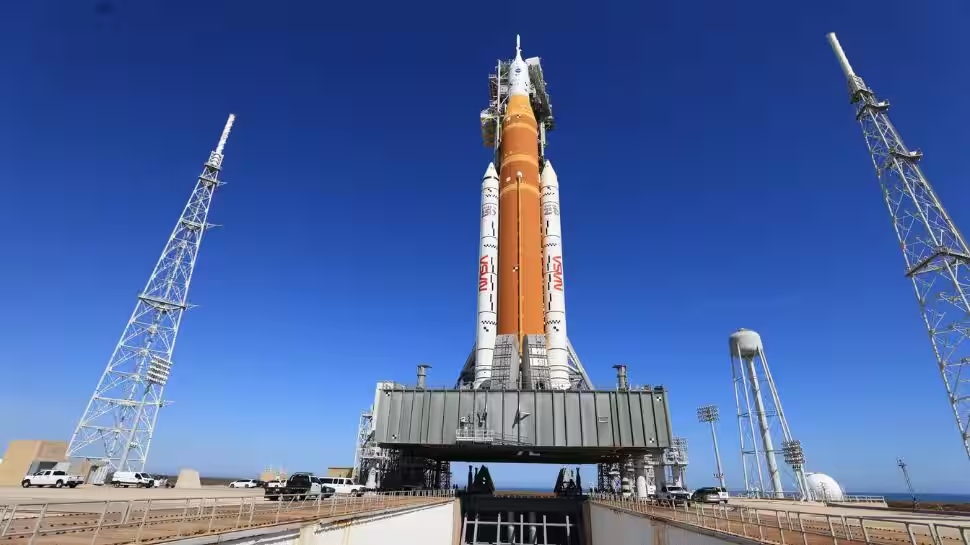
NASA’s Artemis II mission, set to send humans around the Moon, is likely to be delayed after the space agency discovered a helium flow problem in the upper part of its Space Launch System (SLS) rocket at Kennedy Space Center.
In a statement, the space agency said teams are removing launch pad platforms before strong winds hit tomorrow. This will help fix the issue quickly, but it will almost certainly push back the March launch of this crewed Moon flight.
NASA explained they noticed the helium flow stop overnight on February 21 in the rocket’s temporary fuel stage. Helium is needed to make the rocket work for launch. Teams are checking data and getting ready to move the Artemis II rocket and Orion spacecraft back to the Vehicle Assembly Building (VAB) if needed.
Add Zee News as a Preferred Source
“NASA is taking steps to potentially roll back the Artemis II rocket and Orion spacecraft to the Vehicle Assembly Building (VAB) at the agency’s Kennedy Space Center in Florida after overnight Feb. 21 observing interrupted flow of helium in the SLS (Space Launch System) rocket’s interim cryogenic propulsion stage. Helium flow is required for launch. Teams are actively reviewing data, and taking steps to enable rollback positions for NASA to address the issue as soon as possible while Engineers determine the best path forward,” the space agency said.
The space agency added, “In order to protect for troubleshooting options at both Pad B and the VAB, teams are making preparations to remove the pad access platforms installed yesterday, which have wind-driven constraints and cannot be removed during high winds, which are forecast for tomorrow. This will almost assuredly impact the March launch window. NASA will continue to provide updates.”
What is NASA’s Artemis II mission?
NASA’s Artemis II mission is designed to send four astronauts on a roughly 10-day journey around the Moon, serving as a critical systems test for future lunar landings and eventual human missions to Mars while supporting plans for a sustained lunar presence.
Mission Overview
Artemis II follows the successful uncrewed Artemis I flight in 2022 and marks the program’s first crewed mission. The astronauts will launch from Kennedy Space Center’s Pad 39B aboard the Space Launch System (SLS) rocket and Orion spacecraft. Rather than entering lunar orbit or landing, the crew will fly a free-return trajectory that loops around the Moon and brings them back to Earth. During the mission, they are expected to travel further from Earth than any humans since Apollo 17 in 1972. The flight will rigorously evaluate deep-space systems, including life support, navigation, communications, and Orion’s high-speed reentry capability at about 25,000 mph.

Comments are closed.