
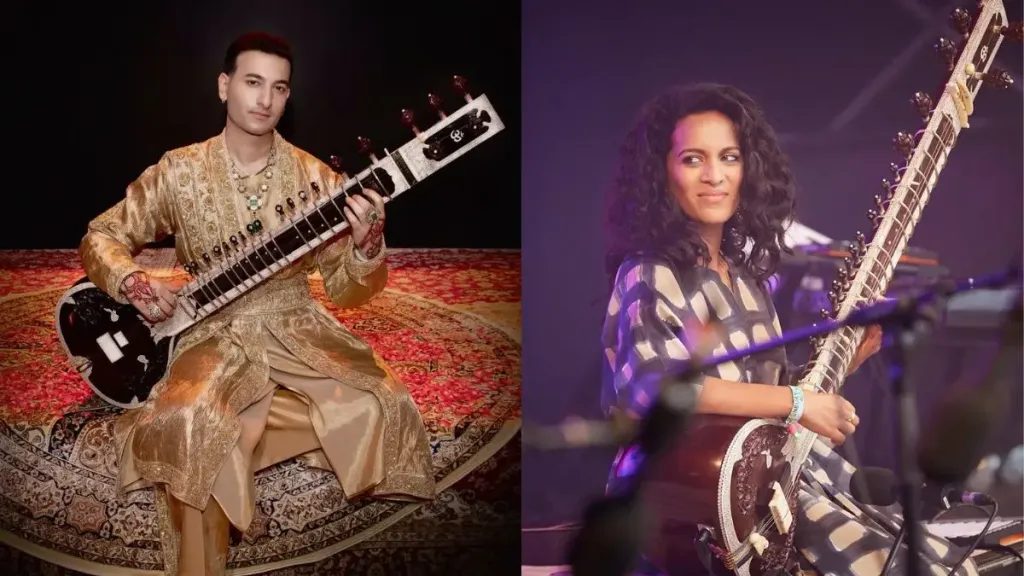
Sharp turn in Guru-disciple dispute, Rishabh Rikhiram Sharma’s direct reply to Anushka Shankar

Anoushka Shankar and Rishab Rikhiram: In the world of Indian classical music, the Guru-Shishya tradition is not only a medium of education, but it is considered the basis of cultural heritage. In such a situation, when a question arises about the guru tradition of an artist, it is natural to have a discussion. Recently, a public debate regarding the relationship between sitar player Rishab Rikhiram Sharma and world famous sitar player Pandit Ravi Shankar has caught the attention of music lovers. Pandit Ravi Shankar’s daughter and sitar player Anushka Shankar says that Rishabh is not a formal disciple of her father. After this, Rishabh Rikhiram Sharma has presented evidence related to this.
What does Rishabh Rikhiram Sharma have to say?
View this post on Instagram
Rishabh Rikhiram Sharma has made his mark on international platforms at an early age. He comes from a famous musical instrument manufacturing family. He is also known as the sitarist who gave a solo performance at the White House and presented music as a form of emotional healing. He has long described himself as the “youngest and last disciple” of Pandit Ravi Shankar.
What did Anushka Shankar say?
View this post on Instagram
Anushka Shankar, in a conversation with Humans of Bombay, said that Rishabh is extremely talented and connects with people beautifully, but there is some misunderstanding about his ‘guru’. He clarified that Rishabh had mainly taken lessons from Panditji’s senior disciple Pandit Parimal Sadaphal and had only learned something informally from his father. Anushka also said that having known her since childhood, it has escalated to calling her the “last” or “youngest” disciple, which is not right, although there is no question about her talent.
What did Rishabh Rikhiram Sharma say in response?
After this statement, Rishabh Rikhiram Sharma issued an official statement. In his statement, he told that during a private meeting on January 3, 2012, Pandit Ravi Shankar, after assessing his talent, asked him to present a raga and then formally accepted him as a disciple through the traditional ‘Ganda Bandhan’ rites.
Pandit Ravi Shankar accepted as disciple even on stage
According to Rishabh, it was not just a simple meeting, but also several hours of formal education. In this, Panditji not only improved the composition but also threw light on the spiritual depth of the Guru-disciple relationship. He also said that later Pandit Ravi Shankar once introduced him on the stage by calling him his youngest disciple, which he considers as proof of this relationship.
Further education under the guidance of Pandit Parimal Sadaphal
Rishabh Rikhiram Sharma’s statement also mentioned that after the demise of Pandit Ravi Shankar, his education continued under the guidance of Pandit Parimal Sadaphal. Rishabh also talked about taking training from other veteran artists, which include names like Ustad Amjad Ali Khan. At an early age, he went to New York to study music production and economics.
What is ‘Ganda Bandhan’ in Indian classical music?
This entire controversy is not just a clash of two statements, but it is also indicative of the tradition in which the word ‘Guru’ is synonymous not only with teacher but also with life guide. ‘Ganda Bandhan’ is considered a sacred rite of passage in Indian classical music, formally accepting the disciple into the tradition.

Comments are closed.