
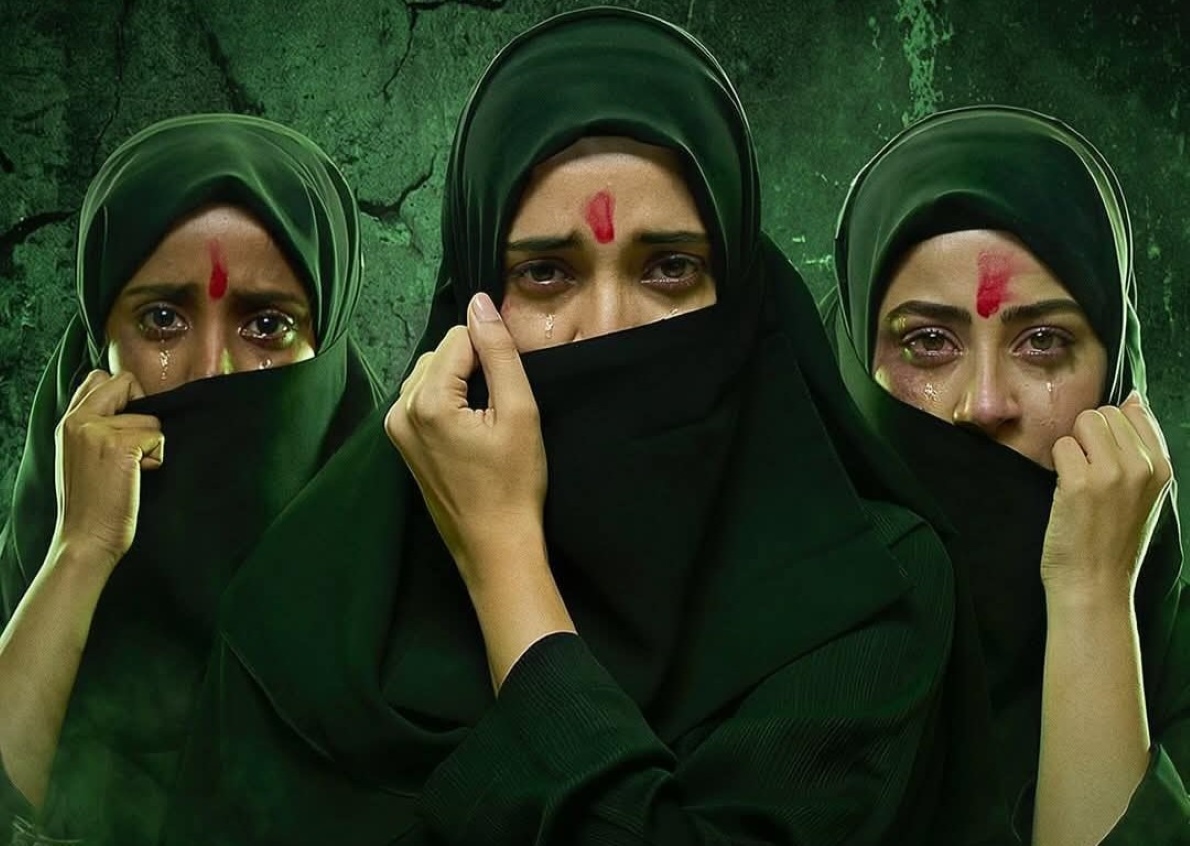

The premise of The Kerala Story (2023) was that 32,000 women from the state had been converted and recruited into terror network. The figure became the film’s marketing hook, and also its weakest factual basis. Directed by Sudipto Sen and fronted by Adah Sharma, the film tells the story of a nursing student allegedly groomed by Muslim classmates, converted and transported to an Islamic State of Iraq and Syria or ISIS-controlled region. It shows her ordeal as evidence of an organised, systematic operation targeting Hindu women through ‘love jihad.’
The problem, to be fair, is not that forced conversions or cases of radicalisation have never existed; there have been numerous cases on interfaith disputes and occasional extremist recruitment in Indian courts perhaps for decades, but the sweeping assertion of a 32,000-strong conspiracy is where the film reveals its divisive construction, a figure that fact-checkers have challenged and refuted. This central factual pillar of the film’s marketing remains conspicuously unsupported as The Kerala Story 2: Goes Beyond gets set for a theatrical release on February 27.
Before the first instalment’s release on May 5, 2023, the matter had reached the Supreme Court of India, which reined in its promotional hyperbole. The SC allowed the film to continue screening but directed the makers to include a disclaimer clarifying that the 32,000 figure was not backed by verified data. Since the makers could provide no evidence for this number, they eventually amended the film’s teaser to say it was the story of “three” girls.
The mathematics of misinformation
In propaganda, the ‘Big Lie’ technique, coined by Adolf Hitler in my fight, works by planting a shocking, high-stakes number in the public consciousness. Even if the number is later retracted in a courtroom, the intended damage — portraying an entire state and a specific community as part of a massive, secret conspiracy in an attempt to whip up hatred — is already done. Kerala Chief Minister Pinarayi Vijayan has remained firm in his criticism. He lashed out at the second instalment after its trailer was launched on February 17, describing the film as a collection of “fabricated narratives” designed to create communal discord and tarnish the state’s secular image, something that the Hindutva brigade resents.
Also read: Kennedy review: Rahul Bhat-led revenge thriller shows flashes of vintage Anurag Kashyap
Senior Congress MP Shashi Tharoor has added his voice to the chorus, accusing the film of “hate-mongering,” like its predecessor and argued that the sequel appears poised to repeat what he describes as a troubling formula. He has particularly questioned the filmmakers’ assertions about large-scale religious conversions, saying the numbers cited in promotional material lack credible sourcing and appear dramatically inflated.
The film is being seen as part of BJP’s aggressive push to break the long-standing hold of the Left (LDF) and Congress (UDF) in Kerala. After Suresh Gopi’s win from Thrissur during the 2024 General elections marked the party’s first-ever parliamentary win in the state with a record 19.2% vote share, the party took control of the Thiruvananthapuram Municipal Corporation in December 2025, winning 50 out of 100 seats to run the state capital. To win over Kerala’s joyously diverse population, the BJP has specifically wooed the Christian community by addressing their concerns over agriculture and ‘love jihad,’ while promoting leaders like George Kurian to key roles in Modi cabinet.
The vocabulary of populist mobilisation
The Kerala Story 2 has its share of legal hurdles. A petition filed in the Kerala High Court by a resident of Kannur seeks to revoke the film’s certification, contending that its trailer paints Kerala as a hotspot for terrorism and coercive conversions, thereby stigmatising an entire state and its people. Taking cognizance of the plea, the court has issued notices to the Ministry of Information and Broadcasting, the Central Board of Film Certification, and producer Vipul Amrutlal Shah, listing the matter for hearing on February 24. The makers, led by director Kamakhya Narayan Singh, insist the project draws from documented legal cases. But it appears far from the truth.
Indeed, it’s the franchise’s relationship with the truth where the most damning evidence of its propagandist intent lies. A hallmark of propaganda is the ‘dehumanisation of the adversary.’ In both the first film and the promotional material for The Kerala Story 2there is a total absence of nuance. Muslim characters are almost exclusively depicted as predators, manipulators, or cold-blooded extremists. And it denies Hindu women of their agency by suggesting that they are inherently ‘gullible’ and in need of paternalistic protection from a ‘predatory’ minority. The sequel has the tagline: “Ab sahenge nahi… loadenge (We won’t tolerate… we will fight),” which uses the classic language of populist mobilisation.
Also read: Assi review: Anubhav Sinha’s thunderclap against rape culture, apathy of legal system
Also, by expanding the setting from Kerala to Rajasthan and Madhya Pradesh, the franchise seeks to nationalise the issue. If you can bear to watch The Kerala Storyyou will know that the film utilises ‘atrocity porn’ — highly graphic, emotionally manipulative scenes of forced conversion and physical desecration (such as the forced eating of beef) — to bypass the viewer’s rational mind and trigger a visceral, “fight-or-flight” response.
One can argue that when cinema prioritizes the provocation of anger over the exploration of truth, it ceases to be art and becomes some kind of psychological operation or, in plain terms, a work of propaganda. The Kerala Story 2, starring Aditi Bhatia, Ulka Gupta, and Aishwarya Ojha as a minor, an aspiring athlete, and a UPSC student, respectively, who face deception and violence after entering interfaith relationships, is likely to be far worse.
Political patronage and the echo chamber
True art usually challenges the status quo, but The Kerala Story was promoted by the highest echelons of political power. When Prime Minister Narendra Modi and various Chief Ministers endorse a film, and states make it “tax-free,” the line between independent filmmaking and state-sponsored messaging disappears. This state backing provides a shade of “official truth” to a fictionalised narrative. As we have seen, it also creates an environment where questioning the film’s accuracy is equated with being ‘anti-national’ or ‘pro-terrorist.”
Also read: Mahesh Narayanan on Patriot and how a filmmaker understands politics as human struggle
This effectively silences critics and creates a feedback loop where the film’s commercial success is used as proof of its ‘truthfulness,’ regardless of its factual bankruptcy. Since the release of the first film, there have been numerous reports of tensions in colleges. By legitimising a “conspiracy theory” through the high-production value of a feature film, the franchise provides a “fact-base” for online trolls and vigilantes.
In a democracy, the responsibility of a storyteller is to build bridges or, at the very least, to show the society in all its messy complexities and contradictions. The Kerala Story franchise does the opposite. In Politics and the English LanguageGeorge Orwell warned that political language is designed “to make lies sound truthful and murder respectable.” That warning can be used as a diagnostic tool here. The philosopher Hannah Arendt wrote in The Origins of Totalitarianism that the ideal subject of propaganda is not the convinced ideologue but the person for whom the distinction between fact and fiction has dissolved.
When a film peddles an unverified statistic as its central thesis, retracting it later is irrelevant. In that sense, the franchise’s greatest achievement is not the performance at the box-office, where the windfall is certain (made on a modest budget of Rs 20-30 crore, The Kerala Story grossed over Rs 300 crore worldwide), but epistemic corrosion, a subtle wearing down of the public’s ability to separate the wheat of truth from the chaff of falsehood.
As Umberto Eco argued in his essay on “Ur-Fascism,” one of the enduring features of authoritarian temptation is the cultivation of a permanent state of emergency, a sense that “we won’t tolerate, we will fight.” In India today that language is designed to pitch one community against another.
Art, at its most rigorous, complicates tribal or atavistic instincts. When cinema instead narrows the frame until entire communities appear as caricatured threats, it stops being art in any serious sense and becomes an instrument. Propaganda may not convince everyone, but it succeeds because it exhausts the rest. In that fatigue, fiction begins to resemble fact.

Comments are closed.