
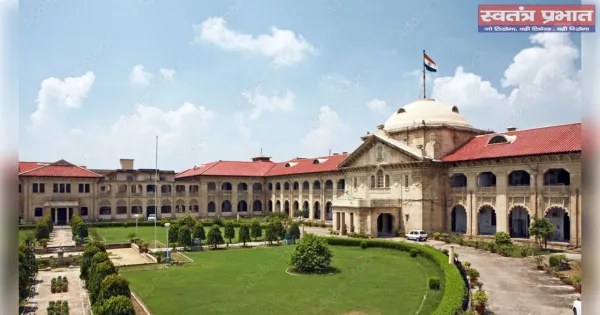

Bureau Prayagraj- The Allahabad High Court (Lucknow Bench) recently held that the State is solely responsible for the unnatural death of a prisoner in its custody, even if the death is clearly unnatural suicide.
A division bench of Justices Shekhar B Saraf and Manjeev Shukla ruled that the right to life and human dignity guaranteed under Article 21 of the Constitution of India is an intrinsic, inviolable and universal right, which extends even to a person who has been unlawfully arrested or detained by the State.
The division bench allowed the writ petition of Prema Devi, in which she had sought compensation for the unnatural death of her minor son in Pilibhit district jail. While directing the respondents to pay a compensation of Rs 10 lakh to the legal heirs of the deceased within three weeks, the bench also asked the UP government to formulate guidelines to decide the compensation.
The petitioner’s son was undertrial in a POCSO case. He committed suicide on February 20, 2024. He was found hanging from the ventilator of the jail toilet. The National Human Rights Commission (NHRC) had earlier recommended a compensation of ₹3,00,000/-. However, this payment was not made due to no action by the authorities. Therefore the petitioner approached the High Court.
It was clearly claimed that the deceased was tortured by the police personnel as the illegal demand of money for relief from such torture was not met, which ultimately led to his unnatural death.
On the other hand, the State argued that the deceased committed suicide by hanging himself. It was held that the incident was suicide and there was no material on record to show that there was any negligence, wrongdoing or involvement on the part of the respondent authorities. It was also said that once the identification process is completed and necessary budget is received from the government, the sanctioned compensation will be released as per law.
However, the division bench rejected the state’s attempt to evade responsibility as it said custodial death is one of the most serious challenges to the protection of fundamental rights in the Indian justice system.
Justice Saraf, writing for the bench, said it was ‘shocking’ that there is no clear mandate in our Indian Constitution to provide compensation for unlawful detention or custodial death. The court further said that if the death in custody occurs naturally then the state cannot be blamed for it. However, if the death is unnatural then the State is fully responsible for its act/omission which led to the death of a person.
The Allahabad High Court also relied on the landmark judgment of the Supreme Court in Rudul Shah v. State of Bihar, which held that refusing to order compensation for deprivation of fundamental rights would amount to a mere lip service to the right to freedom.
The Court in Nilabati Behera vs. State of Orissa and D.K. Also took into account the decisions of the Supreme Court in Basu v. State of West Bengal, which held that money compensation is a fair and effective remedy based on the principle of strict liability for which the defense of sovereign immunity does not exist.
Specifically, while determining the amount of compensation, the court examined a judgment of the Meghalaya High Court (Suo Moto Custodial Violence), which divided compensation into categories based on the age of the victim. However, the Division Bench refused to accept it as authoritative precedent noting that that decision had been stayed by the Supreme Court in State of Meghalaya v. Killing Jana.
But the State is solely responsible for the unnatural death of the deceased. The bench said, “…the State’s responsibility increases for the death of a prisoner in police custody. No State can escape its responsibilities of providing better facilities to the prisoners. Therefore, a case of custodial death is made out in this case.” In view of this, the court concluded that this was a clear violation of constitutional protection, which required intervention under Article 226 of the Constitution. Therefore, the court allowed the writ petition and directed the state to pay ₹10,00,000 as compensation to the legal heirs within three weeks.

Comments are closed.