
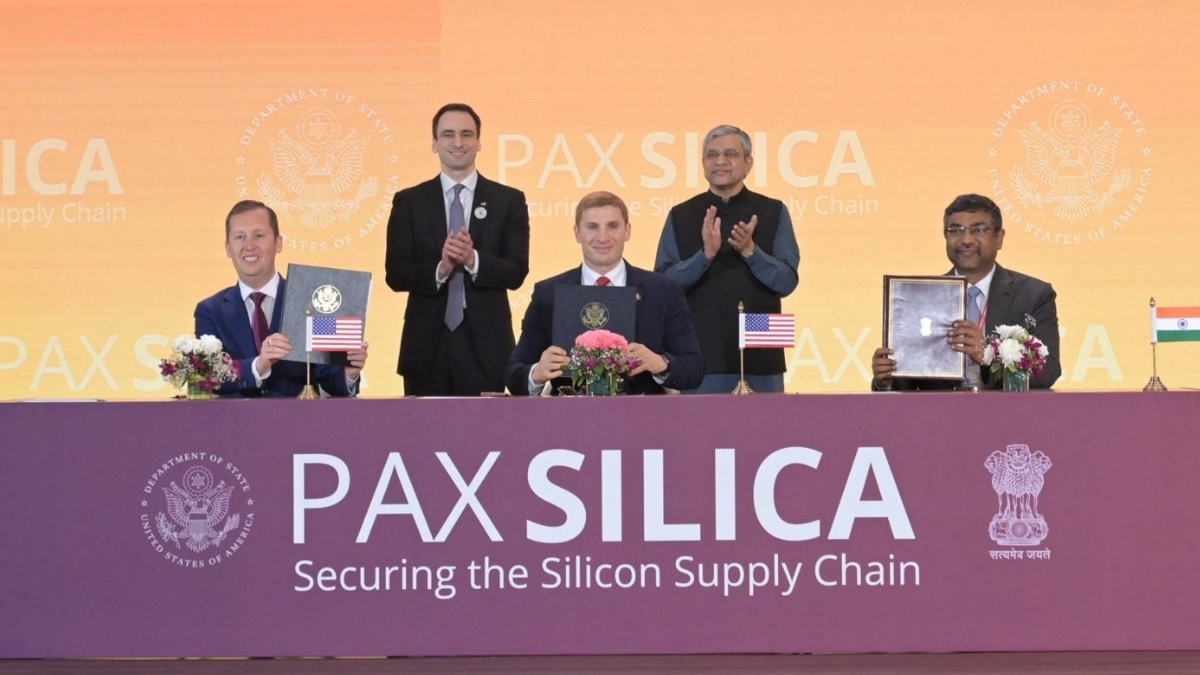

Pax Silica is the US-led initiative to strengthen AI and supply chain security among allies
The coalition aims to create a secure, resilient, and innovation-driven supply chain spanning critical minerals and AI technologies
According to IT minister Ashwini Vaishnaw, the pact will boost India-US cooperation on critical tech and supply chains
Weeks after the US initiated the process to extend an invite to India to join Pax SilicaIndia officially has officially joined the AI and supply chain security alliance. The Ministry of External Affairs announced India entered the Pax Silica initiative by becoming a signatory to the Pax Silica Declaration on the sidelines of the AI Impact Summit in New Delhi today.
Besides, India also signed a Joint Statement on the “India-US AI Opportunity Partnership” as a bilateral addendum to the Declaration.
In his keynote remarks, IT minister Vaishnaw highlighted the strong potential for India and the US to collaborate on supply chain security. He also emphasised that cooperation under Pax Silica would further deepen engagement on critical technologies and supply chain resilience under the India-US Comprehensive Global Strategic Partnership.
“Through the Joint Statement on the AI Opportunity Partnership, India and the United States aim to promote pro-innovation regulatory approaches, strengthen the physical AI stack, and advance free enterprise. The partnership envisions empowering AI developers, startups, and ecosystem enablers; exploring joint research and development; facilitating industry partnerships and investments in next-generation data centres; enhancing cooperation on access to compute and advanced processors; and accelerating innovation in AI models and applications,” the MEA noted.
What Is Pax Silica?
Pax Silica is a multilateral initiative launched by the US in December 2025 to secure supply chains for silicon, semiconductors, AI and related components critical to AI infrastructure. The initiative is focussed on producing high-purity silica, a foundational raw material required for semiconductor manufacturing. It is pertinent to note that AI chips require ultra-clean silicon wafers derived from high-grade silica to ensure performance at smaller nanometre nodes.
Besides, it also aims to reduce “coercive” dependencies, protect materials and capabilities fundamental to AI, and ensure aligned nations can develop and deploy transformative technologies at scale, as per the US state department.
Launched in December last year, the initiative formally took shape at the Pax Silica Summit in Washington on December 12, where participating countries signed the founding declaration.
Australia, Greece, Israel, Japan, Qatar, the Republic of Korea, Singapore, the United Arab Emirates, and the United Kingdom are among the 11 members that are currently part of Pax Silica. The European Union participates in the group as a non-signatory member.
India’s entry to the Pax Silica Summit came amid the ongoing India AI Impact Summit, where the country’s India’s AI prowess has been on full display over the past few days. The Summit, the first global AI gathering to be hosted in the Global South, has witnessed participation from over 20 heads of State, 60 ministers and 500 global AI leaders.
The country’s AI ecosystem is beginning to take a concrete shape. As per Google and Inc42’s Bharat AI Startups Report, 2026the Indian AI market is expected to become a $126 Bn opportunity by 2030, with a potential GDP impact of $1.7 Tn by 2035.

Comments are closed.