

Positioned as a premium import, frozen Musang King durian from Malaysia typically sells for about US$64 per kilogram on online platforms. Social media responses indicate that the fruit is regarded as exotic and novelty products in the market, especially when used in dessert-style products.
“Some consumers have highlighted the fruit’s distinctive texture and flavour, pointing to a small but enthusiastic following,” Mohamad Termizi Piee, Malaysia’s trade commissioner in Seoul, told The Star.
Due to limited supply, items like frozen Musang King are typically sold through online marketplaces like Coupang rather than major supermarket chains, Mohamad Termizi noted.
He said sales volumes are still relatively low, indicating trial purchases and niche demand rather than widespread consumption.
Malaysian External Trade Development Corporation’s engagement with South Korean importers has also shown rising interest in high-end ASEAN food products, such as frozen durian and processed durian offerings, he added.
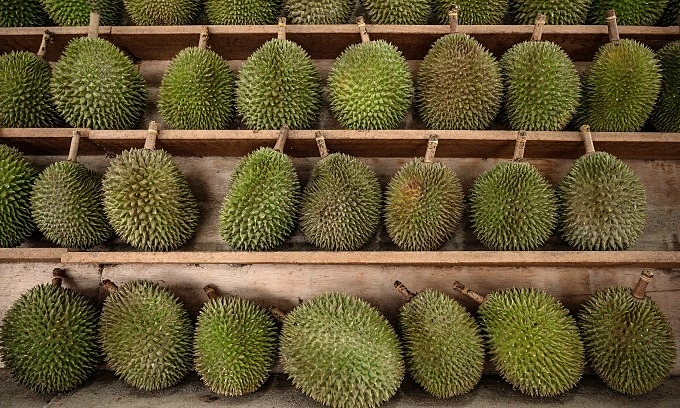
This picture taken on July 8, 2020 shows durians displayed for sale in Kuala Lumpur. Photo by AFP |
Malaysia currently exports durians to over 40 markets, including Canada, Japan, the UAE and Saudi Arabia. It received the green light to export fresh durian to South Korea in September 2010 and was later permitted to ship frozen durians.
Shipments to that market have been growing in recent years, making it an increasingly important growth market, according to Datuk Nor Sam Alwi, director-general of the Department of Agriculture.
They amounted to 0.13 tonnes worth RM18,096 (US$4,650) in 2022 before rising to 0.24 tonnes worth RM37,977 in 2023 and 8.31 tonnes worth RM889,821 in 2024.
“In 2024, South Korea was ranked 16th among Malaysia’s durian export destinations out of a total of 27 countries,” Nor Sam said.
Overall, Malaysia’s durian exports have shown steady growth over the years, with China being the top market, according to Named.
The country secured approval to send fresh durians to China in 2024, having previously exported mainly frozen pulp and paste.
Rising exports have been accompanied by expanding production, with plantation areas increasing from just over 163,000 acres in 2016 to more than 227,000 acres by 2024. Output almost doubled to over 568,000 tonnes during the same period.
But a recent change in consumer preferences in the world’s largest market for durian has led to an oversupply in Malaysia, a situation local farmers have described as a “durian tsunami,” The New York Times reported.
Local media reported last December that the surplus had driven prices of the famed Musang King variety down to about RM10 per kilogram, or even lower in some areas, compared with RM60–80 per kilogram during the main harvest season from May to August.
Other popular and premium varieties, including Black Thorn, IOI, D24 and Red Prawn, were also sold for as little as RM10–15 per kilogram, according to the New Straits Times.
Malaysia’s agriculture minister, Mohamad Sabu, has described the glut as temporary and said the upcoming peak season would offer a better gauge of market conditions.
“I still believe that durians will be the economic boom for Malaysia,” he noted in an interview.

Comments are closed.