
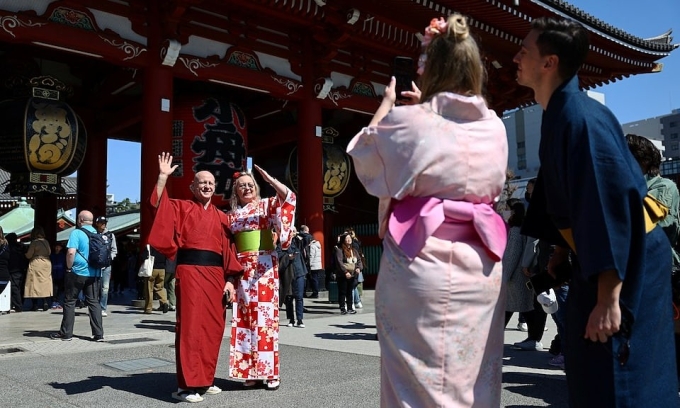

Foreign tourists wearing Japanese traditional kimono clothes pose for a photograph near Sensoji temple at Asakusa district, a popular sightseeing spot in Tokyo, Japan in 2025. Photo by Reuters
Japan has barred tourists from taking the Japanese-Language Proficiency Test (JLPT) starting this year, as authorities introduce residency requirements aimed at improving administration and preventing application irregularities nationwide.
Under the revised policy, applicants wishing to sit the exam in Japan will generally need mid- to long-term residency status or special permanent residency. They will also be required to provide a valid residence card number and its expiration date during registration, according to Japan Times.
The JLPT is the world’s largest examination for assessing Japanese language ability. Administered by Japan Educational Exchanges and Services and The Japan Foundation, the test has certified the listening and reading proficiency of non-native speakers since its launch in 1984. In 2024, around 1.47 million candidates sat the exam, marking the highest participation level in its history.
Previously, the test was open to all non-native speakers, including short-term visitors traveling on tourist visas. However, exam organizers said the rule change was prompted by repeated administrative difficulties, such as overseas applicants using Japanese addresses without permission or providing invalid phone numbers, which complicated the delivery of test vouchers and official score reports.
Despite the restriction within Japan, the JLPT will continue to be offered at numerous overseas testing centers. Certain exceptions will remain for specific groups, including individuals with diplomatic status or those covered by special residency arrangements, as reported by Tokyo Weekender.
While the policy effectively excludes individuals on 90-day tourist visas, several groups are exempt from the residency card requirement. These include naturalized Japanese citizens who are non-native speakers, holders of diplomatic or official visas, and personnel stationed in Japan under agreements involving United States or United Nations forces.

Comments are closed.