
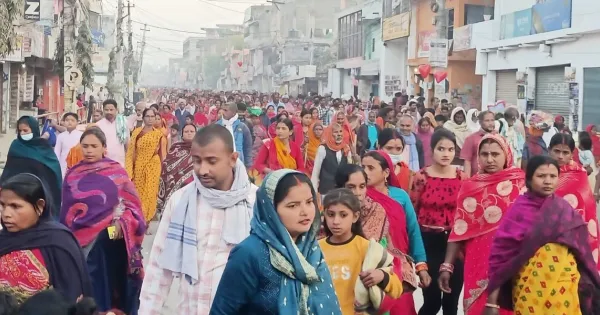
Eight days of Mithila Madhya Parikrama completed in Nepal, departure of Dhanusha on the ninth day

Kathmandu. The pilgrims of Mithila Madhyaparikrama have completed the journey of Mahottari district. After taking night rest in Kanchanavan in the district on Monday, the eighth day, the pilgrims left for Dhanusha on Tuesday, the ninth day. Kanchanavan is especially famous for Holi Festival in this journey.
Kanchanavan is the eighth night halt of this parikrama and the fifth stop in Mahottari district. Before this, the pilgrims entering Mahottari on the fourth day took night rest at Matihani, Jaleshwar, Madai and Dhruvkund.
In this 15-day parikrama, which is organized in a total circle of 133 kilometers with Janakpurdham as the centre, there is a tradition of six nights rest in Dhanusha district and four nights in Madhubani district of India.
Starting from the Mithila Vihari temple located at Therakchuri in the Mithila Vihari municipality of Dhanusha district on the day of Phagun Amavasya, this yatra is carried out barefoot, carrying the idols of Mithila Vihari (Shri Ram) and Kishoriji (Sitaji) in a dola (doli).
Today the travelers leaving for Dhanusha from Kanchanavan will rest for the night in the mountains. After this, Dhanushadham on 10th day, Satokhardham on 11th day, Aurhi on 12th day and night rest on the last 15th day will be at Rangshala ground of Janakpurdham. Earlier on the first day, the travelers had taken night rest at Hanumangarhi in Dhanusha.
During this journey, the night halt places of 2nd, 3rd, 13th and 14th day are Kalyaneshwar (Kalna), Girijasthan (Phulhar), Karuna and Bisaul in Madhubani district of India respectively. In this parikrama, a distance of 107 kilometers is covered in Mahottari and Dhanusha towards Nepal and 26 kilometers towards India.
According to Mahant Dr. Ravindradas Vaishnav, the successor of Lakshminarayan Math located in Matihani, after the marriage of Maryada Purushottam Shri Ram and Devi Sita in Tretayug, they went on a forest tour to various places in the then Mithila state. The tradition of this parikrama was established with the faith of following his footsteps. According to him, this journey is done with the desire for human welfare and salvation.

Comments are closed.