


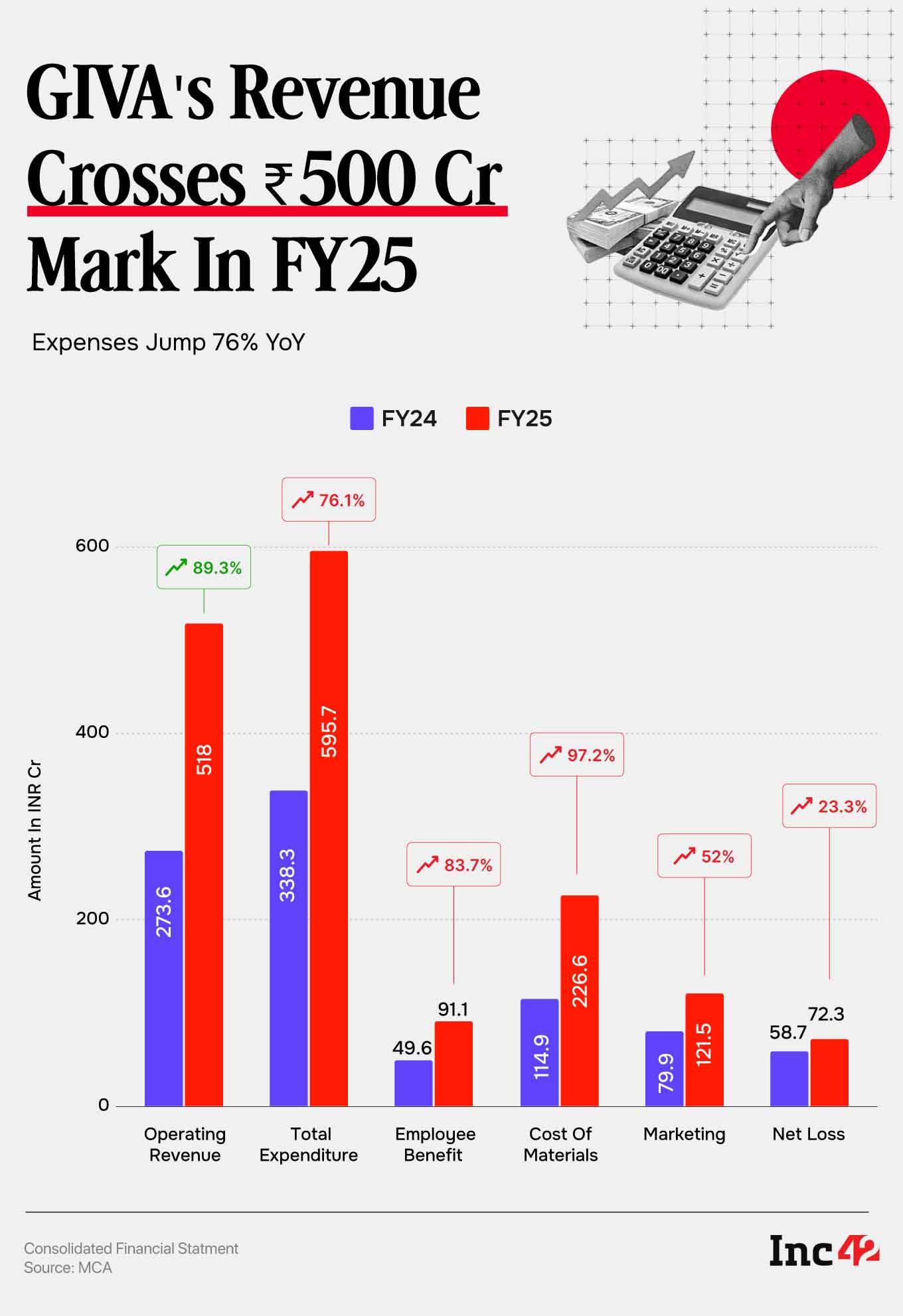
GIVA saw its operating revenue jump to ₹518 Cr in the financial year ended March 2025 from ₹273 Cr reported in the year-ago period
The startup’s biggest expense during the quarter was the cost of materials, which shot up over 97% YoY to ₹226 Cr
The D2C jewellery brand, which is currently in talks to raise ₹150-₹200 Cr, is said to be on track to post a revenue of ₹800-₹850 Cr in FY26
D2C jewellery brand GIVA’s consolidated net loss widened 23% to ₹72.3 Cr in the financial year ended March 2025 (FY25) from ₹58.7 Cr in the previous fiscal year.
Its operating revenue surged over 89% to ₹518 Cr during the year under review from ₹273.6 Cr in FY24.
Including other income of ₹5.3 Cr, mainly from bank interest and sale of investments, GIVA’s total income in FY25 stood at ₹523.3 Cr as against ₹279.6 Cr in the previous fiscal year.
Alongside revenue growth, GIVA’s total expenditure rose in FY25, though at a slower pace. Expenses stood at ₹595 Cr during the year, up 76% from ₹338 Cr in FY24. Here’s a breakdown of its expenses:
Cost Of Materials: The startup’s biggest expense during the quarter was the cost of materials, which shot up over 97% YoY to ₹226 Cr.
Employee Expenses: GIVA’s spending on employee benefit expenses zoomed 84% to ₹91.1 Cr in FY25 from ₹49.6 Cr in the previous fiscal year. The sharp increase indicates that the D2C brand increased its headcount during the year under review.
Marketing Expenses: Like most D2C brands, GIVE spends a significant amount on advertising and marketing. In FY25, its spending under the head grew 52% YoY ₹121.5 Cr.
Rent: With an increase in its offline store count, GIVA’s expenditure on building, furniture and fixture rent more than doubled during the year under review. It spent over ₹47 Cr on operating leases in FY25, up 134% from ₹20 Cr in the previous fiscal.
Decoding GIVA’s Business Model
Founded in 2019 by Ishendra Agarwal, Nikita Prasad and Sachin Shetty, GIVA initially sold authentic 925 fine silver jewellery that was modernised for a younger palette that wanted more affordable jewellery options. It later diversified into 14K and 18K gold and lab-grown diamond jewellery, and has been looking to break into other product categories, including men’s jewellery.
Besides its own website, the brand retails its products through physical stores it operates across the country and a shop-in-shop model with Shoppers Stop and other chains. Currently, it operates over 240 stores spanning 48 Tier I & II cities across the country.
GIVA last raised ₹530 Cr in June last year in a funding round led by Creaegis, along with participation from existing investors such as Premji Invest, Epiq Capital and Edelweiss Discovery Fund. It is reportedly planning to hit public markets in the next 2-3 years.
Last month, Economic Times reported that the D2C brand was in talks to raise ₹150-₹200 Cr in a round led by existing investors Premji Invest and Creaegis, with participation from Titan Capital and Kenro Capital. The round will be a mix of primary and secondary transactions.
The report said that the jewellery brand is on track to clock a revenue of ₹800-₹850 Cr in the ongoing fiscal year, up about 55-65% from FY25.
Overall, GIVA has raised a total funding of over $160 Mn to date from investors like Arkam Ventures, Prosus, Riverwalk Holdings, and more.
The Bengaluru-based startup is currently doubling down on offline expansion and plans to increase its store count to 1,000 by 2028 through an aggressive expansion plan. In FY25, GIVA also tried its hand at quick commerce through ‘GIVA Go’, which promises two-hour deliveries from retail stores in select pincodes.
As part of diversification, GIVA is eyeing lab-grown diamonds, which have already eaten up significant market share from natural diamond jewellery in geographies like the US. In India, this number still stands at 10%. However, the segment raked in ₹100 Cr, or 20% of GIVA’s overall revenue, in FY25.
GIVA’s biggest competitors in the jewellery space include D2C brands BlueStone and CaratLane. BlueStone went public in August last year and managed to turn profitable in the third quarter of the current fiscal (FY26) with a net profit of almost ₹70 Cr. Recently, it also backed lab-grown diamond brand Ethera with ₹25 Cr, signaling an interest in the bubbling segment.
CaratLane, on the other hand, was fully acquired by Tata Group’s Titan in 2023 after it picked up a 27% stake in the company for ₹4,621 Cr following phased buyouts in previous years. Its revenue grew 42% in Q3 FY26 to ₹1,537 Cr.

Comments are closed.