
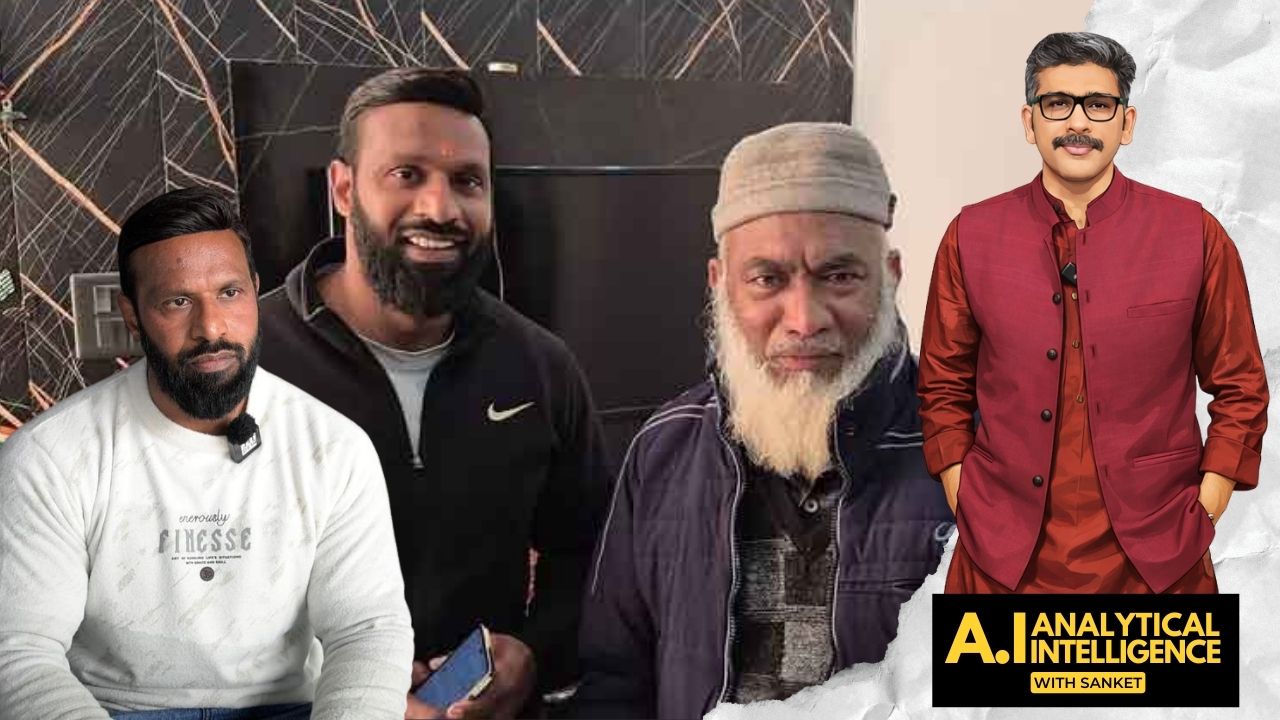

“Deepak is not an exception. He is a true Indian.” That was the central assertion during a sharp and layered discussion on whether the act of Deepak Kumar — now widely known as Mohammed Deepak — should be celebrated as rare courage or recognised as the norm in Indian society.
On AI With Sanket, The Federal spoke to senior journalists Irfan Habib and Shahid Siddiqui about the brave act of Deepak Kumar, who intervened when an elderly Muslim shopkeeper was confronted by a mob in Uttarakhand’s Kotdwar on January 26. The debate quickly moved beyond one man’s act to larger questions about secularism, politics, and the state of Indian society.
The Kotdwar incident
The discussion began with the context. On Republic Day, a mob allegedly linked to the Bajrang Dal objected to 70-year-old Vakeel Ahmed naming his store “Baba Uniform Shop.” They reportedly told him that “Baba” was a Hindu word and should not be used by a Muslim.
Ahmed, who has Parkinson’s disease, tried to explain that the shop had carried the same name for two decades. As tensions escalated, Deepak Kumar, who runs Hulk Gym in Kotdwar, stepped in. When asked who he was to intervene, he responded: “My name is Mohammed Deepak.”
Also read: In rare harmony, Belagavi Muslim couple raises Hindu orphans, holds Lingayat wedding
Since then, his act has drawn both admiration and backlash. His gym membership reportedly fell from 150 to 15. FIRs were filed against him, and he received threats.
True Indian act
Irfan argued that what Deepak did was “a truly Indian act.” He said India’s cultural legacy is rooted in syncretism and composite nationalism. “We grew up in that India where people stood up for each other,” he said, adding that Deepak represented “love, empathy, togetherness.”
He called it unfortunate that such actions are now treated as extraordinary. “For those who have seen a different India in the last 12 or 15 years, Deepak is an exception. For us, he is not.”
Also read: Why in Tamil Nadu, Pongal celebrations unite Hindus and Muslims in common ‘thanksgiving’
Siddiqui echoed the sentiment, stating that in decades of reporting from riot-affected areas — from Bhagalpur to Mumbai — he had witnessed countless ordinary citizens protecting neighbours of other faiths. “For every one person killed, I have seen 10 people coming out to save others,” he said.
Politics and optics
The debate sharpened when the host raised Deepak’s meeting with Rahul Gandhi. Would aligning, or even being seen with a political leader dilute his message?
Irfan dismissed the concern. In a democracy, he said, political leaders have reach and influence. “If somebody else invites him who shares his vision, he should go and meet him,” he added, even naming Narendra Modi as someone Deepak said he would meet if invited.
Also read: Namaz-Hanuman Chalisa row intensifies at Lucknow University, 13 get notices
Siddiqui, however, disagreed. While he called it “a good message for Rahul Gandhi,” he warned that it may not be ideal for Deepak. “In today’s polarised world, when you stand up with a politician, the message goes that you are aligning with their ideology,” he said. That, he argued, risks diluting a message that had cut across political lines.
He suggested that meeting spiritual leaders, intellectuals, or civil society figures might have reinforced the non-political character of Deepak’s act.
Beyond politicians
The conversation then moved to whether peace initiatives should be political at all. Siddiqui argued for a broad-based, non-political movement against hatred. “We need a movement against hatred,” he said, adding that such movements often emerge organically from society.
He proposed that journalists, writers, artists, women’s groups, and intellectuals form collectives to counter polarisation. Political parties, he suggested, often instrumentalise secularism for votes rather than embrace it as an ideology.
Irfan pushed back on romanticising non-political figures, arguing that civil society must act but the state also has a responsibility. He noted that a “small section” feels empowered today, and that administrative attitudes often change with governments. “Once that assurance disappears, 80 per cent of these people will vanish,” he said, referring to those who spread hate.
Violence in mind
A key theme that emerged was the idea of “violence in the mind.” Irfan said that while riots in the past were physically brutal, they were often followed by normalcy. Today, he argued, hostility has moved inward.
“There is a violence in the mind,” he said. He expressed concern over historical grievances being weaponised to fuel present-day divisions. “You can’t take revenge of history in the present,” he added.
He criticised the selective use of the past to justify current animosities. “You have to salvage something from the past which is salvageable. Not everything.”
Also read: Kerala Story 2 plea: ‘Kerala lives in total harmony’, says HC; orders removal of teaser
Siddiqui agreed that hatred has long existed but is now more visible. “Today it’s open. It’s coming out of hiding,” he said. In some ways, he added, that visibility makes it easier to confront.
Role of society
Both panellists ultimately converged on one point: the burden lies with society.
Siddiqui said political actors will “politicise and use situations in their favour,” and that meaningful change must come from within communities. He recalled personal experiences of discrimination in school and state inaction during the 1993 Mumbai riots to underscore that no political party holds a monopoly on virtue.
Irfan stressed the importance of mutual respect rather than mere tolerance. “Tolerance is a very negative word for me,” he said. “You need to respect each other.”
Also read: Slammed for ‘social harmony’ reel, Pune influencer deletes video, apologies
He reiterated that the spirit of living together harmoniously was embedded in the Constitution and Constituent Assembly debates, even if the word “secular” was formally inserted later.
Exception or norm?
As the conversation drew to a close, the question remained: is Mohammed Deepak an exception or a reflection of the real India?
For Irfan, he is a reminder of what India has always been. For Siddiqui, he is one among many — now amplified by social media and circumstance.
Also read: 4 booked for offering namaz at Mathura temple to spread ‘harmony’
What both agreed on is that such acts must not remain isolated symbols. Whether through grassroots mobilisation, civil society action, or everyday courage, they argued that society must reclaim the space from those who profit from division.
Deepak Kumar may have become a symbol. But the debate suggests the real test lies in whether thousands more are willing to step forward — without waiting to be named.
The content above has been transcribed from video using a fine-tuned AI model. To ensure accuracy, quality, and editorial integrity, we employ a Human-In-The-Loop (HITL) process. While AI assists in creating the initial draft, our experienced editorial team carefully reviews, edits, and refines the content before publication. At The Federal, we combine the efficiency of AI with the expertise of human editors to deliver reliable and insightful journalism.

Comments are closed.