
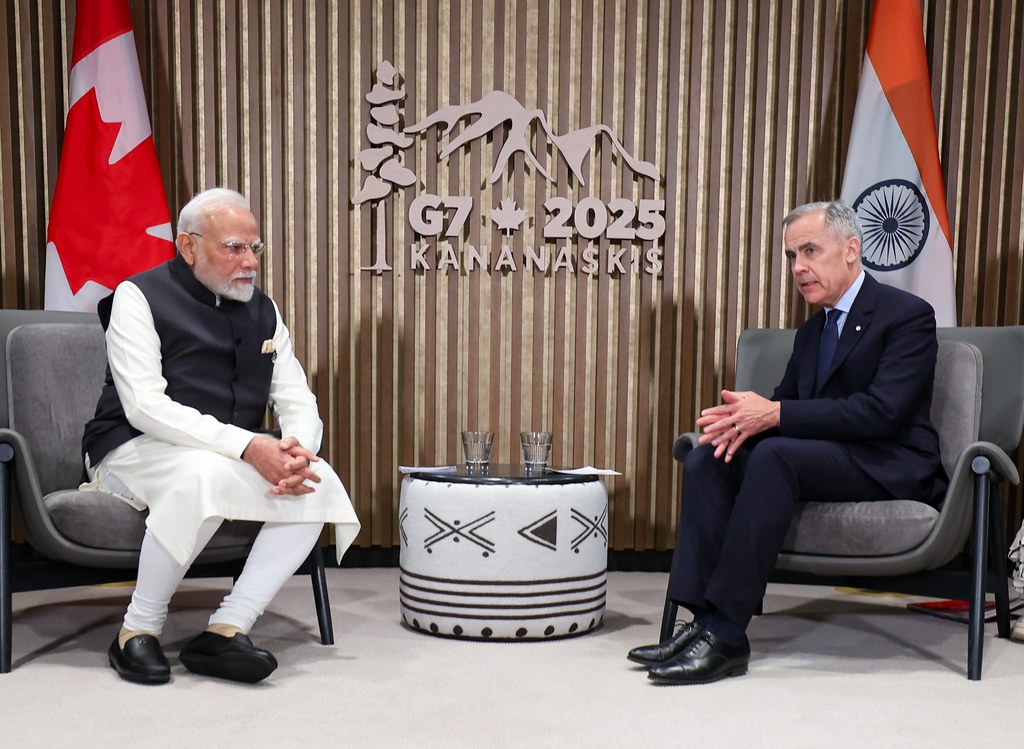

Prime Minister Mark Carney will begin a high-stakes visit to India on February 26, 2026, marking the first official prime ministerial trip to the country since relations sharply deteriorated under former prime minister Justin Trudeau. The nine-day Indo-Pacific tour, which also includes Australia and Japan, is widely viewed as a pragmatic reset between Ottawa and New Delhi after years of diplomatic strain.
The trip unfolds at a pivotal geopolitical moment. Canada is seeking to diversify trade relationships amid global uncertainty and evolving US tariff pressures under President Donald Trump. At the same time, India continues to expand its global economic footprint and strategic influence across the Indo-Pacific. Against that backdrop, Carney’s visit aims to recalibrate ties toward economic cooperation while managing lingering security concerns.
From Diplomatic Fallout to Pragmatic Reset
Canada–India relations reached historic lows in 2023 and 2024 following allegations by the Trudeau government regarding Indian involvement in the killing of pro-Khalistan activist Hardeep Singh Nijjar in British Columbia. The diplomatic fallout included mutual expulsions of diplomats and a freeze in trade negotiations.
Since taking office, Carney has signaled a shift in tone, emphasizing economic stability and strategic diversification over public confrontation. Officials describe the visit as focused on shared interests such as trade growth, energy security, technology partnerships, and Indo-Pacific stability.

Carney is scheduled to meet Indian Prime Minister Narendra Modi in New Delhi on March 2 for high-level bilateral discussions. The India leg will begin in Mumbai on February 26 with meetings involving major business leaders and investors.
Trade Talks and Economic Targets
A central objective of the visit is to fast-track negotiations on the Comprehensive Economic Partnership Agreement, known as CEPA. Bilateral trade between Canada and India stood at approximately $30.8 billion in 2024. Both governments have expressed ambitions to more than double that figure to $70 billion by 2030.
Canada views India as a key growth market in sectors such as agriculture, natural resources, clean technology, financial services, and advanced manufacturing. India, in turn, sees Canada as a reliable partner for energy, food security, and critical mineral supply chains.
Strengthening trade ties also aligns with Ottawa’s broader strategy to reduce economic dependence on the United States and expand partnerships across Asia.
Energy, Uranium, and Strategic Cooperation
Energy is expected to anchor much of the bilateral discussion. India has outlined plans to expand its nuclear power capacity to 100 gigawatts by 2047 as part of its long-term energy transition strategy. Canadian officials are exploring opportunities to supply crude oil, liquefied natural gas, and potentially uranium for India’s nuclear sector.
Beyond energy, talks are anticipated to cover clean technology collaboration, artificial intelligence, critical minerals, and maritime security cooperation in the Indo-Pacific region. Both countries have growing interests in supply chain resilience and reducing exposure to geopolitical shocks.
Citizenship Revocation Case Adds Sensitive Dimension
Shortly before the visit, the Canadian government initiated proceedings to revoke the citizenship of Tahawwur Rana Hussain, who is accused by Indian authorities of facilitating the 2008 Mumbai attacks that killed 166 people. Ottawa’s move is based on alleged misrepresentation in his citizenship application rather than terrorism convictions directly.
The case is now before the Federal Court. Its timing has drawn attention in diplomatic circles, as it may be viewed in India as a gesture addressing long-standing grievances linked to the Mumbai attacks.


A Broader Indo-Pacific Strategy
Following India, Carney will travel to Australia and Japan as part of a broader Indo-Pacific engagement strategy. The tour reflects Canada’s effort to position itself as a reliable partner in a region that is increasingly central to global trade, technology development, and security dynamics.
While tensions between Ottawa and New Delhi have not fully disappeared, the upcoming meetings represent a deliberate attempt to move beyond confrontation and toward structured cooperation. The success of the visit may shape the trajectory of Canada–India relations for years to come, particularly as both countries navigate an increasingly fragmented global landscape.
For Canada, the stakes are clear: economic diversification, energy security partnerships, and renewed diplomatic channels with one of the world’s fastest-growing major economies.

Comments are closed.