
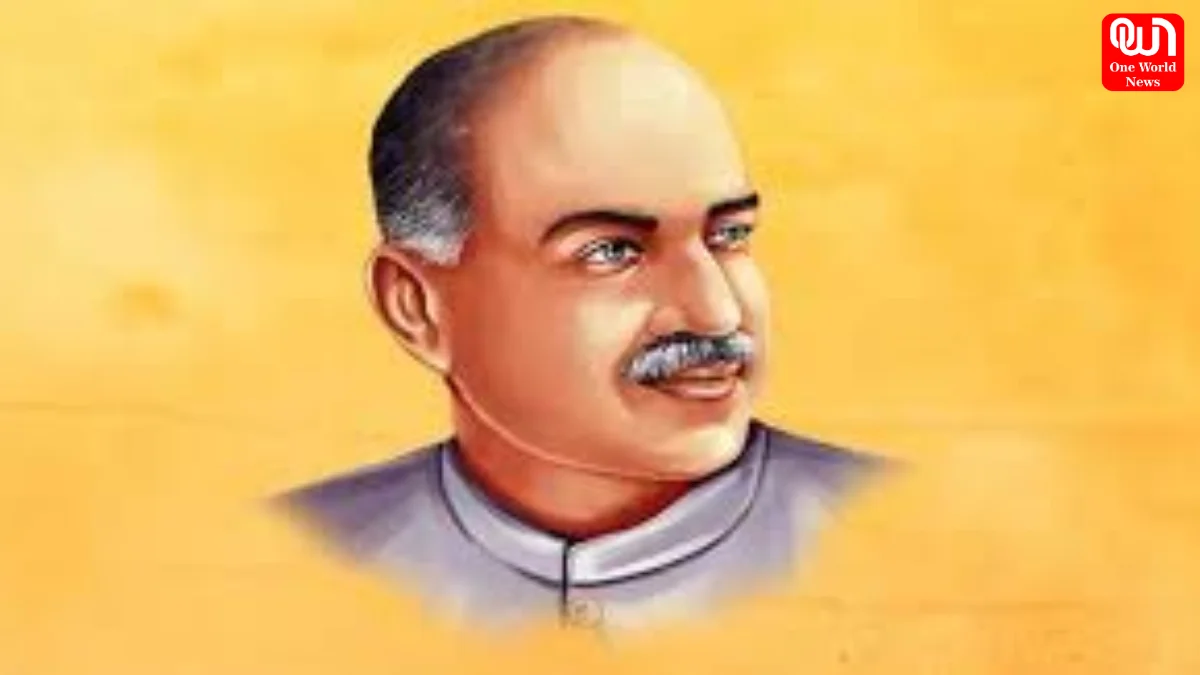

I am Apoorva, and today, 6 July — the birth anniversary month of Syama Prasad Mookerjee — we remember a voice that refused to echo in silence… a mind that challenged the tide… a leader whose conviction still stirs the conscience of India.
In our segment History & Forgotten Legends, we revisit the remarkable legacy of Syama Prasad Mookerjee — a scholar, nationalist, and statesman whose ideas continue to shape India’s political framework.
Early Life and Intellectual Brilliance
Born on 6 July 1901 in Calcutta (now Kolkata), Syama Prasad Mookerjee was raised in an environment of academic excellence. His father, Sir Ashutosh Mookerjee, was a distinguished educationist and Vice-Chancellor of Calcutta University. Following in his father’s footsteps, Syama Prasad Mookerjee demonstrated extraordinary intellectual promise. At the age of 33, he became one of the youngest Vice-Chancellors of the University of Calcutta, marking his early commitment to educational reform and national progress.
But he was not just an academic. Syama Prasad Mookerjee was a fearless political thinker who believed that ideas must translate into action. His transition from academia to active politics reflected his desire to shape India’s destiny during a period of intense political transformation.
Entry into National Politics
Syama Prasad Mookerjee entered public life during British rule and later became a prominent figure in independent India’s political landscape. He served as the Minister for Industry and Supply in Prime Minister Jawaharlal Nehru’s first cabinet after independence in 1947. However, ideological differences, especially concerning national integration and minority policies, led him to resign from the cabinet in 1950.
His political journey soon took a decisive turn when he founded the Bharatiya Jana Sangh in 1951 — a party that would later evolve into today’s Bharatiya Janata Party (BJP). Through this platform, Syama Prasad Mookerjee articulated a vision of strong national unity rooted in one constitution, one flag, and one head of state.
Rrad more: Political Roundup: Global Power Moves and Political Flashpoints
Stand on Jammu & Kashmir and Article 370
Today, when we speak of national unity, the name Syama Prasad Mookerjee rises with powerful relevance. He firmly opposed the special status granted to Jammu & Kashmir under Article 370 of the Indian Constitution. He believed that one nation must stand under one constitutional framework, without separate symbols or provisions that created political distinction.
His slogan — “Ek desh mein do vidhan, do pradhan, do nishan — nahi chalenge” — became a rallying cry for those who supported complete integration of Jammu & Kashmir with India. For Syama Prasad Mookerjee, this was not merely a political stance; it was a matter of principle and sovereignty.
His opposition to the permit system that restricted Indian citizens from freely entering Jammu & Kashmir led him to launch a protest movement. In 1953, he entered the region without a permit and was subsequently arrested.
Mysterious Death and National Impact
In June 1953, while in detention in Srinagar, Syama Prasad Mookerjee died under circumstances that remain debated and controversial. His untimely death at the age of 51 shocked the nation and intensified political discussions surrounding Jammu & Kashmir’s constitutional status.
Though his life ended abruptly, his ideas did not. Decades later, in August 2019, the Government of India revoked Article 370, a move that many supporters viewed as the fulfillment of Syama Prasad Mookerjee’s long-standing vision of complete constitutional integration.
Enduring Political Influence
Today, his ideas continue to influence political discourse across India. Syama Prasad Mookerjee is remembered not merely as a leader of the past but as a foundational thinker in the evolution of nationalist politics. His emphasis on cultural identity, constitutional unity, and centralized sovereignty remains central to many contemporary debates.
Read more: Uday Bhanu Chib Arrested Over Shirtless Protest at AI Summit
His sacrifice reminds us that conviction often demands courage beyond comfort. Whether one agrees or disagrees with his ideology, there is no denying the impact of his resolve and determination.
As India evolves in the 21st century, the legacy of Syama Prasad Mookerjee stands as a reminder that political thought, when rooted in strong belief, can shape the course of a nation. Legends do not fade. They become foundations.
Today, we remember Syama Prasad Mookerjee — not just as a political figure, but as a thought that still breathes in the present.

Comments are closed.