
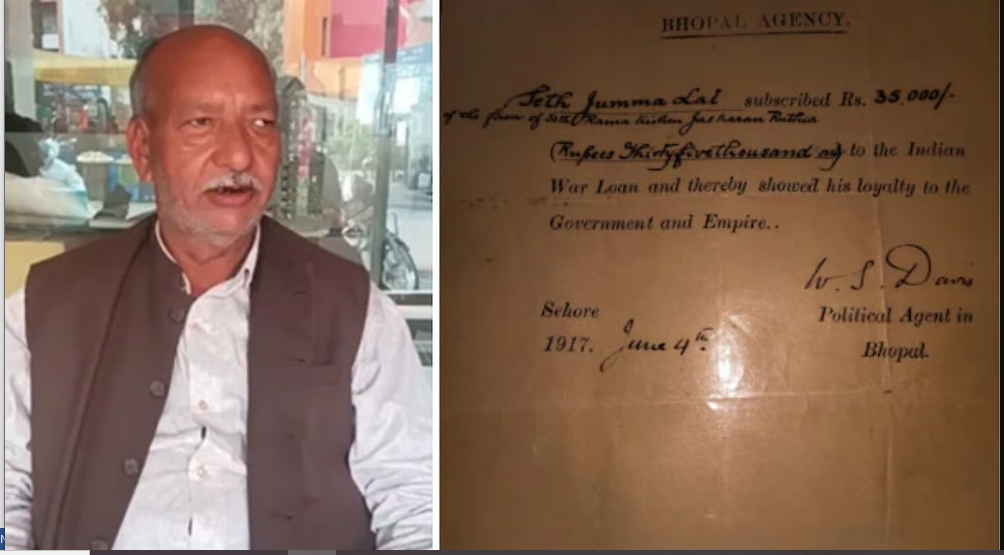

NEW DELHI, Feb 25: A family in Madhya Pradesh is preparing to raise a demand before the UK government for clearing a loan taken by the then British Empire 109 years ago.
The British Empire once prided itself on being the realm where the sun never set. But in the quiet town of Sehore in Madhya Pradesh, a forgotten piece of paper suggests that even the mighty Empire once needed a sunrise loan from a wealthy local businessman.
In 1917, as the world was in the grip of war and imperial administration stretched thin, the British government reportedly borrowed Rs 35,000 from Seth Jummalal Ruthia, one of the then wealthiest and most influential businessmen of Sehore and the Bhopal princely state. The amount was enormous by the standards of that era, enough to alter fortunes, shape estates, and command influence in royal and colonial circles.
According to the Ruthia family, the money was never repaid. Now, more than a century later, Seth Jummalal’s grandson, Vivek Ruthia, says he is preparing to send a legal notice to the British government to recover what he calls a “historic and unpaid sovereign debt.”
Speaking about the discovery, Vivek Ruthia claims the family recently found documentary evidence, including certificates and correspondence among old records and a family will after his father’s death. “In 1917, my grandfather, the late Seth Jumma Lal Ruthia, loaned Rs 35,000 to the British government. That amount has not been repaid to this day,” he said.
According to him, the documents suggest the loan was taken to streamline administrative management in the Bhopal princely state during British rule and was named as a war loan. Seth Jummalal Ruthia died in 1937, nearly 20 years after the loan was extended. The matter, the family claims, remained unsettled and gradually slipped into obscurity until now.
The figure of Rs 35,000 in 1917 may appear modest by modern standards, but Vivek Ruthia argues that its present-day value would run into crores. “If you calculate the amount based on the gold price of 1917 and compare it to today’s rate, the figure becomes significantly higher,” he says. In other words, what once may have financed wartime administration could now be worth a fortune.
The family is reportedly preparing to invoke principles of international law, arguing that sovereign nations are, in theory, obliged to honor previously incurred debts. Legal experts say that while such cases are rare and complex, historical claims backed by documentary evidence can open unusual legal debates, especially when they involve pre-independence transactions between colonial authorities and private individuals.
Before Independence, the Ruthia family was among the most prominent and affluent in the Sehore and Bhopal princely states. Known for their administrative influence and financial strength, they reportedly held vast land and property. Even today, it is said that a significant portion, between 20 to 30 per cent of Sehore’s settlements stand on land once owned by the Ruthias.
The family continues to own properties in Sehore, Indore, and Bhopal and is involved in agriculture, hospitality, and real estate. However, like many old landed families, they are also entangled in property disputes and cases involving legacy rents fixed decades ago at nominal amounts.
(Rohit Kumar)

Comments are closed.