
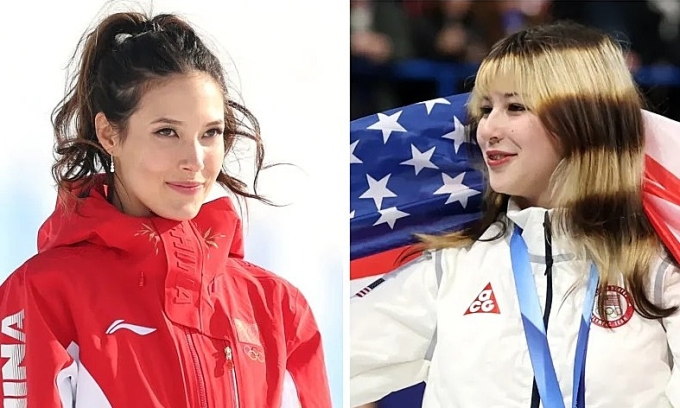

Alysa Liu (R) and Eileen Gu at the 2026 Winter Olympics. Photos by Instagram/@eileengu, @alysaxliu |
“Is it just me, or do Alysa Liu and Eileen Gu look like the hero and villain of a Disney movie?” social media user @Noahpinion posted on X, attracting hundreds of thousands of views. The post was attached with photos of Liu celebrating a figure skating medal and Gu modeling at an event.
The debate gained significant traction following Liu’s triumphant return from retirement to win two gold medals for the U.S. in the women’s individual and team figure skating events in Milan. Meanwhile, Gu secured a gold and two silver medals in freestyle skiing for China, cementing her status as the most decorated freeskier in Olympic history.
Snow Princess
Born and raised in California to families of Chinese descent, Liu, 20, and Gu, 22, are both champions in their respective sports. However, because one competes under the American flag while the other represents China, they have been placed at opposite ends of a comparison they did not create.
Gu, dubbed the “Snow Princess” by Chinese media, was born in San Francisco. Her parents separated when she was young, and she was raised by her mother, Yan Gu, a successful venture capitalist who studied at Peking University and Stanford. Gu grew up between two worlds, spending her school years in San Francisco and her summers in Beijing, her mother’s homeland.
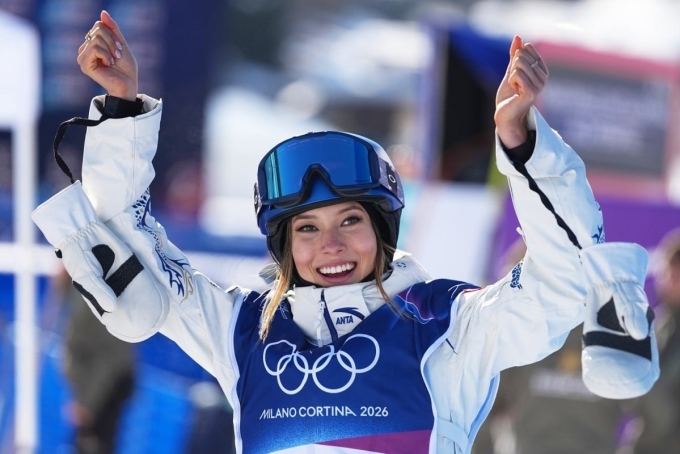 |
Eileen Gu competes at the 2026 Milano Cortina Winter Olympics. Photo by AP |
She began skiing at age three in the Lake Tahoe area and won her first national championship at just nine years old. Initially competing for the U.S., she switched her sporting allegiance to China in 2019 at age 16, citing a desire to inspire millions of young people in Beijing.
At the 2022 Beijing Olympics, Gu won two gold medals and one silver. By the 2026 Milano Cortina Games, she was one of the world’s highest-earning female athletes, bringing in approximately $23 million annually.
In China, she has become a sports icon, with millions of followers. State media outlet Global Times called her an “idol for the whole world”.
Ice Angel
Liu’s background was a stark contrast. She is the daughter of Arthur Liu, a political activist who participated in the 1989 Tiananmen Square protests and was forced into exile. Because this topic remains censored in China, Liu’s achievements receive little to no mainstream media coverage there, according to BBC.
Liu was raised in California by her single father in a large family that at one point shared a one-bedroom apartment, moving from Clovis to Richmond, a working-class city in the San Francisco Bay Area.
She trained at the Oakland Ice Center and became the youngest-ever U.S. national figure skating champion at age 13.
At 16, Liu walked away from figure skating, citing burnout and loss of interest. Two years later, she returned to the ice on her own terms. At the 2026 Winter Olympics, Liu ended a 24-year drought for American women by winning the individual figure skating gold. Media outlets have even nicknamed her the “Ice Angel.”
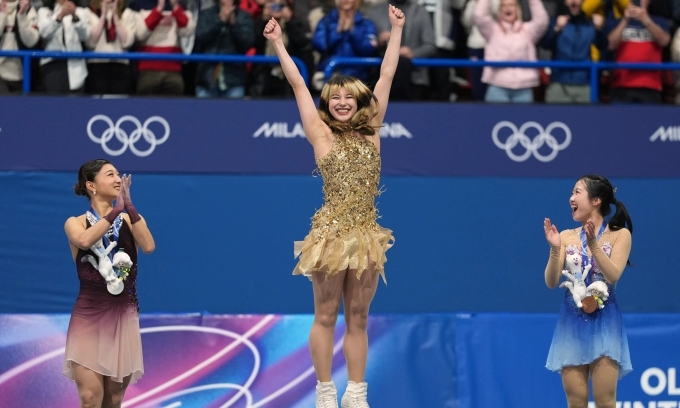 |
Alysa Liu (C) celebrates her gold medal in women’s singles figure skating at the 2026 Winter Olympics. Photo by AP |
The hero and the villain
The rivalry between the two narratives has intensified alongside U.S.-China tensions. According to Professor Yinan He of Lehigh University, the “New Cold War” atmosphere dictates that individual identity is increasingly judged through the lens of national loyalty, leaving little tolerance for athletes navigating dual identities.
Gu has faced ongoing criticism in the U.S. for her decision to compete for China.
The backlash flared up again recently after American freeskier Hunter Hess expressed mixed feelings about representing the U.S. amid domestic political controversies. When President Donald Trump called Hess a “real loser,” Gu defended the American athlete, stating, “As someone who’s been caught in the crossfire before, I feel sorry for the athletes.”
This comment drew immediate criticism. Former NBA player Enes Kanter Freedom labeled Gu a “traitor,” questioning why she felt comfortable criticizing Trump but remained silent on Chinese policies.
U.S. Vice President JD Vance also weighed in, stating he supports athletes who grew up in America and chose to compete for the country.
Meanwhile, Liu is largely ignored on Chinese social media. When there are posts praising her, they are often met with comments such as: “Why are you praising this person? Her whole family is anti-China.”
Liu’s family has previously stated they were targeted in a campaign directed by the Chinese government to monitor dissidents abroad. In 2022, Liu revealed that FBI agents informed her family they might be under surveillance. While the figure skater recounted the experience as if it were a bizarre prank, her father emphasized he understood the severe price of speaking out back in 1989. These details have garnered Liu sympathy and admiration in the U.S., sharpening her contrast with Gu in online discussions.
Analysts argue that public attention goes beyond nationalism. Professor He told BBC that social class heavily shapes how the public perceives both athletes. Gu grew up in an elite environment, attending prestigious private schools and living in San Francisco’s affluent Sea Cliff neighborhood. Consequently, he views her choice to represent China as a calculated business decision.
Liu, on the other hand, is the daughter of exiled refugees who struggled through hardship, walked away from her sport, and returned purely out of love for it. Her trajectory perfectly fits the story of the American Dream.
Dave Portnoy, social media personality and founder of American media company Barstool Sports, affirmed that he would never support Gu.
“When in life, if you have the chance to be Alysa Liu or Emily [Eileen] Gu, always pick Liu,” he said, as quoted by Daily Express.
Portnoy considered Liu an American icon and predicted Hollywood would eventually adapt her story into a film.
In contrast, when Marvel actor Simu Liu expressed pride in Gu’s accomplishments, he was met with a wave of comments demanding he “go back to China”.
Following a grueling 2026 Olympic schedule where she competed in three separate freeski finals, Gu admitted she felt like she was skiing with the weight of two countries on her shoulders after missing gold in the slopestyle event. While supporters viewed this as a moment worthy of empathy, critics reacted harshly, arguing she only represents one country, and it is not the United States.
Amidst the controversy, the athletes’ actual sporting achievements risk being overshadowed.

Comments are closed.