
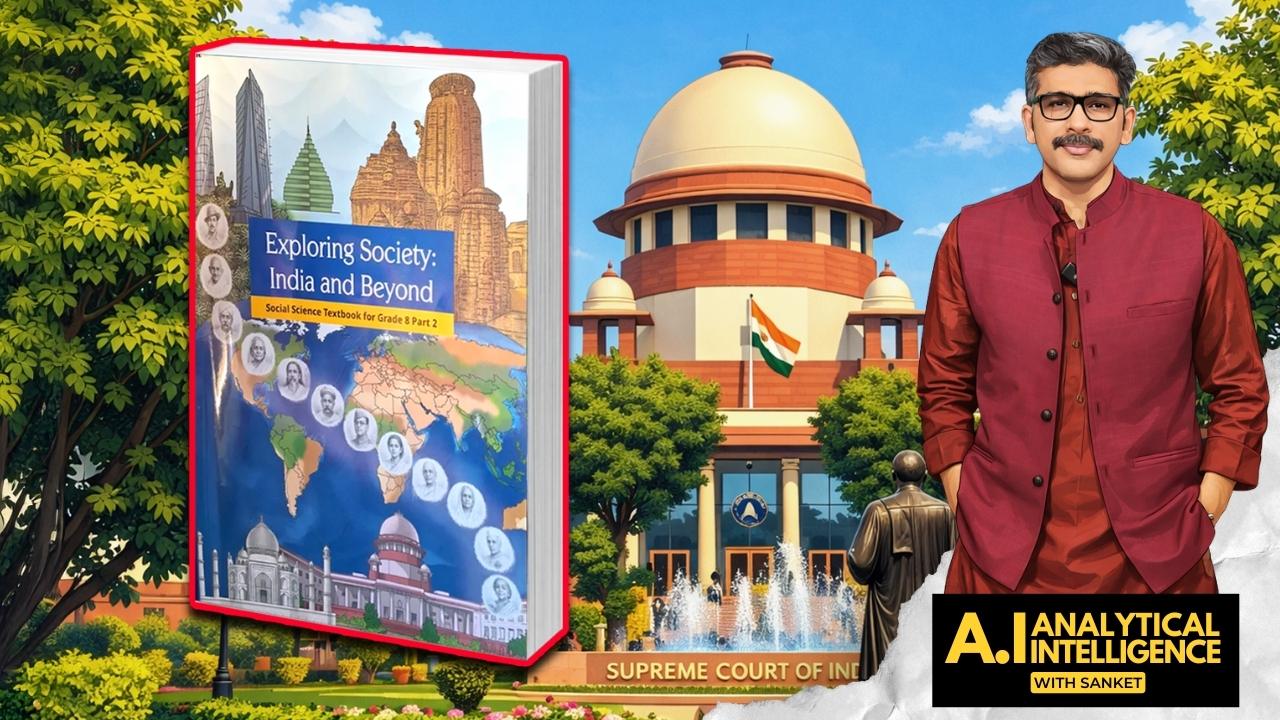

In this episode of AI with Sanket, The Federal spoke to JS Rajput, former Director of NCERT, and senior journalist V Venkatesan on a NCERT textbook’s reference to corruption and case delays in the judiciary that sparked strong objections from the Supreme Court. The panellists discussed whether the court overreacted, and whether discussing corruption in textbooks undermines institutions or strengthens democratic awareness.
The issue was raised during court proceedings, including by senior advocates Kapil Sibal and Abhishek Manu Singhvi, prompting sharp remarks from the bench.
“The Supreme Court has reacted in haste,” said Rajput, defending the Class 8 civics chapter that mentions corruption and delay in the judiciary. He argued that children must be exposed to real-world realities and that institutions should not be “thin-skinned” when confronted with criticism.
Children and reality
Rajput rejected the suggestion that the textbook chapter was imparting “selective truth”.
“If children in Class 8 are 13 or 14 years old, after 10 years they will occupy serious positions with responsibilities. Why should they not be familiar with the world they will be facing?” he asked.
He emphasised that NCERT is a national institution tasked with shaping future generations. If objections arise, he said, they should be addressed through institutional mechanisms.
Also Read: NCERT textbook row: Dharmendra Pradhan orders probe, assures action
“Write to NCERT. Every year we reprint our books and incorporate suggestions from students, scholars, historians, and even people from the judiciary,” he noted.
According to him, referring to corruption in the judiciary is not inherently wrong.
“It is incorrect to label that something serious has happened,” he said, adding that any required changes should be examined by experts rather than triggered by public pressure.
Sharp reaction
Rajput was critical of the Supreme Court’s immediate response.
“The Supreme Court reacted very sharply, which was not necessary. It has its stature and respect. NCERT is also an equally-responsible organisation and deserves respect,” he said.
Also Read: Congress backs SC ban on NCERT textbook, alleges RSS-driven revisions
He argued that corruption in the lower judiciary is a widely discussed issue.
“Go to a tehsil headquarters and talk to people,” he said, adding that children are already aware of such realities.
He maintained that the chapter should not be removed merely because of remarks made in court.
“It has to be examined by experts,” he stressed.
‘NCERT open to feedback’
Rajput cited an anecdote from his tenure to underline NCERT’s openness to feedback. A Class 3 student once pointed out that a textbook caption incorrectly described a farmer as ploughing a field when the plough was resting on his shoulder.
“The boy was right,” Rajput recalled. He wrote back personally, congratulated the student, and praised his critical thinking.
“Such changes NCERT makes every year, and will continue to make,” he said.
Also Read: ‘Heads must roll’: SC bans NCERT book over chapter on ‘judiciary corruption’
He suggested that instead of issuing a one-line regret, NCERT should explain why the chapter was written and what its intent was.
“If you have written a chapter, you must tell the country why,” he said.
Rajput added that if he were still at the helm, he might have broadened the chapter to “Corruption in Public Life”, using the judiciary as one example while encouraging students to explore other institutions as well.
‘Corruption a systemic issue’
The host Sanket Upadhyay raised the question of whether isolating corruption to the judiciary was appropriate when corruption exists across institutions.
Rajput agreed that corruption is a systemic issue.
“Children must know they will face a world in which corruption is rampant everywhere,” he said. He would have modified the chapter, but defended its inclusion in principle.
Also Read: NCERT apologises after facing SC ire over chapter on judicial corruption
He also questioned whether adverse opinions should automatically prompt public apologies.
“Why was this chapter approved? Who wrote it? What was the intent? These questions must be answered,” he said.
Recalling his tenure between 1999 and 2003, Rajput said NCERT had faced criticism before but defended its academic processes while accepting rational suggestions in the national interest.
Overreaction?
Senior journalist Venkatesan echoed the view that the court appeared to have overreacted.
“On the face of it, it looks as if the court has overreacted,” he said, questioning whether issuing a contempt notice was warranted.
He pointed out that the textbook merely stated that the judiciary suffers from corruption and that delays are a major problem.
“Justice delayed is justice denied. What is wrong with that?” he asked.
According to Venkatesan, interpreting such references as an attempt to malign the judiciary may be excessive.
‘Not a taboo subject’
Venkatesan cited instances where members of the judiciary themselves acknowledged internal problems.
He referred to former Supreme Court judge Markandey Katju, who in Raja Khan vs State of Uttar Pradesh (2010) remarked that “something is rotten in the Allahabad High Court”.
Also Read: SC on NCERT’s ‘corruption in judiciary’ chapter: ‘Will not allow institution to be defamed’
He also mentioned the 1995 C Ravichandran Iyer case, which laid down the in-house procedure for addressing allegations against judges, and the 2010 contempt case involving Shanti Bhushan.
“These examples are in the public domain,” he said. “This is not a taboo subject that students should not know.”
Transparency concerns
Venkatesan highlighted figures cited in Parliament on February 13, where the law minister reportedly said that 8,639 complaints had been received over a decade regarding judges at various levels.
“What happened to these complaints? Nobody knows,” he said, raising concerns about the opacity of the in-house mechanism.
Also Read: CJI’s office received 8,360 complaints against sitting judges in last 10 years: Govt
He explained that in-house committee reports are typically not made public, except for the operative portion recommending resignation or further action. Greater transparency, he suggested, would protect the credibility of the institution.
Public confidence in the judiciary, he emphasised, is crucial for democracy. However, disclosures of corruption can shake that confidence, making accountability mechanisms even more important.
Institutional sensitivity
The discussion also touched upon the basic structure doctrine, which the court has invoked in landmark cases since 1973 to protect core constitutional principles, including judicial independence.
Venkatesan observed that while judicial independence is vital, the institution appears particularly sensitive to allegations affecting it. He questioned why invoking the doctrine was necessary in the present context.
Also Read: What Justice Bhuyan’s remarks on judicial transfers reveal about state of judicial independence
Both panellists agreed that criticism does not automatically weaken institutions. Instead, open debate and scrutiny may strengthen democratic values.
The larger question remains: does acknowledging corruption in textbooks undermine institutional authority, or does it encourage critical thinking among future citizens?
(The content above has been transcribed from video using a fine-tuned AI model. To ensure accuracy, quality, and editorial integrity, we employ a Human-In-The-Loop (HITL) process. While AI assists in creating the initial draft, our experienced editorial team carefully reviews, edits, and refines the content before publication. At The Federal, we combine the efficiency of AI with the expertise of human editors to deliver reliable and insightful journalism.)

Comments are closed.