
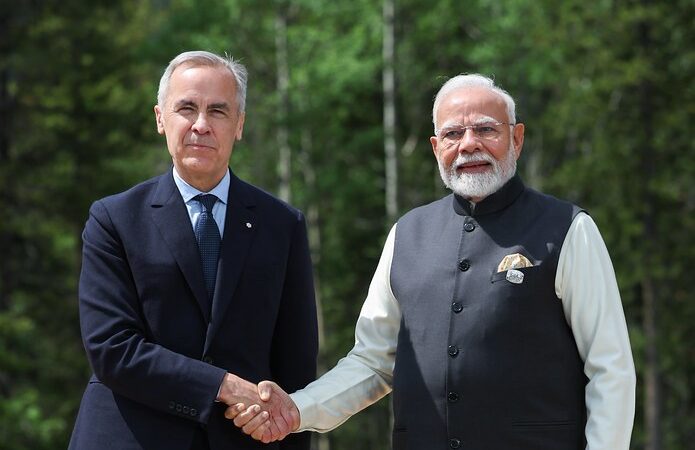

Canadian Prime Minister Mark Carney has landed in Mumbai on his first official visit to India, marking a pivotal moment in Canada’s evolving global strategy. The trip signals more than a diplomatic reset. It represents a calculated effort to rebalance Canada’s economic dependencies, strengthen ties with one of the world’s fastest-growing major economies, and redefine Ottawa’s foreign policy posture at a time of heightened geopolitical uncertainty.
The visit follows a prolonged diplomatic freeze between Canada and India that began in 2023 after then–Prime Minister Justin Trudeau publicly alleged credible links between Indian officials and the killing of Sikh leader Hardeep Singh Nijjar near Vancouver. New Delhi strongly denied the accusations, and relations deteriorated sharply. Diplomatic expulsions, public accusations, and strained trade discussions defined much of the following year. Now, under Mark Carney, Ottawa is attempting to recalibrate.
Carney’s India visit is part of a broader Indo-Pacific tour that also includes Australia and Japan. The mission aligns with his stated objective to double Canada’s non-U.S. exports within a decade. The urgency is unmistakable. Tensions with Donald Trump have intensified amid tariff threats and rhetoric suggesting Canada could become the “51st state.” Trump recently floated the possibility of imposing a 100 percent tariff on Canadian goods in response to Ottawa’s potential China trade initiatives, escalating economic uncertainty between the longtime allies.
Against that backdrop, India’s strategic importance becomes clear. As the world’s fourth-largest economy and Canada’s seventh-largest trading partner in 2024, India offers scale, demographic growth, and long-term investment potential. Both countries resumed diplomatic services last year and reopened dialogue on a long-discussed trade agreement. Carney’s business-focused leadership style is being framed by some analysts as a pragmatic pivot designed to stabilize economic ties rather than amplify ideological disputes.
Still, the visit unfolds under a cloud of unresolved tensions. Canadian officials, including Public Safety Minister Gary Anandasangaree, have stated that concerns remain about alleged intimidation of Sikh activists on Canadian soil. Representatives from the World Sikh Organization of Canada have criticized Carney’s outreach as premature, arguing that activists continue to face threats. The legacy of the 2023 crisis remains politically sensitive within Canada’s significant Sikh diaspora.

Internationally, Carney’s approach aligns with what observers have called his “Davos doctrine,” referencing his remarks at the World Economic Forum condemning economic coercion by major powers. In Davos, Carney emphasized stability, predictable trade relationships, and respect for sovereignty, positioning Canada as a defender of middle-power diplomacy in an era of tariff battles and strategic rivalries. Warmer relations with India are central to that framework.
For India, the calculus is equally pragmatic. Ongoing trade pressures from the United States have encouraged New Delhi to diversify partnerships. Canada, with its natural resources, clean energy potential, agricultural exports, and technology sector, presents an opportunity for balanced economic collaboration. Both governments appear motivated by mutual economic self-interest rather than ideological alignment.
Carney’s visit does not erase the diplomatic scars of 2023, nor does it resolve domestic political criticism. But it marks a turning point. Canada is signaling that it intends to operate with strategic autonomy, broadening its economic footprint beyond the United States while rebuilding key international relationships. Whether this outreach yields a comprehensive trade agreement or merely a cautious thaw remains to be seen. What is clear is that Canada’s global posture is shifting, and India is once again central to that calculation.

Comments are closed.