
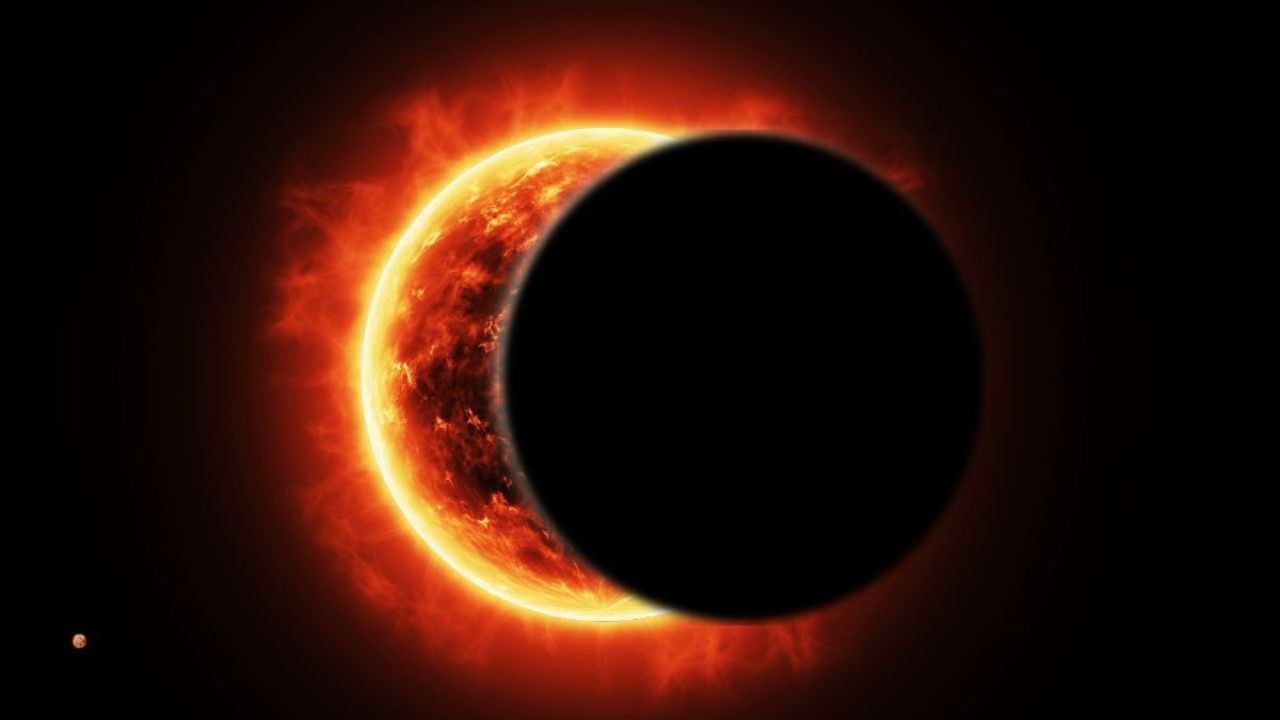
The longest solar eclipse of the century will take place in 2027, there will be dense darkness all around for 6 minutes and 22 seconds.

Solar eclipse 2026:The year 2026 is going to be very special in terms of astronomical events. On one hand, there is confusion regarding the date of Holi festival, while on the other hand, curiosity among people has increased regarding solar and lunar eclipse. According to the calendar and astrological calculations, this time there will be a change in the traditional dates due to the eclipse.
While the lunar eclipse in 2026 is falling on the very next day of Holi, there are many discussions going on regarding the solar eclipse as well. Also, experts have clarified that the ‘longest solar eclipse of the century’ will take place in 2027, which will last for 6 minutes 22 seconds.
Why was there confusion on the date of Holi in 2026?
According to astrological calculations, Holika Dahan will be performed on March 2, 2026. Usually Holi of colors is played the next day, but this time a lunar eclipse is taking place on March 3.
Worship and auspicious works are considered prohibited during the Sutak period that falls during the eclipse. In such a situation, astrologers advise to avoid playing with colors on March 3. Therefore, Holi of colors will be celebrated on 4 March 2026.
Solar Eclipse 2026: When and where will it be visible?
According to experts, there will be two solar eclipses in the year 2026. The first solar eclipse has occurred on 17 February. The second solar eclipse of the year will take place on 12 August 2026.
However, this solar eclipse of August 12 will not be visible in India. It can be seen mainly in Europe, Canada and Greenland. Since it will not be visible in India, its Sutak period will also not be valid in the country and there will be no restriction on religious activities.
The longest solar eclipse of the 21st century will occur in 2027.
Amidst the rumors spreading on social media about the solar eclipse of 2026, experts have made it clear that the ‘biggest solar eclipse of the century’ will take place on August 2, 2027. This will be the longest solar eclipse of the 21st century, whose duration will be approximately 6 minutes 22 seconds.
A solar eclipse of such a long duration will not be seen again till the year 2114. During this period, there will be dense darkness during the day for some time and a night-like scene may be seen during the day.
Where will the solar eclipse of 2027 be visible in India?
The solar eclipse on August 2, 2027 will be partially visible in many states of India. It can be seen in Andaman and Nicobar Islands, Andhra Pradesh, Arunachal Pradesh, Assam, Bihar, Chandigarh, Chhattisgarh, Delhi, Goa, Gujarat, Haryana, Himachal Pradesh, Jammu and Kashmir, Jharkhand, Karnataka, Kerala, Lakshadweep, Madhya Pradesh, Maharashtra, Manipur, Meghalaya, Mizoram, Nagaland, Odisha, Puducherry, Punjab, Rajasthan, Sikkim, Tamil Nadu, Telangana, Tripura, Uttar Pradesh, Uttarakhand and West Bengal.
Since this eclipse will be visible in India, its Sutak period will remain valid.
What is eclipse?
According to astronomy, when the Moon comes between the Earth and the Sun and partially or completely covers the Sun’s light, then a solar eclipse occurs. This process is possible on Amavasya day.
At the same time, in Hindu beliefs, eclipse is linked to Rahu and Ketu, which are said to be afflicting the Sun and Moon in mythology.

Comments are closed.