


Share prices of 39 of the 54 new-age tech companies fell in a range of 0.38% to over 24% this week
The total market cap of the 54 new-age tech companies declined $15.9 Bn to end the week at $127.3 Bn from $143.2 Bn last week
10 companies —Veefin Solutions, Awfis, Zaggle, Ola Electric, Smartworks, Pine Labs, WeWork India, MapmyIndia, Urban Company and PhysicsWallah — saw their share prices hit fresh lows this week
New-age tech stocks slumped this week amid AI-led rout in the broader equities market. Of the 54 new-age tech companies under our coverage, only 15 companies saw an uptick in their stock price, in a range of 0.11% to close to 29%, during February 23-27.
Meanwhile, share prices of 39 new-age tech companies fell in a range of 0.38% to over 24%. TAC Infosec’s shares plunged the most at 24.2% to end the week at ₹384.1, while 10 companies saw their share prices hit fresh lows this week. Veefin Solutions, Awfis, Zaggle, Ola Electric, Smartworks, Pine Labs, WeWork India, MapmyIndia, Urban Company and PhysicsWallah were the companies that hit new lows.
Almost every heavyweight new-age tech company, including Groww, Paytm, Swiggy, Eternal, saw a decline in their share price this week.
As a result, the total market cap of the 54 new-age tech companies declined $15.9 Bn to end the week at $127.3 Bn from $143.2 Bn last week.
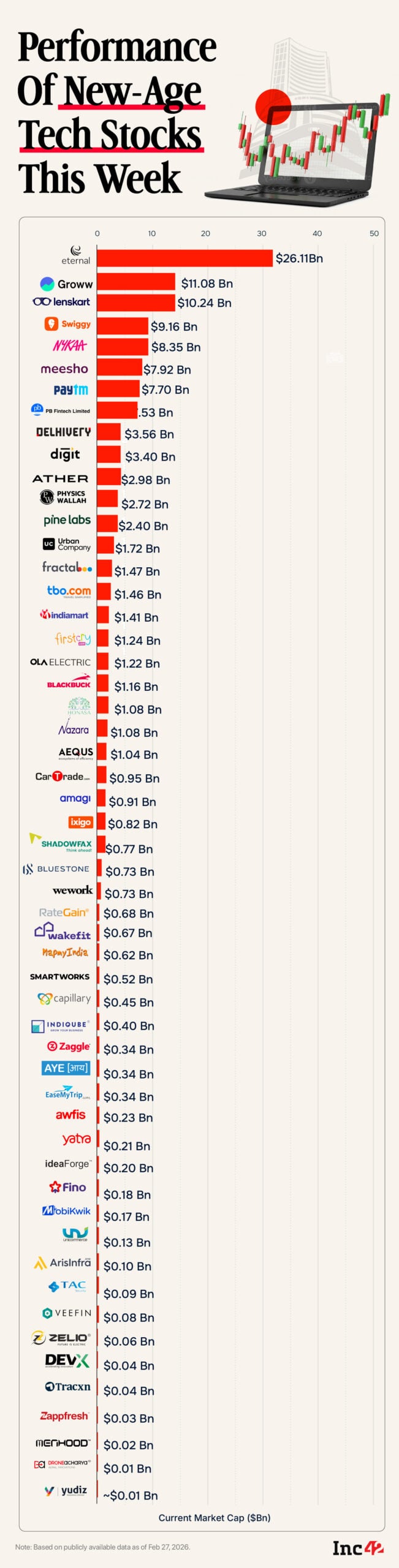
Amid this bearish momentum, shares of BSE SME-listed Zelio Mobility skyrocketed 28.92% to end the week at ₹337.5. Meanwhile, Lenskart continued its bull run, touching a fresh all-time high this week again.
With that, here’s a run down of some of the key developments at the new-age tech companies this week:
- Fino Payments Bank’s CEO Rishi Gupta was arrested yesterday for alleged tax evasion. Gupta was arrested under section 132(1)(a) of the Central Goods and Services Tax (CGST) Act and section 132(1) (i) of the state GST Act.
- Capillary Technologies’ step-down subsidiary acquired Mastercard’s cloud-based loyalty and engagement platform SessionM for $20 Mn to strengthen its presence in the North American and Latin American loyalty markets.
- IndiQube’s company secretary and compliance officer Pranav Ayanath Kuttiyat and workspace planning general manager Bhavna Srivastava tendered their resignations on February 25 (Wednesday) to pursue “new opportunities that align with the long-term career goals”.
- MobiKwik’s stock broking arm MobiKwik Securities Broking Pvt Ltd received approval to initiate operations as a trading member on the BSE.
- PB Fintech set up a new entity, Paisa Financial Services Pvt Ltd, to enter the collection business.
With that, here’s a look at broader market trends this week.
AI Advancements Continue To Weigh On Indian Equities Market
The Indian equity market remained under persistent selling pressure, driven by concerns around AI exposure. After a positive start to the week, benchmark indices traded sideways for most of the week before seeing a sharp decline in the final session yesterday, which tilted momentum in favour of the bears. While Sensex plunged 1.8% to end the week at 81,287.19, Nifty 50 declined 1.6% to end at 25,178.65.
The market sentiment was once again dampened by persistent selling in Indian IT stocks amid growing concerns over the impact of AI on the future of the industry.
Notably, AI majors OpenAI and Anthropic have raised billions of dollars in recent weeks while issuing doomsday predictions about the future of work.
Anthropic CEO Dario Amodei predicted AI will surpass human cognitive abilities in 1-2 years, acting as a “country of geniuses in a datacentre” by 2026-2027. He warned of significant economic disruption, including the potential halving of entry-level white-collar jobs.
However, on the domestic front, macroeconomic indicators continued to present a relatively stable backdrop. Growth in the eight core infrastructure sectors moderated to 4% in January from 5.1% a year earlier, indicating a slight cooling in momentum.
“Economic growth expectations remain robust. India’s economy is likely to expand around 8.1% in Q3 FY26 under the revised series. Corporate earnings outlook also remains encouraging, with estimates suggesting Indian companies could deliver 8-10% year-on-year revenue growth in Q4 FY26, supported by resilient rural demand and a gradual recovery in urban consumption,” Ajit Mishra , SVP of Research at Religare Broking, said.
Meanwhile, tensions between the US and Iran, which already weighed on market sentiment earlier this week, escalated into a military stand-off today. Coupled with continued caution and volatility in FII flows, this is likely to keep investor sentiment subdued.
Now, let’s take a look at the performance of the week’s top gainer and loser.
TAC Infosec Hit By AI-Led Rout
Shares of NSE Emerge-listed cybersecurity firm TAC Infosec were the worst hit amid mounting fears of AI-driven disruption among Indian new-age tech stocks. The company’s shares closed yesterday’s session at ₹384.1, marking a steep 24.2% decline from the previous week.
The broader sell-off in the cybersecurity segment was triggered by growing concerns around AI-led automation of security functions. Investor sentiment turned sharply negative after Anthropic unveiled Claude Code Security, an AI-powered cybersecurity tool capable of scanning entire codebases, identifying vulnerabilities, and suggesting fixes.
The launch raised concerns that AI could automate key aspects of application security, potentially disrupting traditional cybersecurity vendors.
Anthropic said the tool goes beyond conventional rule-based scanning by analysing how components interact, tracing data flows, and identifying complex vulnerabilities in a manner similar to human security researchers. This sparked fears that AI could significantly reduce reliance on manual code audits and vulnerability assessments.
The impact was visible globally, with shares of companies such as CrowdStrike declining amid concerns over long-term revenue pressures. The ripple effects extended beyond cybersecurity, with consulting majors like IBM also facing pressure, as AI tools could accelerate the modernisation of legacy systems such as COBOL, reducing demand for traditional consulting services.
However, analysts cautioned that Claude Code Security is still in its early preview stage and does not replace core cybersecurity functions such as real-time threat detection, incident response, and enterprise security infrastructure. As such, the sharp market reaction appears to be driven more by sentiment and fears of future disruption than immediate fundamental impact.
Zelio Jumps On Capacity Expansion
Shares of Zelio E-Mobility emerged as the top gainer among new-age tech stocks this week, following its capacity expansion.
The company said it inaugurated a new manufacturing facility in Odisha’s Cuttack to strengthen its presence across Eastern India. The move comes amid rising demand from key regional markets such as Odisha and West Bengal, and is expected to reduce delivery timelines, lower logistics costs, and enhance supply chain efficiency.
With the commissioning of the Odisha plant, Zelio’s total installed production capacity has increased 2.5X from 72,000 units per annum to 1,80,000 units per annum. This includes the expansion of its Hisar facility to 1,20,000 units annually and the addition of 60,000 units per annum from the new Odisha plant.
The company has invested under ₹3 Cr in the new facility, which is already operational and expected to contribute to revenue immediately.
The expansion aligns with Zelio’s broader growth strategy following its ₹78.34 Cr SME IPO last year, with a portion of the proceeds earmarked for scaling manufacturing capacity. The company reported strong financial performance in H1 FY26, posting consolidated revenue of ₹134.78 Cr and a net profit of ₹11.87 Cr.
Edited by: Vinaykumar Rai

Comments are closed.