
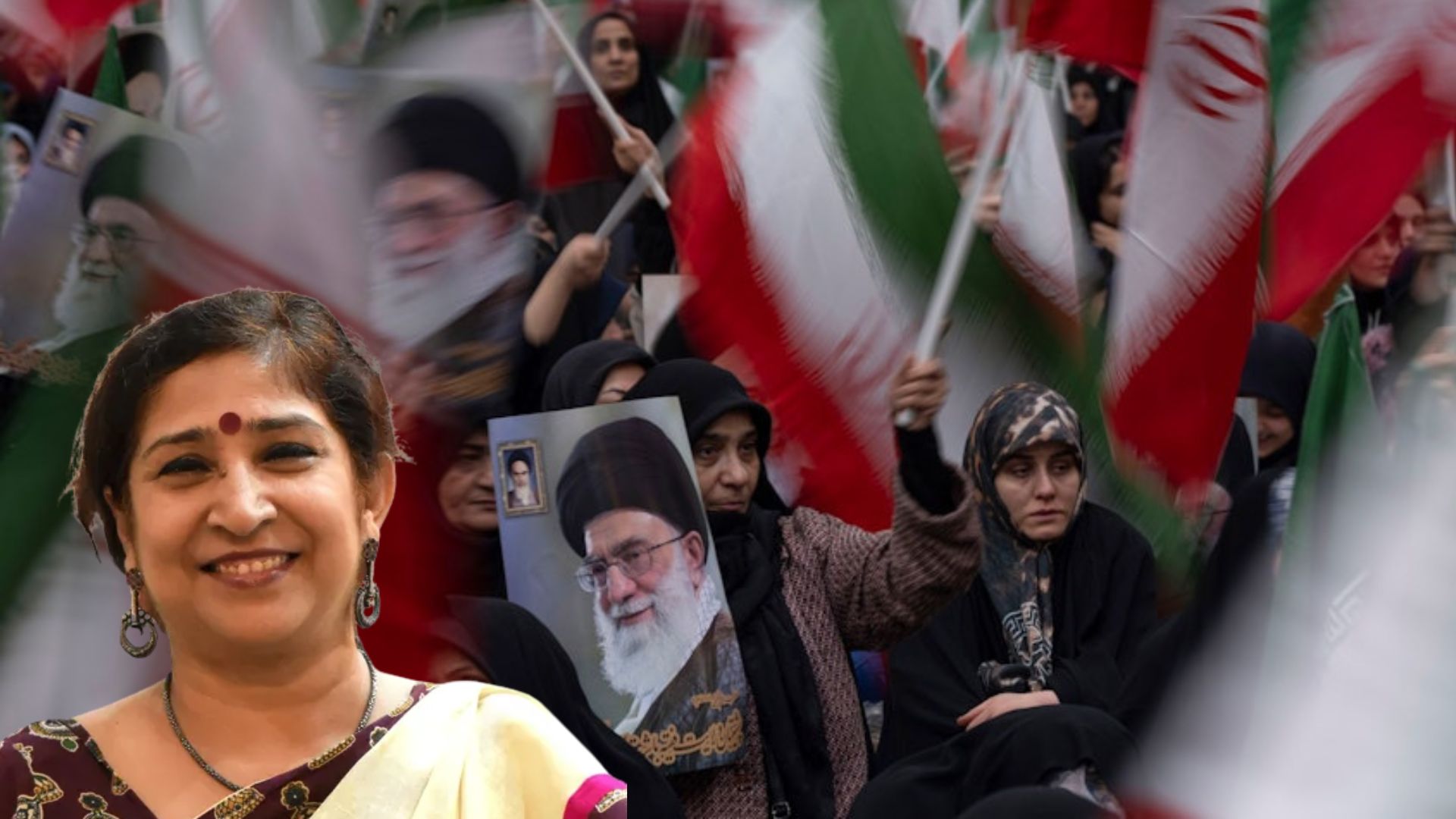

As the US and Israel intensify strikes on Iran and Tehran retaliates against American bases across West Asia, the region is at a perilous crossroads. The Federal spoke to Meena Singh Roy, head of the West Asia Centre at the Manohar Parrikar Institute for Defence Studies and Analyses (IDSA), to unpack what the escalation means for Iran, the region, and the global order.
Edited excerpts:
Ayatollah Khomeini has been killed, and West Asia is in turmoil. How do you assess the situation?
I have been watching developments in this region for a very long time. As far as Iran-US relations are concerned, we should understand that a paradigm shift happened on October 7. Since then, many of the major issues people predicted did not happen. This is one region where we have seen strategic surprises, major fault lines, and mistakes by various powers pursuing their own interests.
I was not surprised when this attack happened. We have been debating it for a while. The question was only when it would happen, how it would happen, and to what extent. The 12-day war in the past gave a signal to Iran that something like this was likely. They were better prepared this time.
Today, I would look at Iran as a very weak country — but that does not mean it is weak in every sense. There are limitations. Its strategic assets — Hezbollah, Hamas, and to some extent the Houthis — are still there, but they have been weakened. Internally too, there are challenges.
But Iran is not Libya, Iraq, or Syria. It is a civilisational state with institutions and structures in place. The United States and Israel are looking at regime change and trying to weaken Iran to the point where it cannot create insecurity for Israel. That is the bottom line.
What should worry not only the region but the entire world are the broader consequences. As an Indian, we have over 9 million people in the Gulf. Our energy security depends on the Strait of Hormuz. We must see how this will affect supply lines and global economic prices. And how long this war will continue is uncertain.
The Gulf countries tried very hard. The international community tried very hard. But President Trump and Benjamin Netanyahu wanted to strike at Iran at its weakest moment. However, I do not think this will result in regime change in the way international media is portraying it.
Didn’t this crisis begin earlier, perhaps after the US invasion of Iraq and the nuclear issue? Is it realistic to expect Iran to give up its nuclear and ballistic missile programmes?
The confrontation between the United States and Iran actually began in 1979, when the Islamic theocracy came into power. Relations deteriorated from that moment. Then came the eight-year Iran-Iraq war, followed by sanctions and isolation.
Yes, there was a window of opportunity in 2015 when the nuclear deal was signed. But Trump later abrogated it. For the US, securing Israel’s security has always been a primary goal.
I bring up October 7 because it fundamentally changed Israel’s security doctrine. What followed in Lebanon and Syria reflects that shift. Israel realised it had to weaken Iran’s strategic assets.
Is the nuclear weapon the core issue? I do not think so. It is one factor that has been debated and also used as an excuse to invade Iran. Iran made some mistakes too. It was unable to convince the international community. There were insecurities among Gulf partners about Iran’s support for resistance groups.
Iran maintains it signed the NPT and does not want nuclear weapons but insists on its right to civil nuclear energy. IAEA reports did not categorically say Iran was building a bomb, though uranium enrichment levels increased. For Israel, a small country, that was alarming, especially after the missile barrages during the 12-day war.
The US and Israel want a nuclear deal crafted on their terms. That is unacceptable to a sovereign country like Iran. Iran has seen what happened to Iraq, Libya, and Syria. And look at North Korea — as a nuclear weapon state, nobody attacks it. What signal does that send? If you are nuclear-armed, nobody attacks.
Will Iran give up its ballistic missile programme? I do not think it would commit what it sees as suicide. Even if the Supreme Leader is gone — which is a huge blow — they have structures in place. An interim leadership council exists. The damage is more to Iran than to others, but the system will continue.
Given internal divisions in Iran, could there be a coup or resistance from within?
There are divisions. Khomeini was not loved by everybody. Sanctions caused economic hardships. We saw how the bazaaris reacted during unrest. There have been serious internal problems, but whenever unrest occurred, it was violently suppressed — in 1999 and other times.
There are people who want change but do not want insecurity. They do not want Iran to become Iraq or Syria. That distinction is important.
The IRGC remains strong. Unless there is division within the Revolutionary Guard or security forces, change is unlikely. It is very difficult to predict that a group wanting reform will suddenly topple the system, like in 1979.
I personally feel change will come from within. There are moderates within the system, some imprisoned, some still inside. Those moderates may gain strength if the system weakens further. But we have to wait and see how this conflict unfolds — how long it lasts, how much damage Iran sustains, and how resilient its security forces remain.
There are more questions than answers. I do not think regime change will happen the way the West wants. Whether liberal forces within the system take charge or the IRGC consolidates power — we do not know.
Iran appears regionally isolated. Has it made strategic mistakes?
Iran was always isolated. But recently, it gained some regional acceptability. The China-led rapprochement between Saudi Arabia and Iran, the role of Oman, and Qatar’s engagement showed that regional problems needed regional solutions.
But Iran does not have a real strategic partner. I have asked Iranian officials — who is your real strategic partner? They are on their own.
Religion plays a role, but this is ultimately about power politics and resources. Gulf countries themselves have faced isolation, like Qatar did. Today, states follow multi-vector foreign policies. They look inward, prioritise economic development, and avoid putting all eggs in one basket.
Iran’s strategic mistake was perhaps inflexibility. It could not adequately explain its support for Hezbollah, Hamas, and the Houthis. It calls them resistance movements, but others see them as destabilising forces.
What about China’s role? Why is Beijing not visibly defending Iran?
I never saw China as Iran’s ally. It is a transactional relationship. China uses countries for its benefit. Yes, China buys Iranian oil and may provide intelligence inputs. But China also has major stakes in the GCC countries. Its binding factor with Iran and Russia is shared tension with the United States.
If China truly considered Iran an ally, it would stand by it. That has not happened. China does not want to antagonise the US. It balances its interests.
Making noises at the United Nations achieves little. Did China stop the war in Gaza? No. Today, there is one powerful nation — the United States — and it is a Trump order. That is the order we are seeing. Nobody is resisting.”
Where does this leave the region and the Palestinian issue?
The region is like a spider web. If you solve one problem, you get stuck in another. The Palestinian issue is in limbo. There is much debate, but who are the serious stakeholders willing to bring meaningful change? The two years of war in Gaza revived global attention on Palestine, but now the Iran conflict has diverted focus again.
The Gulf countries are grappling with multiple challenges. This Iran-US-Israel war has shifted the regional narrative once more. There are more question marks than answers.
How do you see this conflict ending?
We will have to see who blinks first. If Iran feels destruction is overwhelming, will it pull back? Or will the US and Israel recalibrate? It depends entirely on how this conflict plays out.
The content above has been transcribed from video using a fine-tuned AI model. To ensure accuracy, quality, and editorial integrity, we employ a Human-In-The-Loop (HITL) process. While AI assists in creating the initial draft, our experienced editorial team carefully reviews, edits, and refines the content before publication. At The Federal, we combine the efficiency of AI with the expertise of human editors to deliver reliable and insightful journalism.

Comments are closed.