

Introduction
The manufacturing industry in Punjab is facing increasing costs of production and the need for precision. However, one of the biggest issues is the experiential, often inefficient, process of choosing between different machining processes.
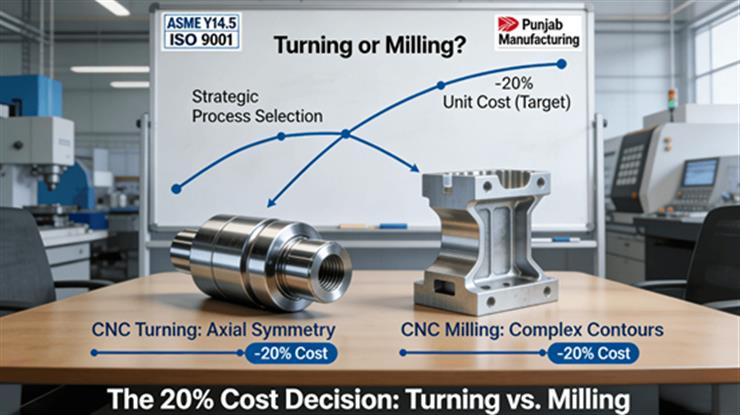
This guide aims to provide a frameworkusing standards such as ASME Y14.5 and ISO 9001, to help make such process decisions more evidence-based. By using the comparative analysis of the CNC turning and milling process, it is possible to reduce costs by 20% while maintaining high levels of precision.
Key Differences: Turning vs. Milling
The first step in cost-effective decision-making in the various industrial sectors in Punjab is to understand the core differences between the two processes. Hence, it is necessary to choose the appropriate CNC turning and milling services.
- Mechanics and Applicable Geometries: In the case of the CNC turning process, the workpiece is rotatedand the single-point cutting tool is moved in a straight line. This process is appropriate for creating axisymmetric geometries such as shafts, bolts, and fittings. In the case of the CNC milling process, the workpiece remains fixed, and the multi-point tool is rotated, moving in the X, Y, and Z axes.
- Efficiency and Material Use: Turning is associated with increased efficiency in terms of reduced cycle time and material wastage for large quantities of cylindrical parts with good surface finish. However, in the case of milling, the process is slower with increased wastage for some parts. The choice of materials is also important in the context of efficiency. Turning is best for metallic materials, while the choice is broader for the materials that can be machined with the milling process.
Strategic Selection for Cost Optimization
The choice between turning and milling is very important in terms of the end product’s cost, time required for production, and quality. The choice is strategic in nature.
- Geometry-Based Decision Matrix: For parts with rotational symmetry such as cylinders or cones, the turning process is the best option. For such parts, the turning process meets the requirements for precise concentricity as per ASME Y14.5 standards. For parts with multiple flat surfaces or pockets with irregular shapes in three dimensions, the milling process is the best option. For the designers in Punjab, it is important to use 3D modeling software to assess the parts’ features to avoid costly machining limitations.
A close-up of an engineer’s decision flowchart on a workbench, starting with “Is the part rotationally symmetric?” to guide users toward choosing CNC Turning or Milling, accompanied by real part samples and calipers for context.
- Volume and Economic Trade-Offs: In volume production of simpler geometries, turning will typically provide lower unit costs because of shorter cycles and easier fixturing. Milling may be competitive in low-volume, complex geometries, where its flexibility will outweigh the cost of setup. A break-even analysis should be performed, recognizing that for some parts, in addition to milling, the use of customized CNC turning services may provide additional cost savings.
Conclusion
Punjab manufacturers through careful comparison of CNC turning versus milling can achieve substantial cost reductionroughly 20% target. The main point here is to realize the geometric fittingleverage the high precision and speed of CNC turning for cylindrical parts, and refine milling operations by toolpath optimization and local material sourcing. Adherence to international standards (ASME Y14. 5, ISO 9001) will ensure reliability and allow gaining an advantage in highly demanding precision industries.
FAQs
Q: What is the primary benefit of CNC turning for cylindrical components?
A: The primary benefit of CNC turning for cylindrical components is that it is more efficient and economical than milling.
Q: How can lead times for CNC turning contracts in Punjab be minimized?
A: The lead time can be reduced by hiring trained and experienced staff who can do the setup quickly, using machines with a high, speed spindle and an automatic tool changer, and by building a good local supplier network for materials delivery just in time.
H3: Author Bio
This resource has been written by the engineering experts at LS Manufacturing. They are a company that specializes in providing high-quality components to the aerospace, medical, and automotive industries, with a focus on meeting the high standards set out by IATF 16949 and AS9100D. They provide complimentary project analysis and Design for Manufacturability reviews.

Comments are closed.