

In 2013 a pamphlet circulated by a grassroots organisation working along the India Nepal border carried a statistic that should have triggered immediate institutional alarm. In Shravasti district in Uttar Pradesh, approximately one in four girls were married before the age of nineteen. The number was not merely a social indicator. It was evidence of systematic non compliance with the Prohibition of Child Marriage Act 2006, a national law that criminalises the marriage of girls below eighteen. The law existed. The numbers existed. Enforcement did not.
The journalist whose reporting forms the backbone of this account encountered that pamphlet and made a decision that many policymakers have avoided. Shravasti lies less than ninety miles from her home town, yet it felt politically distant from the constitutional promises made in New Delhi. On her first visit, the visual landscape told its own story. Male out migration was high, driven by economic necessity. Young brides remained in extended households with in laws, managing domestic labour and raising children often before they themselves reached adulthood. The burden of agricultural work, caregiving and household management rested on girls who had been legally defined as minors only months earlier. It was in April 2014 that she met Arti, fourteen years old, on the eve of her wedding. According to the journalist’s account, Arti welcomed her warmly into the family home, introduced friends and relatives, and supervised preparations with visible competence. She moved with the efficiency of someone accustomed to responsibility. At fourteen she had already internalised the discipline of adult domestic management. When asked how she felt about her impending marriage, Arti’s response was neither romantic nor rebellious. She said, what is there to feel, it happens to everyone. That sentence was not apathy. It was social conditioning distilled.
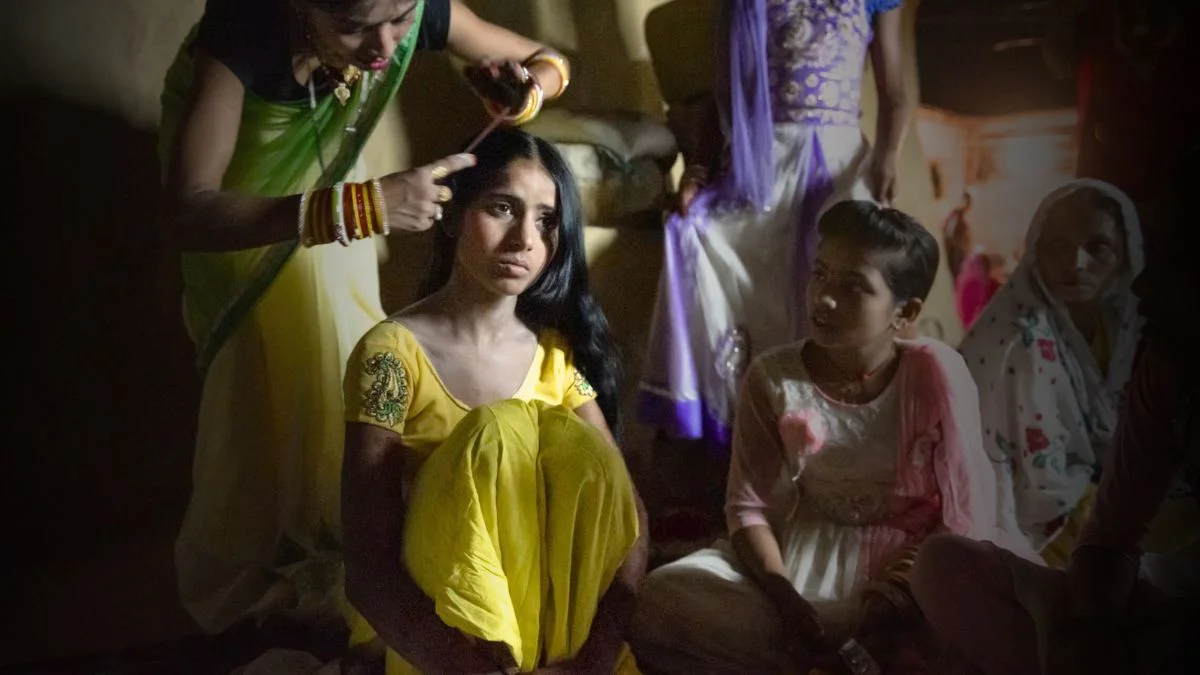
The following day, as she was dressed in her new sari, surrounded by female relatives adjusting her hair and makeup, there were fleeting moments when vulnerability surfaced. The journalist observed that Arti appeared briefly withdrawn, almost suspended between childhood and the irreversible transfer of authority over her life. Then the ceremony proceeded. Ritual prevailed over rights. Under Indian law, Arti’s marriage was voidable and those who facilitated it were liable to criminal sanction. Under international law, India is a party to the Convention on the Rights of the Child and the Convention on the Elimination of All Forms of Discrimination Against Women, both of which obligate the state to eliminate child marriage and protect the autonomy and health of girls. Yet in districts such as Shravasti the architecture of rights collapses under the weight of custom, poverty, dowry expectations and administrative indifference.
After marriage Arti relocated to her husband’s family home. She assumed full responsibility for domestic chores, seeking approval from a mother in law whose expectations were shaped by the same patriarchal norms. Her husband, twenty one years old, continued his education. Arti’s schooling ended. This educational discontinuity is not incidental. Data from the National Family Health Survey consistently demonstrate that early marriage correlates strongly with truncated education for girls, reduced labour force participation and increased vulnerability to domestic violence. Education is not merely academic attainment. It is leverage in negotiations over one’s own body and future.
At nineteen Arti experienced her first pregnancy, which ended in miscarriage at the end of 2019. She was heartbroken and left physically weak. In April 2020, during the first wave of the Covid nineteen pandemic, the journalist telephoned to check on her. The call was answered by Arti’s father in law, who informed her that Arti had taken her own life.
Her death occurred during a period when India, like much of the world, was under strict lockdown. The pandemic intensified economic stress, domestic confinement and disruption of support networks. National Crime Records Bureau data for 2020 recorded an increase in reported suicides across the country, including among housewives. While individual causation in any suicide is complex and multifactorial, the structural context cannot be ignored. Young married women in rural India often live in hierarchical households with limited mobility, limited economic independence and limited access to confidential mental health services. When grief, reproductive loss and interpersonal conflict converge within such constraints, the risk environment deepens. Arti’s trajectory from adolescent bride to nineteen year old suicide victim is not an anomaly but a case study in systemic failure. Child marriage in India has declined over decades, yet prevalence remains significant in certain states and districts. According to the National Family Health Survey five conducted between 2019 and 2021, the percentage of women aged twenty to twenty four who were married before eighteen in India stood at twenty three point three percent. Uttar Pradesh, due to its population size, contributes substantially to the absolute number of child brides. These figures represent millions of girls whose legal minority was overridden by custom and economic calculus.
The legal framework is not silent. The Prohibition of Child Marriage Act 2006 provides for the appointment of Child Marriage Prohibition Officers, empowers courts to issue injunctions and renders certain child marriages void. The Protection of Children from Sexual Offences Act 2012 criminalises sexual activity with minors, which in principle applies within child marriages. Yet enforcement in rural districts is sporadic. Local authorities may hesitate to intervene in what are framed as community matters. Families may fear social ostracism if they resist marriage arrangements. Political incentives rarely align with rigorous prosecution in areas where early marriage is normalised.
Internationally, child marriage is recognised as a human rights violation with documented consequences for maternal mortality, infant health, educational attainment and economic productivity. The United Nations Sustainable Development Goals include a target to eliminate child marriage by 2030. India has endorsed these commitments. However, progress is uneven and vulnerable to regression during crises. The Covid nineteen pandemic disrupted schooling for extended periods, increased economic precarity and, according to several civil society reports, heightened the risk of child marriage in some regions as families sought to reduce perceived financial burdens.
Arti’s miscarriage and subsequent suicide also illuminate the intersection between reproductive health and mental health. India’s public health system has expanded maternal care services over recent years, yet mental health integration remains inadequate, particularly in rural settings. The National Mental Health Programme exists on paper, but district level implementation varies widely. Stigma around psychological distress, combined with scarcity of trained professionals, leaves many young women without confidential avenues for counselling. When a nineteen year old bride suffers reproductive loss within a household where her status may already be fragile, the absence of psychosocial support can be fatal. It is convenient for policymakers to treat child marriage as a residual cultural practice gradually fading with development. This narrative obscures the political economy that sustains it. Dowry expectations, land fragmentation, insecurity about girls’ safety and limited secondary school access in rural areas all reinforce early marriage. Migration patterns that leave young women in joint households without their husbands for extended periods create additional power imbalances. Enforcement officers are often under resourced. Data systems capture prevalence but rarely track individual outcomes such as educational dropout, domestic violence or mental health deterioration post marriage.
The pandemic period during which Arti died further exposed institutional fragility. Lockdowns constrained access to helplines, courts and non governmental organisations that might otherwise intervene. Economic contraction intensified household tensions. For adolescent brides already living at the edge of agency, confinement removed even the limited social interaction that might provide relief. While national attention focused on infection rates and economic stimulus, the interior lives of girls like Arti remained invisible.
From a legal perspective, her marriage represented a failure to enforce statutory protections. From a public health perspective, her miscarriage and suicide represented a failure to integrate reproductive and mental health services. From an international relations perspective, her life and death sit within a broader global struggle to meet commitments on gender equality and child protection. Development assistance, domestic budgets and diplomatic rhetoric frequently invoke empowerment of women and girls. Yet in districts such as Shravasti, empowerment remains aspirational rather than operational.
The most disturbing aspect of Arti’s story is its normality. Her initial response to marriage, what is there to feel, it happens to everyone, reflects collective internalisation of inevitability. When illegality becomes routine and rights become abstract, accountability dissolves. The state is not absent. It is selectively present. It registers births, conducts surveys and proclaims schemes. It does not consistently interrupt the transaction that converts a fourteen year old girl into a wife. Arti’s suicide is not solely a private tragedy. It is the terminal point of a chain of decisions made by adults, tolerated by local authorities and insufficiently challenged by systems designed to protect minors. Each link in that chain was foreseeable. Each was documented in data, policy briefs and parliamentary debates. Yet prevention requires political will that competes with electoral calculations and bureaucratic inertia.
Experts analysing child marriage in India often focus on aggregate decline and comparative state performance. Those metrics matter, but they can anaesthetise urgency. A reduction from thirty percent to twenty three point three percent nationally still translates into millions of girls entering adult roles before psychological and physical maturity. Each statistic contains an Arti whose education stopped, whose reproductive health was compromised and whose mental resilience was tested beyond capacity. The question for India, and for the international community that partners with it on gender and development initiatives, is whether child marriage will continue to be treated as a cultural residue or confronted as a rule of law crisis. Laws without enforcement invite contempt. Commitments without monitoring invite regression. Arti’s life intersected with both failures.
When a fourteen year old bride supervises her own wedding preparations with practised efficiency, observers may mistake composure for consent. It is not consent when choice is structurally absent. It is adaptation to constraint. When she later loses a pregnancy and, at nineteen, loses hope, the narrative should not end with personal sorrow. It should trigger forensic examination of the institutions that allowed her childhood to be traded and her distress to go untreated. Arti’s death during a global pandemic did not generate national headlines. It did not prompt parliamentary debate. It did not alter budget allocations. Yet it stands as a precise indictment of the gap between law and lived reality. Until that gap is closed through rigorous enforcement, sustained investment in girls’ education, accessible mental health services and genuine community engagement, the cycle will persist.
The brutality of child marriage lies not only in early ceremonies but in the slow erosion of possibility that follows. Arti met the law on paper and tradition in practice. Tradition prevailed. The cost was a life that should have unfolded over decades but was extinguished at nineteen. For a country that aspires to demographic dividend and global leadership, such losses are not marginal. They are structural wounds that weaken the very foundations of development and justice.

Comments are closed.