
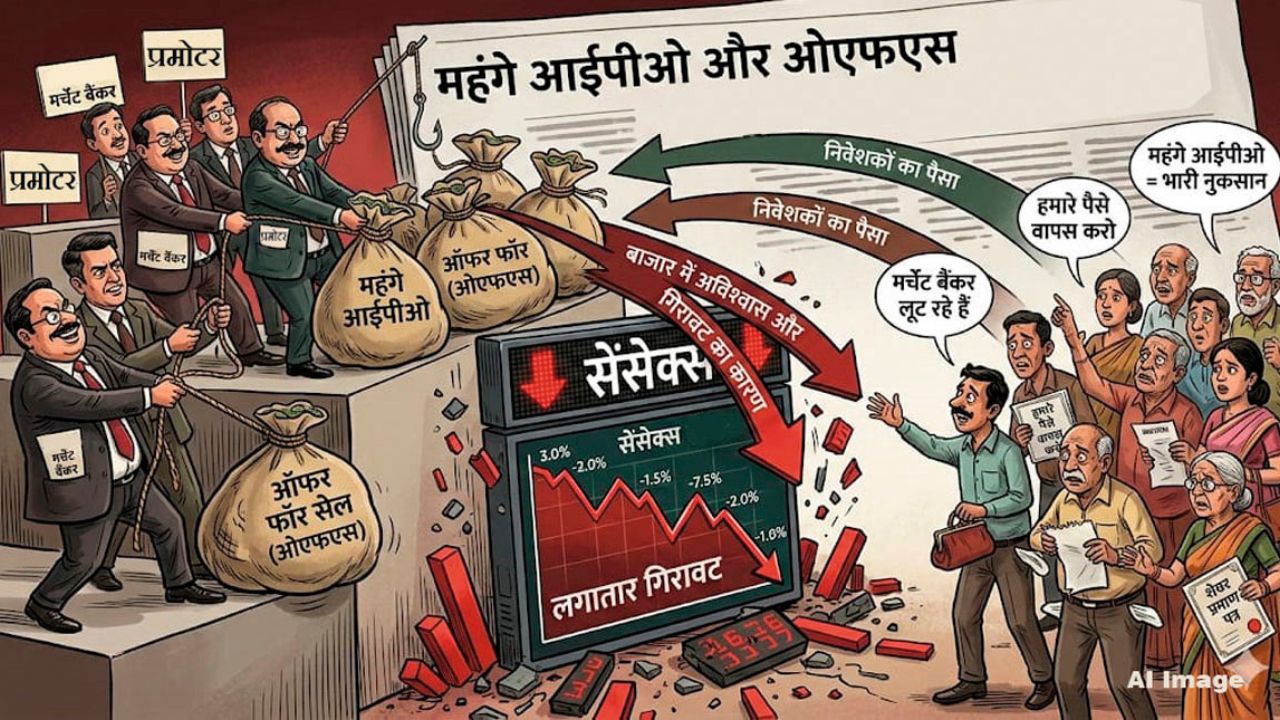

Share Market Crash Hindi: The Indian Stock Market, already suffering from recession, has now been hit twice by the Iran-Israel war. The four main benchmarks of the stock market, Sensex-Nifty and Midcap-Smallcap, have fallen to their lowest levels in 11 months. In fact, capital markets regulator ‘SEBI’ The Indian stock market is suffering from a severe recession due to the biggest IPO-OFS loot in history that has been going on for the last 5 years by taking illegitimate advantage of the open exemption given by SEBI and this recession started from October 2024, which is continuing.
Even though India has become the fourth largest economy in the world with a high growth of more than 7% and the stock indices of all the big countries of the world have reached new heights in the year 2025, the risk of recession in the Indian market is increasing. Neither the Finance Minister nor the SEBI chief has ever paid attention to this serious issue. The result of this negligence of the government and SEBI is that the Indian market has been in recession for the last 17 months and the share prices of 80% of the companies are falling to 52-week or new minimum levels. During the last 17 months, share prices of more than 4100 companies have suffered losses ranging from 10 to 50%. Still SEBI officials are maintaining silence.
India growth story fuss
Now India’s growth story has almost deflated and greedy merchant bankers, promoters and big fund houses are responsible for it. That is, by forming a cartel, these capitalists are defrauding crores of retail investors across the country through expensive public issues-offer for sale (IPO-OFS). The kind of looting that took place in the IPO market, such corporate looting also took place during 1992-1995. Its adverse effect was that for several years there was a severe recession in the economy and the stock market. Even now the danger of a similar massive recession has arisen. Warning of this huge recession ‘Obnews’ In its article published on December 22, 2021 ”India Growth Story being blown out” I had given.
SEBI’s ‘open exemption’ unfair advantage of
SEBI’s ‘open exemption’ The amount of capital that has been raised through expensive IPOs in the last 5 years by taking illegitimate advantage is more than was raised even in the last 20 years. In the last 5 years, a record capital of Rs 6 trillion has been raised from the market through about 400 IPOs, which is 30% more than the capital of Rs 4.55 trillion raised through 658 IPOs in the 20 years between 2000 and 2020. The matter of concern is that 65% of this is Offer for Sale (OFS) i.e. huge capital of about Rs 4 trillion, which has gone directly into the pockets of capitalists and foreigners. In the last two years alone, OFS worth Rs 2.30 trillion have been launched at fantastically expensive valuations.
What is also worrying is that in about 50% of IPOs, crores of investors have suffered losses worth billions of rupees. Expensive IPOs including Paytm, Ola, Meesho, Glotis, Jarrow, Accelsoft, DreamFolk, Credo, Utkarsh, IdeaForge, Brainbees, Dame Capital, Aikiyo, Acme, Honasa, FirstCry, Concord, Orkla, IndoPharm, SolarWorld, Sheshasai, Zen Aromatics, Swiggy, Shadowfax, CleanMax are countless examples of corporate loot. The IPO of Reliance Power in 2008 was also a big robbery. Today all these shares are biting the dust.
Disappointment with the new SEBI Chairman too!
If the figures of this IPO loot are calculated in the last three decades, it will be more than Rs 5 lakh crore (Rs 5 trillion). It is a matter of regret that despite this loot of billions of rupees made from crores of small investors of the country, SEBI has still left the most important task of setting the price in IPO to the greedy merchant bankers and promoters. The maximum loot in IPO was done during the tenure of former SEBI chairperson Madhabi Puri Buch. The investors of the country had high expectations from the new President Tuhin Kant Pandey that he would curb this open looting, protect the interests of small investors and save the market from recession, but they too seem to be disappointed. In such a situation, investors themselves will have to be alert for the safety of their deposits.
Also read:- Now you will get a house in Mumbai without lottery, MHADA’s ‘First Come-First Serve’ scheme started, know the method and conditions of application.
Why recession despite huge investment of Rs 6 trillion?
Why are the same institutional investors (fund houses) who are bringing recession by calling the Indian stock market expensive even at a PE ratio of 20 to 30, are putting the savings of retail investors at stake by investing fearlessly in companies that launch very expensive IPOs even at a PE ratio of 100 to 1000? This is a big question.
From October 2024 to February 2026, foreign institutional investors have sold a total of Rs 4 trillion, while Indian institutional investors have made a net purchase of more than Rs 10 trillion in the market on the back of increasing investment by retail investors. That means an investment of Rs 6 trillion more. In such a situation, the question arises that why is there recession despite huge net investment of Rs 6 trillion? It is clear that these Rs 6 trillion have gone into the pockets of capitalists through IPO-OFS.
In fact, capital markets regulator ‘SEBI’ The Indian stock market is suffering from a severe recession due to the biggest IPO-OFS loot in history that has been going on for the last 5 years by taking illegitimate advantage of the open exemption given by the Indian Securities and Exchange Board of India (IAS), and this recession started from October 2024, which is continuing.
– Vishnu Bhardwaj reports from Mumbai for Obnews Live.

Comments are closed.