

Prices of the popular 95-octane fuel, also called RON-95, went up 1.39% to S$2.92 (US$2.28) per liter at Shell on Tuesday morning, as reported by The Straits Times.
Other operators, including Caltex, Esso and Sinopec, later followed suit, except for SPC, which kept its price steady at S$2.87.
SPC currently offers the lowest rates for 92-octane and 98-octane petrols, at S$2.84 and S$3.38, respectively. It also sells the cheapest diesel at S$2.57.
Elsewhere, 92-octane is sold by Esso and Caltex at S$2.88, up from Tuesday, while 98-octane ranges between S$3.42-3.44, with the highest price quoted by Shell at S$3.44.
Diesel prices have also risen to S$2.70 at Shell, Esso and Caltex.
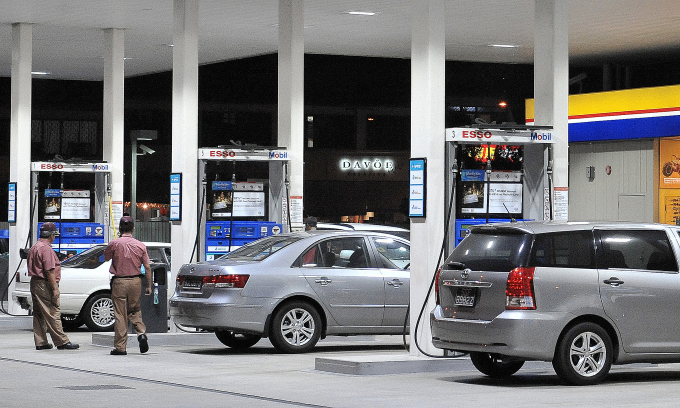
An Esso (ExxonMobil) petrol station along Upper Thomson Road, Singapore on Feb. 12, 2009. Photo by SPH Media via AFP |
The Middle East conflict began last Saturday when the U.S. and Israel launched military strikes on Iran that killed its supreme leader, Ali Khamenei. Iran retaliated with attacks targeting Israel as well as Kuwait, Qatar, Bahrain and the United Arab Emirates.
As a result, global energy prices spiked, with the benchmark Brent crude oil contract climbing 4.7% to US$81.40 a barrel on Tuesday, its highest close since January 2025, as energy exports from the region were halted, Reuters reported.
Roughly 20% of the world’s crude shipments move through the key maritime corridor linking the region’s leading producers to the Arabian Sea.
Economists and business leaders in Singapore have warned that the most immediate threat is sharp swings in oil prices, especially if traffic through the Strait of Hormuz is disrupted.
Selena Ling, chief economist at OCBC, told The Business Times that a halt in physical flows through the Strait could keep crude prices elevated for months rather than just weeks.
She added that any sustained supply interruption would likely stoke global inflation, hitting Asia harder than other regions given its reliance on imported energy and the expansion of power-hungry data centers.
For Singapore, that would mean pressure on both consumer prices and trade flows. Airlines, heavy industry and shipping firms would be among the most exposed, whereas energy producers and commodity exporters would benefit.

Comments are closed.