
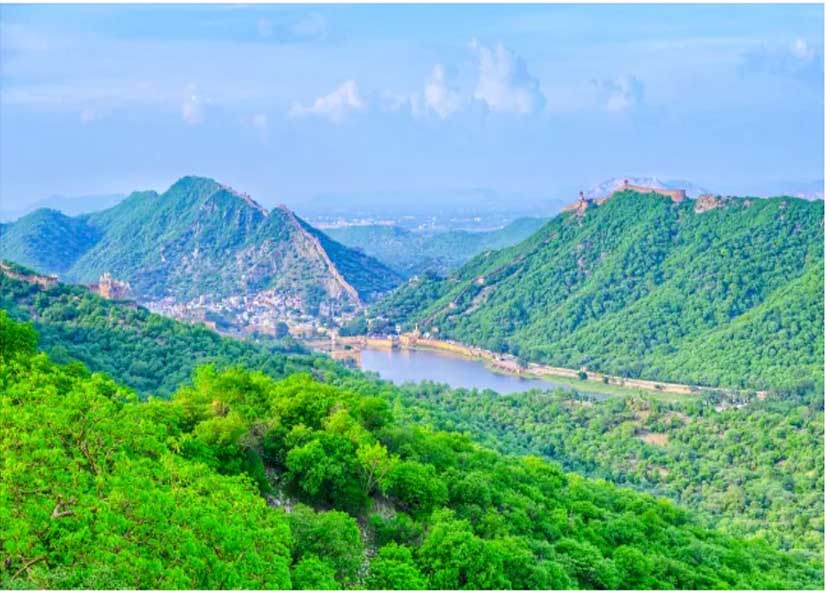
Forest Department issues notice, 15 days ultimatum for removal of religious places built in Aravalli hills

Now the Forest Department has taken a tough stand against some religious places built in the Aravalli Hills. The department has issued an ultimatum of 15 days to remove illegal constructions. If the constructions are not removed within the stipulated time, legal action will be taken by the Forest Department. According to sources, the department has pasted two notices in the temple premises and has also ordered the local people to remove the illegal construction.
The Forest Department has once again adopted a tough stance to remove illegal religious and other constructions built in the Aravalli hills. In June-July last year, on the orders of the Supreme Court, the department had conducted a bulldozer operation in which 241 illegal constructions spread over 261.06 acres were demolished in Lakkarpur, Anangpur, Ankheer and Mevla Maharajpur areas. Forest Department officials said that during that campaign, there was a lot of difficulty in the demolition action in village Anangpur. After this, on the orders of the Supreme Court, the Central Environment Commission (CEC) was formed, which inspected the spot and presented its report in the court.
According to the information, illegal constructions exist on a total of 780.26 acres of land in Aravalli. The Forest Department has now issued an ultimatum to remove illegal constructions within 15 days. The department has said that if the constructions are not removed on time, strict action will be taken.
15 days time given
On February 26, the Forest Department has issued a notice against illegal constructions of some religious places located in the Aravali area of Faridabad. The notice states that the structures built in these religious places violate the PLPA Act. The Forest Department has clarified that the purpose of the Aravalli region is only for plantation and environmental protection, hence any kind of construction is illegal here. In the notice, an ultimatum has been given to remove the illegal structures within 15 days.
Encroachment and illegal mining in Aravalli has serious impact on climate balance: Report
A study report released in January 2026 by Union Environment, Forest and Climate Change Minister Bhupendra Yadav revealed that encroachment, deforestation, illegal mining and expansion of urban infrastructure in the Aravalli ranges have severely impacted groundwater recharge, biodiversity, air quality and climate balance.
The report notes that large-scale conversion of forest land occurred before the 1980s, especially around the Sariska and Bardod wildlife sanctuaries, leading to a severe decline in natural forest cover. This resulted in fragmentation of important wildlife habitats and watersheds. The objective of this study was to evaluate measures for ecological restoration of the Aravalli landscape. This research was conducted by Sankala Foundation in collaboration with the Embassy of Denmark in India and Haryana State Forest Department.
A recently released study has recommended adopting an integrated approach to prevent and improve ecological degradation in the Aravalli region. In this approach environmental sustainability is linked with biodiversity conservation, climate resilience, livelihood security and human rights. The Aravalli range, one of the oldest mountain ranges in the world, acts as an important natural barrier to the National Capital Region (NCR) and the Indo-Gangetic plains. This area contributes significantly to groundwater recharge, water conservation and sustenance by maintaining the local ecosystem.
Concern expressed over these in the report
The fragile ecosystem of the Aravalli range, which spans four states and 29 districts and is home to more than 5 crore people, is under serious threat due to deforestation, rapid urbanisation, unsustainable land use and land degradation and desertification. The study said encroachment, illegal mining and expansion of urban infrastructure are seriously impacting the Aravali’s groundwater recharge capacity, biodiversity, air quality and climate regulation. As a result, the ability of the Aravalis to act as a green barrier has weakened, accelerating desertification and threatening the ecological sustainability of the northern plains.
Sankala Foundation has implemented a site-specific, evidence-based and community-inclusive ecological restoration model by selecting four villages in the Aravali region of Gurugram. This model focuses on the southern part of the district and provides a practical approach to addressing these environmental challenges.
Follow the LALLURAM.COM MP channel on WhatsApp

Comments are closed.