
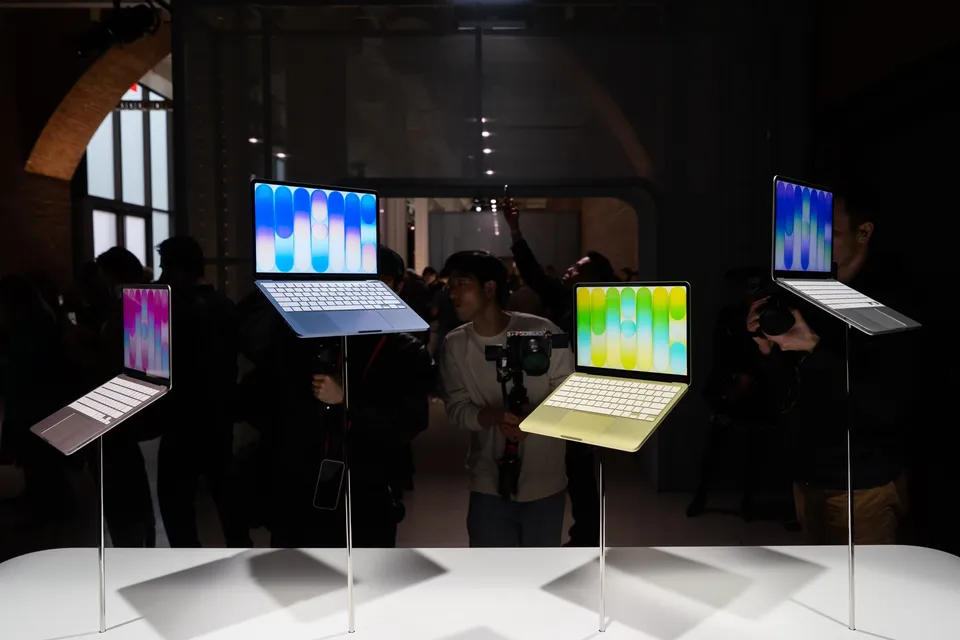

For decades, Apple’s strategy was simple: build the best, charge the most, and leave the “budget” scraps to Windows OEMs and Chromebooks. But on Wednesday, March 4, 2026, the company officially tore up that playbook. In a move that sent shockwaves through the tech industry, Apple unveiled the MacBook Neo, a $599 laptop that represents the most aggressive price-to-performance play in the history of the Mac.
This isn’t a recycled “SE” model or an old chassis with a new chip. The MacBook Neo is a ground-up reimagining of what an entry-level computer should be. By pricing it at $599 (and just $499 for students), Apple isn’t just expanding its catalog; it is declaring war on the mid-range Windows market.
The most controversial and brilliant aspect of the MacBook Neo is its heart. For the first time, Apple has crossed the streams, powering a Mac not with an M-series chip, but with the A18 Pro, the same 3-nanometer silicon found in the iPhone 16 Pro.
While purists might scoff at a “smartphone chip” in a laptop, the benchmarks tell a different story. According to Apple, the MacBook Neo is up to 50% faster for everyday tasks than the bestselling Windows PCs equipped with the latest Intel Core Ultra 5. Even more staggering is its AI performance: the 16-core Neural Engine is reportedly 3x faster at on-device AI workloads than its Windows competitors. By using the A18 Pro, Apple has achieved a fanless, silent design that delivers 16 hours of battery life without the thermal throttling that plagued early thin-and-light portables.
Design: Citrus, Indigo, and Aluminum
Apple is clearly leaning into the “fun” factor to lure the education and Gen-Z markets. The MacBook Neo ditches the serious Pro tones for a playful palette of Citrus (yellow), Indigo (purple), Blush (pink), and Silver.
Despite the budget price, the chassis is 100% aluminum, made with 60% recycled content. At 2.7 pounds and just 0.5 inches thick, it is the most portable Mac in the current lineup. The 13-inch Liquid Retina display offers a crisp 2408 x 1506 resolution and 500 nits of brightness specs that usually command a $1,000 price tag in the Windows world. However, to keep costs down, the display lacks the ProMotion high refresh rates and the “notched” design of the Air and Pro lines, opting instead for a classic, symmetrical bezel.
Apple Intelligence and the ‘Neo’ Experience
The MacBook Neo isn’t just a hardware play; it is a vehicle for Apple Intelligence. Running on macOS Tahoe, the Neo is built to handle local AI tasks like real-time writing tools, generative image cleanup, and “Siri 2.0” with ease.
By ensuring that its cheapest laptop is a “First-Class AI Citizen,” Apple is building a moat. A student who buys a Neo today isn’t just getting a laptop; they are getting a personalized digital assistant that works across their iPhone and iPad. This “ecosystem lock” is what keeps Windows OEMs up at night, it’s no longer about who has the best spreadsheet machine, but who has the smartest companion.
The Strategic Nightmare for Windows and ChromeOS
Industry analysts are calling the Neo a “watershed moment.” For years, Microsoft and Google have dominated the $400–$700 segment because Apple simply didn’t play there. With the Neo, that dominance is under immediate threat.
In a world where global memory prices are spiking and PC manufacturers are struggling to keep costs low, Apple’s vertical integration allows them to offer 256GB of storage and 8GB of unified memory at a price point that makes Chromebooks look underpowered and budget Windows laptops look plasticky. The Neo effectively closes the door on “value” Windows machines that often suffer from poor trackpads, mediocre screens, and terrible resale value.
The Sacrifices: What’s Under the Cutting Room Floor?
To hit $599, Apple did have to make some calculated compromises. Most notably, the base model lacks a backlit keyboard, a feature many have come to take for granted. Additionally, the trackpad is a standard Multi-Touch surface without the haptic feedback found on more expensive models.
Touch ID is another casualty of the budget wars; it is only available if you step up to the $699 model, which also doubles the storage to 512GB. Furthermore, the two USB-C ports are not Thunderbolt-rated, meaning data transfer speeds will be slower for power users. However, for the average student or office worker, these are likely viewed as acceptable trade-offs for a machine that runs macOS flawlessly.
The MacBook Neo is a signal that Apple is no longer content with 10% of the PC market. By leveraging its mobile silicon success to drive down prices, Apple has created a device that is almost impossible to ignore. Whether you are a student looking for your first “real” computer or a Windows user tired of the bloatware, the Neo makes a compelling argument: the best value in tech might just have an Apple logo on it.

Comments are closed.