
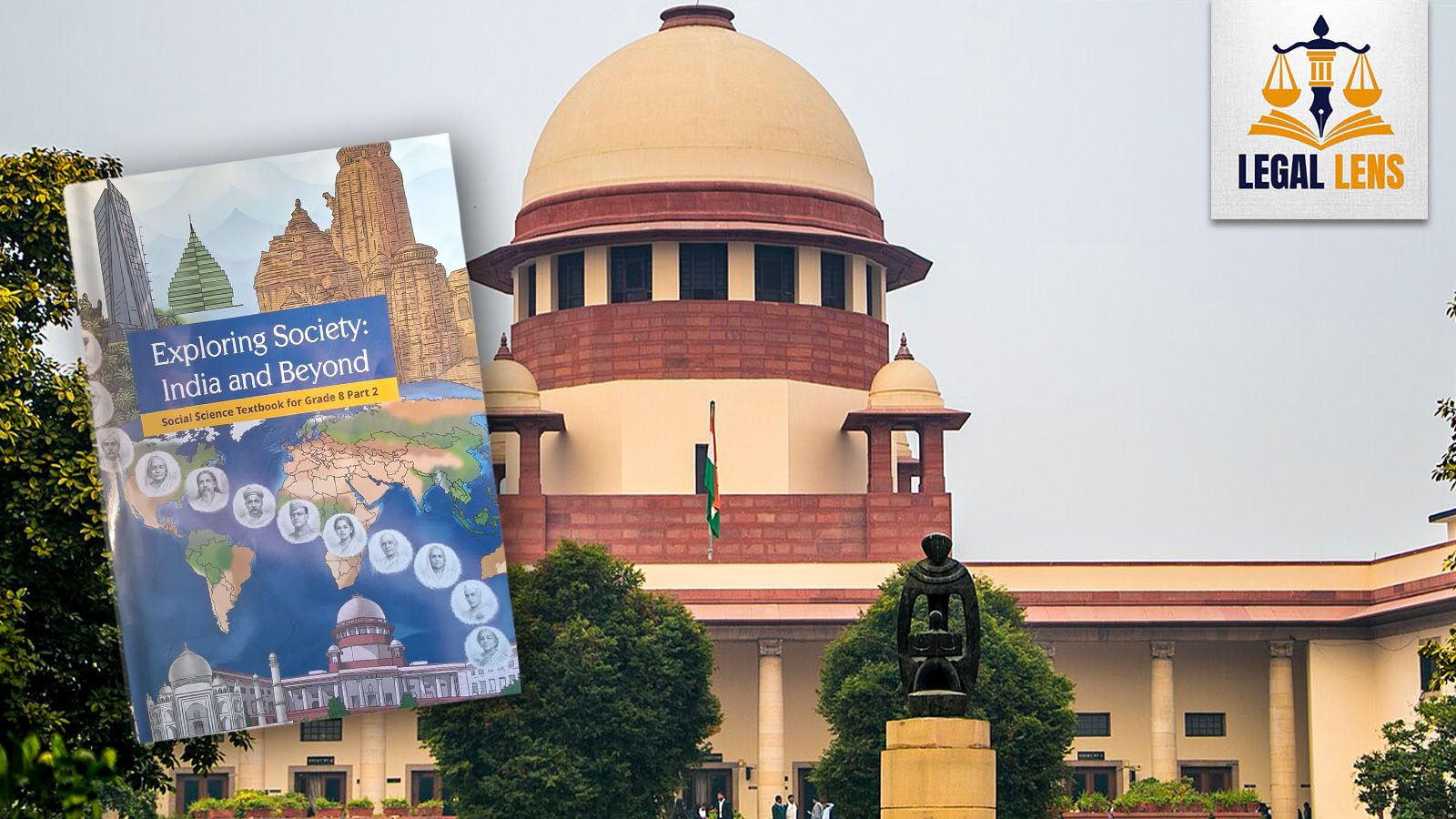

The NCERT issue begins with a statutory definition. Section 2(c)(i) of the Contempt of Courts Act, 1971 defines criminal contempt as any act that “scandalises or tends to scandalise” the authority of a court. It is a useful starting point, because the controversy around the Class 8 social science textbook has been framed almost entirely through this lens.
The doctrine of “scandalising the court” is a legacy of English common law, with deep roots in the monarchical system of justice. Historically, British judges were considered the direct representatives of the Crown, and any attack on them was akin to an attack on the sovereign.
An eminent jurist had once explained this as a principle to sustain the “blaze of glory” around the judiciary to ensure public confidence. The phrase “scandalising the court” is paternalistic and somewhat authoritarian, as it seeks to shield the judiciary from all criticism and to maintain its mystical authority.
This provenance matters because it underlines the doctrine’s original logic: preserving institutional aura.
Ironically, in the UK, the term was abolished in 2013, on the recommendation of its Law Commission. Subsequently, courts in the UK declared the act of “scandalising the court” obsolete.
Also read: NCERT textbook row: Has SC overreacted?|AI With Sanket
This comparative reference is significant because it highlights how the jurisdiction that birthed the doctrine has consciously stepped away from it. But, in India, the legal challenge to the use of this term in our statute book has not so far been successful.
That litigation history, however, does not settle the issue of how the judiciary chooses to use the provision in practice. Nothing prevents our judiciary from letting it remain a little-used provision in the light of the UK eschewing it.
Court’s discretion
On February 26, our Supreme Court found it all the more relevant to invoke it against the authors of the NCERT textbook because they chose to expound on “corruption in the judiciary”.
In other words, even if Parliament has not amended the Act, the court still has discretion about how readily it reaches for this weapon.
Also read | Who writes NCERT textbooks, and who really controls what goes in them?
The Supreme Court’s three-judge Bench, comprising Chief Justice of India Surya Kant, and Justices Joymalya Bagchi and Vipul M Pancholi, expressing its shock over the book’s contents, banned it and ordered seizure of its copies, besides issuing show-cause notices threatening contempt action.
That institutional response sets up the core tension: how the judiciary reacts to criticism when the criticism is directed at itself.
Child and the newspaper
To see the tension plainly, it helps to shift vantage points—from doctrine and institutional self-description to the world as an eighth-standard student encounters it.
It would indeed make sense to imagine a thought experiment. A typical eighth-standard student in a metropolitan city is, by now, a reasonably informed news consumer. They may not read the newspaper cover-to-cover, but they see headlines on their phone, catch dinner-table conversations, and absorb fragments of public discourse daily.
Also read: ‘Heads must roll’: SC bans NCERT book over chapter on ‘judiciary corruption’
By the time the NCERT textbook lands on their desk, they likely already know about the Justice Yashwant Varma episode — the discovery of large amounts of unaccounted cash at a sitting High Court judge’s residence, the subsequent inquiry, and the protracted and still-unresolved process of accountability. They know about the 4.7 crore pending cases in district courts. They may have heard adults complain about having to “manage” lower court proceedings.
Just a formal endorsement
Against that background, the textbook arrives as a formal endorsement that these issues are part of the country’s civic conversation.
So, the child looks at the textbook, which tells them that corruption, pendency, and inadequate judicial infrastructure are challenges facing the Indian judicial system, and then looks up to see the Supreme Court calling this a “calculated conspiracy to defame”. The question forming in the young mind is a fair one: which account is closer to reality?
At that moment, institutional credibility is being negotiated in real time through competing narratives.
The court’s response, paradoxically, may have done more damage to institutional credibility among precisely the demographic it sought to protect than the textbook ever could have. When an institution responds to a critique with suppression rather than rebuttal, it confirms rather than refutes the critique.
Speed and intensity
From this vantage, the controversy becomes less about a paragraph in a textbook and more about the judiciary’s reflexes when its legitimacy is tested.
That brings us to a broader pattern: the speed and intensity with which the court moves, appears to vary depending on what, and who, is implicated.
Also read: SC on NCERT’s ‘corruption in judiciary’ chapter: ‘Will not allow institution to be defamed’
It is tempting to see the court’s “overreaction” to the textbook controversy as its eagerness to give a clean chit to itself and protect its turf. But the pattern of displaying selective urgency by the judiciary is visible across several domains.
Read alongside the textbook ban, this suggests a judiciary that reacts fastest when the mirror is held too close.
The same theme of selective emphasis also surfaces in the court’s constitutional self-narration.
Basic structure doctrine
The Court expressed its dismay in its order on February 26 that the controversial NCERT textbook did not find it necessary to highlight its contributions to preserve the nation’s democratic fabric, uphold constitutional morality and the basic structure doctrine.
That complaint, in turn, invites a comparison: how the court deploys the basic structure doctrine, and whether it does so consistently across its components.
The NJAC judgment of 2015 is the most significant recent example of the court deploying the basic structure doctrine to protect its own institutional interests.
The Supreme Court struck down the National Judicial Appointments Commission Act, holding it violated the basic structure of the Constitution by undermining judicial independence. The judgment, delivered by a five-judge bench with a 4:1 majority, effectively declared that the executive and legislature could have no meaningful role in judicial appointments, because judicial independence — as interpreted by judges themselves — demanded it.
In that case, the court’s muscularity was unmistakable, and it was justified in the language of protecting constitutional architecture.
Relevance of dissent
The dissent by Justice Jasti Chelameswar is worth remembering here. He warned that the collegium system had become what he called “a euphemism for nepotism”, promoting “mediocrity or even less,” and that the NJAC could have served as a check on “unwholesome trade-offs within the collegium and incestuous accommodations between judicial and executive branches.” His voice was overruled 4:1.
Also read: NCERT apologises after facing SC ire over chapter on judicial corruption
The relevance of the dissent is that it underlines the stakes: institutional autonomy can coexist with institutional opacity.
The basic structure doctrine, as a constitutional innovation, is broadly salutary — it has protected secularism, federalism, free and fair elections, and the right of judicial review itself over the decades. But it is worth asking: has it been applied with equal vigour across all elements of the basic structure, or does it get deployed most forcefully when judicial independence specifically is threatened?
Democracy-defining domains
This question becomes especially pointed when placed alongside the court’s pace in other democracy-defining domains.
Free and fair elections are a component of the basic structure — the Indira Nehru Gandhi case of 1975 established this. Yet, when the electoral bonds scheme effectively provided a mechanism for anonymous corporate funding of political parties, enabling opacity in a domain where the public has a fundamental right to know, the court’s response was delayed and incomplete.
The Electoral Bonds judgment in 2024 struck down the scheme, but years of opacity had already occurred, and the political beneficiaries retained what they had received. The basic structure component of democratic transparency did not generate the same institutional urgency that the NJAC case did.
Speed and muscle
Similarly, federalism is a basic structure element under the SR Bommai v. Union of India judgment. Governors in several states have sat on Bills passed by elected assemblies for months and years, declining to act, in what constitutional scholars across the political spectrum have described as a fundamental subversion of parliamentary federalism.
The Supreme Court has spoken on this, but implementation has been tortuous and executive compliance grudging. The basic structure, it appears, is enforced with varying degrees of muscle depending on which institution’s interests are centrally at stake.

Comments are closed.