
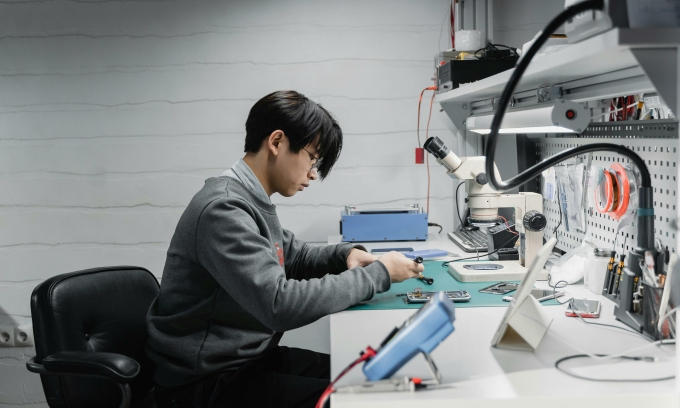

Instead, the teenager from Yangjiang, a small coastal city in Guangdong Province, enrolled at Shenzhen Polytechnic University, a vocational school, to study electronic information engineering technology.
What sealed his decision was a campus visit where he saw “robots running around everywhere” and students hands-on with advanced equipment, he recounted at a freshman symposium, according to the Shenzhen Special Zone Daily.
A few years ago, this would have been considered a bewildering waste of talent. In China, where the grueling gaokao college entrance exam has for decades served as the gateway to social mobility, choosing a vocational school over a top-tier university was seen as a last resort, only when one’s scores left no better option.
That stigma is eroding fast. Across the country, high-scoring students are increasingly turning to vocational universities, institutions that grant bachelor’s degrees but focus their curricula squarely on hands-on technical training rather than academic theory.
The driving force is brutally pragmatic: China’s job market is flooded with graduates from traditional universities who cannot find work, while vocational graduates are landing jobs at far higher rates.
At Shenzhen Polytechnic University, dubbed the “Little Tsinghua” of vocational schools, the physics-stream admission score surged to 617 points this year, up from 595 after its upgrade to university status in 2023, surpassing many traditional elite institutions, according to China Daily.
At Shunde Polytechnic in Guangdong, more than 1,180 of the 1,275 students admitted in 2024 scored above the regular university cutoff, the South China Morning Post reported.
The shift reflects a deeper structural transformation in how China thinks about higher education.
Gerard Postiglione, emeritus professor of education at the University of Hong Kong, told the South China Morning Post that China is working to integrate rather than separate the academic and vocational-technical sides of higher learning, a recalibration driven by rapid technological development and economic diversification.
Beijing has been actively fueling this expansion. After the State Council launched a pilot program with just 15 vocational universities in 2019, the number has grown to more than 100, according to the SCMP. Last month, the government proposed establishing eight more.
For students like Lin, the calculus is straightforward. A prestigious degree from a traditional university no longer guarantees a good job. A vocational degree focused on drones, robotics or AI engineering increasingly does.

Comments are closed.