
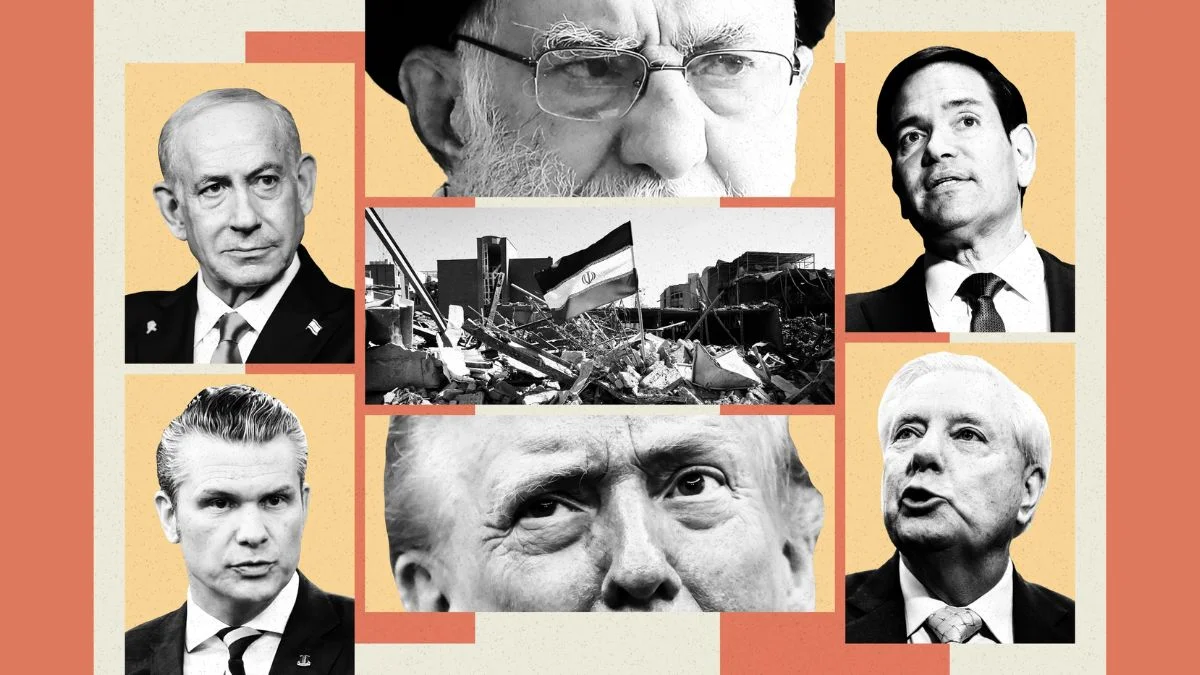

The latest United States military strikes against Iran represent one of the most consequential geopolitical escalations of the decade and have already triggered a cascade of strategic, economic and political consequences that extend far beyond the immediate theatre of conflict. What initially appeared as a calculated military operation designed to degrade Iranian capabilities has rapidly evolved into a far more volatile confrontation with implications for global energy markets, American military readiness, regional stability in the Gulf and the domestic political landscape of the United States itself. For an administration that built much of its political identity on promises to avoid new foreign wars, the unfolding conflict now presents a profound contradiction that could shape both international relations and American electoral politics for years to come.
President Donald Trump returned to the White House on a wave of nationalist rhetoric that emphasised military strength while simultaneously promising to avoid the prolonged entanglements that characterised earlier American interventions in the Middle East. The pledge resonated strongly with a political base fatigued by decades of war in Iraq and Afghanistan. Yet the decision to strike Iran once again has dramatically altered that narrative. Since the attacks began on Saturday, six American service members have been killed, while Iranian counterattacks have already targeted Gulf states that host American forces and Western economic infrastructure. The rapidly escalating cycle of retaliation has revived the spectre of a prolonged regional war, precisely the scenario that many American voters believed had been left behind.
The strategic context surrounding the current strikes differs significantly from the geopolitical environment that defined Trump’s first administration. During his earlier presidency, Trump was frequently surrounded by a national security team composed of officials drawn from traditional Republican foreign policy circles who often attempted to moderate his instincts. The present administration, by contrast, is widely viewed as being staffed by loyalists who possess a far clearer understanding of how the president approaches decision making on international crises. This shift has produced a more assertive foreign policy posture that emphasises speed, surprise and the willingness to employ military force in pursuit of geopolitical objectives.
Observers inside Washington increasingly note that the administration appears acutely aware of the political calendar that now frames American policymaking. With midterm elections approaching in roughly eight months, the White House is operating within a narrow window in which decisive international action can be undertaken without the immediate constraints that often emerge once electoral campaigns intensify. The result is an executive branch that appears willing to move aggressively on global security issues, particularly in areas where presidential authority traditionally enjoys far greater latitude than domestic policy.
Iran has long occupied a central place within the strategic worldview of Trump and many of his closest advisers. The Iranian government is widely regarded within Republican national security circles as one of the primary state sponsors of militant proxy networks across the Middle East, while its nuclear programme has been viewed for decades as a potential trigger for regional proliferation. The current administration therefore frames its military campaign as part of a broader effort to neutralise what it considers the most significant threat to long term stability in the region. In the view of officials within the White House, crippling the Iranian regime would weaken the strategic partnerships that Tehran has cultivated with major geopolitical rivals of the United States, including Russia and China.
The perception of previous successes has also contributed to the administration’s willingness to escalate. Trump’s decision during his first term to order the killing of Islamic Revolutionary Guard Corps commander Qassem Soleimani was widely predicted by many analysts to ignite a major regional war. Although tensions surged in the immediate aftermath, the feared spiral into full scale conflict did not materialise. Similarly, Trump’s controversial recognition of Jerusalem as the capital of Israel and the relocation of the American embassy there in 2018 defied warnings from foreign policy experts who anticipated widespread unrest across the Middle East. The administration now appears to interpret these experiences as evidence that bold actions can succeed despite the scepticism of the diplomatic establishment.
Additional confidence has reportedly emerged from more recent operations undertaken during Trump’s second term, including actions targeting the Venezuelan government. Within the White House there is a growing belief that assertive interventions can reshape political landscapes in adversarial states without necessarily producing the catastrophic consequences often predicted by critics. This belief has helped embolden a president who increasingly views the projection of military power as a defining instrument of his foreign policy legacy. However, the economic ramifications of the Iran conflict are already beginning to reverberate across global markets. The most immediate concern involves the Strait of Hormuz, a narrow maritime corridor through which approximately twenty percent of the world’s crude oil supply passes each day. Disruptions to shipping traffic through this chokepoint have historically produced dramatic surges in energy prices. Even the perception of instability in the area can drive significant market volatility, as insurers, shipping companies and energy traders attempt to anticipate the risks associated with transporting cargo through a conflict zone. Energy analysts have already recorded significant increases in oil prices following the outbreak of hostilities. If the confrontation persists beyond several weeks, the consequences for global energy markets could be severe. Some forecasts suggest that crude prices could climb into triple digit territory, a development that would ripple through the global economy by increasing transportation costs, fuelling inflationary pressures and undermining consumer confidence. Such a price shock would be particularly damaging for European economies that are still adjusting to the energy disruptions triggered by Russia’s invasion of Ukraine earlier in the decade.
The paradox confronting the Trump administration is that the United States now enjoys a stronger position in global energy markets than at any previous point in modern history. Thanks to the expansion of domestic production during the shale revolution, the country has established itself as a net exporter of crude oil. This status provides Washington with greater strategic flexibility when confronting instability in oil producing regions. Nevertheless, the domestic political sensitivity surrounding petrol prices remains extremely high, particularly during election cycles. Even modest increases at the pump can produce disproportionate political backlash, especially when voters perceive that foreign policy decisions are contributing to rising costs. The strategic uncertainty surrounding the conflict is compounded by the absence of a clearly articulated endgame. Defence officials have emphasised tactical objectives such as destroying Iranian ballistic missile infrastructure, crippling naval capabilities and neutralising nuclear facilities. Yet there has been comparatively little public discussion regarding the political landscape that might emerge if these military goals are achieved. The possibility of regime change has occasionally surfaced in presidential rhetoric, although recent statements from administration officials appear to treat that outcome as desirable but not essential.
The question of political succession inside Iran therefore looms large over the entire confrontation. With the death of Supreme Leader Ayatollah Ali Khamenei, attention has turned to potential figures who might assume control of the Islamic Republic’s political and religious institutions. Among the most frequently mentioned candidates is Mojtaba Khamenei, the late leader’s son, who is believed to maintain close ties with the powerful Revolutionary Guards. Other names circulating within diplomatic circles include Alireza Arafi, a member of the transitional council formed after Khamenei’s death, and Seyed Hassan Khomeini, the grandson of the revolutionary leader Ayatollah Ruhollah Khomeini. Each of these figures represents a different faction within the complex political structure that governs Iran. Despite speculation about succession, the Iranian regime retains a decisive advantage that external military pressure cannot easily eliminate. The state continues to control the armed forces, internal security services and the instruments of coercive authority necessary to maintain power. Even if significant damage is inflicted upon its military infrastructure, the leadership in Tehran may still possess sufficient resources to sustain a prolonged resistance against foreign intervention. Historical precedents across the Middle East demonstrate that dismantling entrenched political systems through external military pressure alone is extraordinarily difficult.
Meanwhile, the logistical challenges facing the United States military are beginning to draw increasing attention within defence circles. The sophisticated precision munitions used in modern air campaigns are expensive and require complex industrial supply chains to produce. Although American stockpiles remain substantial, they are not limitless. Defence officials have privately acknowledged that sustaining high intensity operations for extended periods could place considerable strain on existing inventories. The United States defence industry has struggled in recent years with workforce shortages and fragile supply chains, making rapid increases in production extremely difficult.
One potential consequence of prolonged operations is the diversion of weapons originally intended for allied nations. Precision guided bombs scheduled for export to NATO partners could be redirected to replenish American stockpiles, a move that would almost certainly generate friction within the alliance. European governments have already begun exploring ways to diversify their defence procurement in response to concerns about the reliability of American supply during times of crisis.
The reaction of international allies has been cautiously supportive yet strategically anxious. Many European governments share Washington’s concerns regarding Iran’s nuclear ambitions, ballistic missile development and support for regional proxy groups. At the same time, European leaders have historically preferred diplomatic engagement over military confrontation when addressing these issues. Their proximity to the Middle East also means that they are more immediately exposed to the economic and security repercussions of conflict in the region.
Across the Gulf, the situation is even more precarious. Countries such as the United Arab Emirates and Bahrain have developed increasingly close intelligence and security relationships with Israel in recent years, driven largely by their shared concern regarding Iranian influence. Nevertheless, these states now find themselves directly exposed to retaliatory strikes from Tehran. Unlike Israel, which possesses extensive civil defence infrastructure including missile warning systems and bomb shelters, many Gulf states lack comprehensive protections for civilian populations. Their anxiety reflects the possibility that a prolonged war could transform their territories into active battlegrounds. The economic dimension of the conflict extends beyond oil prices alone. Natural gas markets have also begun reacting sharply to the instability, particularly after reports that some liquefied natural gas facilities in Qatar have curtailed exports amid rising security risks. For European economies that rely heavily on imported LNG following the collapse of Russian gas supplies earlier in the decade, such disruptions could prove deeply destabilising.
Another critical variable shaping the conflict involves the strategic importance of the Strait of Hormuz itself. Although Iran has threatened to close the waterway, its ability to completely block the passage remains limited. The Iranian navy lacks the conventional power required to maintain a sustained blockade against American and allied naval forces. However, Tehran possesses other asymmetric tools that could render the strait extremely dangerous for commercial shipping. Naval mines, drone swarms and missile attacks against tankers could create an environment so hazardous that insurers refuse to cover voyages through the corridor, effectively halting traffic without requiring a formal blockade.
In response, the United States government has begun exploring extraordinary measures to stabilise maritime trade, including providing naval escorts and government backed insurance guarantees for shipping companies willing to operate in the area. Whether such measures will restore confidence among ship owners remains uncertain. Even with financial protections in place, the risk of physical attack may deter many commercial operators from entering the region until hostilities subside. Domestically, the political consequences of the conflict are already becoming evident. Opinion polls suggest that while a majority of Republican voters support the strikes against Iran, the broader American public remains sceptical. For Democrats, the war presents a potential opportunity to challenge the administration’s narrative on economic management, particularly if energy prices continue to rise. Inflation remains a deeply sensitive issue for voters, and any perception that foreign military adventures are contributing to higher living costs could become a potent campaign theme.
At the same time, American political history demonstrates that wartime dynamics can produce unpredictable electoral effects. Leaders often experience temporary surges in public support during periods of national crisis, a phenomenon sometimes described as the rally around the flag effect. Whether such a dynamic will materialise in the current conflict remains unclear, particularly given the lingering fatigue among voters regarding overseas military engagements. Ultimately the unfolding confrontation between the United States and Iran represents far more than a regional skirmish. It is a complex geopolitical episode that intersects with global energy security, great power rivalry, alliance politics and domestic electoral calculations within the world’s most powerful democracy. The outcome will depend not only on battlefield developments but also on the ability of political leaders in Washington, Tehran and allied capitals to navigate a landscape of extraordinary uncertainty.
For President Trump the stakes are especially high. The military campaign against Iran may yet succeed in degrading Tehran’s strategic capabilities, but without a coherent long term vision for the region the operation risks becoming another chapter in the turbulent history of Middle Eastern interventions that began more than two decades ago. Whether the conflict remains a limited military operation or evolves into a far broader regional war may ultimately define the geopolitical legacy of this presidency.

Comments are closed.