
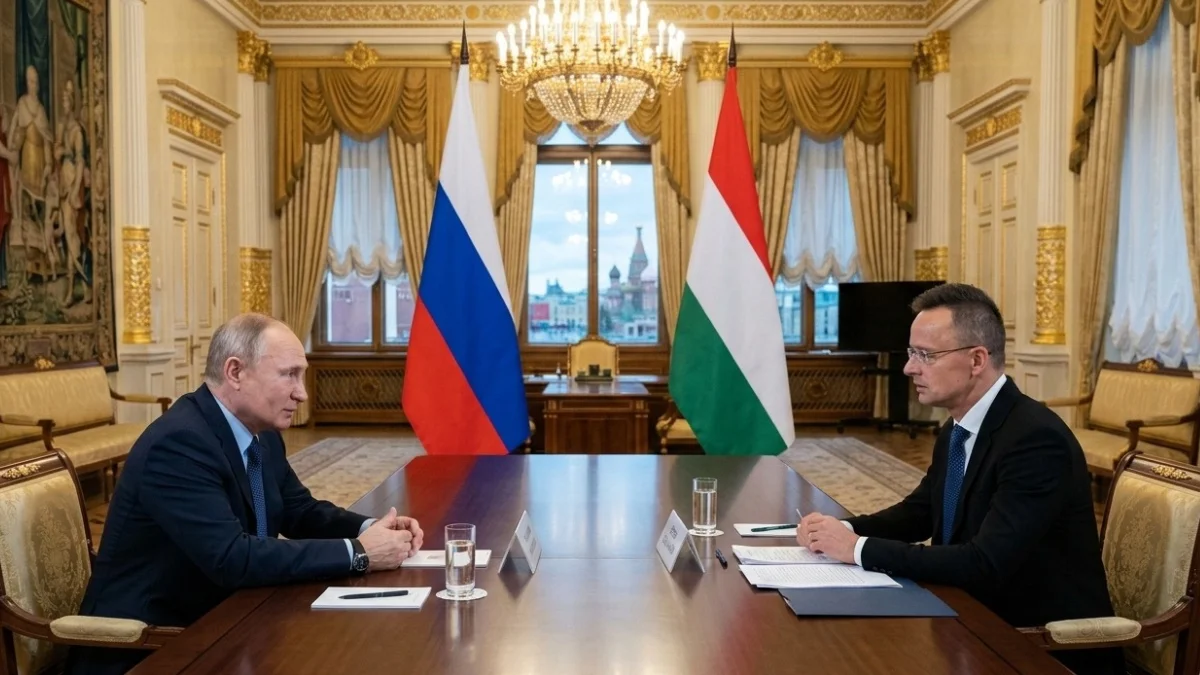

Russian President Vladimir Putin hosted Hungary’s Foreign Minister Péter Szijjártó in Moscow this week for talks focused mainly on oil and gas supplies. The meeting comes at a time when global energy markets are facing uncertainty due to ongoing conflicts, including the war in Ukraine and the recent tensions in the Middle East.
Hungary has remained one of the few European Union countries that continues to rely heavily on Russian energy. During the meeting, Szijjártó said his visit aimed to ensure that Hungary would continue receiving Russian oil and gas without major disruptions. He also sought assurances that the supplies could continue at stable prices despite rising global energy costs.
Putin acknowledged Hungary’s concerns about energy security and said Moscow was ready to discuss the situation in global and European gas markets. He noted that some factors affecting supply are outside Russia’s direct control, but indicated that the two sides could work together to address Hungary’s needs.
A key issue in the discussions was the flow of Russian oil through the Druzhba pipeline, which passes through Ukrainian territory before reaching Hungary. Hungarian officials have recently claimed that oil shipments through the pipeline have been blocked for weeks. Budapest has accused Ukraine of deliberately slowing or halting the transit of Russian oil for political reasons, a claim Kyiv denies.
Szijjártó said the Hungarian government wants guarantees that its energy supply will remain secure even as global markets face pressure from conflicts and supply disruptions. The situation has become more complicated due to instability in the Middle East, which has contributed to higher energy prices and concerns about global shipping routes.
During the meeting, Putin also announced that Russia would release two prisoners of war of Hungarian origin who had been captured while fighting for Ukraine. According to the Russian president, the move came after a request from Hungarian Prime Minister Viktor Orbán. Putin said the detainees would be able to return to Hungary on the same plane used by the Hungarian delegation.
The talks highlight the continued cooperation between Moscow and Budapest despite broader tensions between Russia and the European Union. While many EU countries have reduced their dependence on Russian energy since the start of the Ukraine war, Hungary has maintained close economic ties with Moscow in the energy sector.
For Russia, maintaining energy partnerships with countries that remain open to cooperation helps preserve its role in European energy markets. The meeting also shows how energy security continues to influence diplomatic relations across Europe during a period of ongoing geopolitical tension.

Comments are closed.