

The tanker SAND, managed by Orient Petroleum Transport Co., Ltd. in Hanoi, was sailing from India to Iraq to load oil. While the ship was in the Gulf of Oman, about 120 nautical miles (216 km) from the Strait of Hormuz, it received reports of escalating conflict in the Middle East on Feb. 28.
The vessel, carrying 23 Vietnamese crew members, was instructed not to enter the strait and instead head toward a safer area in the Indian Ocean.
At 2 p.m. on March 1 (local time), while still in the Gulf of Oman en route to the Indian Ocean, the captain of the SAND received a distress call reporting a fire aboard the MKD VYOM, a Marshall Islands-flagged tanker about 40 nautical miles away.
Crew members on the vessel were attempting to extinguish the fire, but the blaze continued to spread. The ship was carrying 61,000 tons of gasoline and was traveling from the port of IJmuiden in the Netherlands to Saudi Arabia.
Captain Bui Duc Tuan said he immediately informed Orient Petroleum Transport about the situation and contacted the MKD VYOM captain to confirm the vessel’s position. After receiving approval from company leadership, he decided to change course and head to the rescue.
“I thought human lives were the most important, so we had to respond immediately, even though we were worried about the possibility of torpedoes or drones,” Tuan said. “All the Vietnamese crew members agreed to turn around to rescue them.”
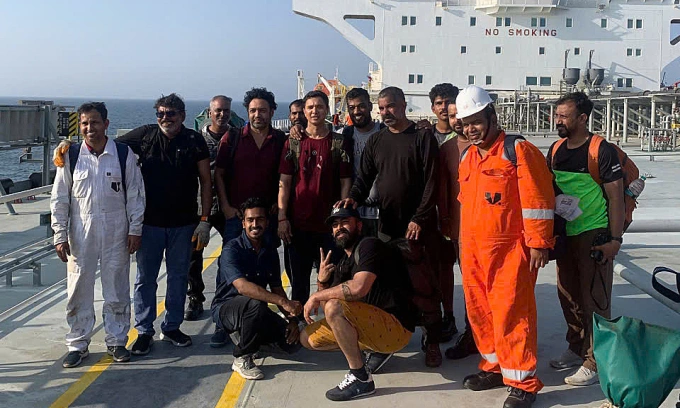
Vietnamese crew members on SAND lower a rescue ladder to assist sailors from the MT MKD VYOM approaching in a lifeboat. Photo courtesy of the Vietnamese sailors |
At the time, several vessels in the area had received the distress signal from the MKD VYOM and from Oman’s maritime rescue authorities, but according to Tuan, only the SAND confirmed it would respond.
After six hours of unsuccessful firefighting, the MKD VYOM crew abandoned ship in two lifeboats.
Navigating through the night, the SAND followed intermittent VHF signals from the stranded sailors. When the ship was about two nautical miles away, Tuan spotted lights from the lifeboats and quickly maneuvered closer. Weather conditions were favorable, with clear skies and calm seas aiding the rescue effort.
At 10 p.m., the first lifeboat carrying eight sailors reached the port side of the SAND. Crew members lowered ladders and used cargo cranes to bring the survivors aboard.
By nearly midnight, a second lifeboat carrying 13 sailors arrived and they were also safely brought on board.
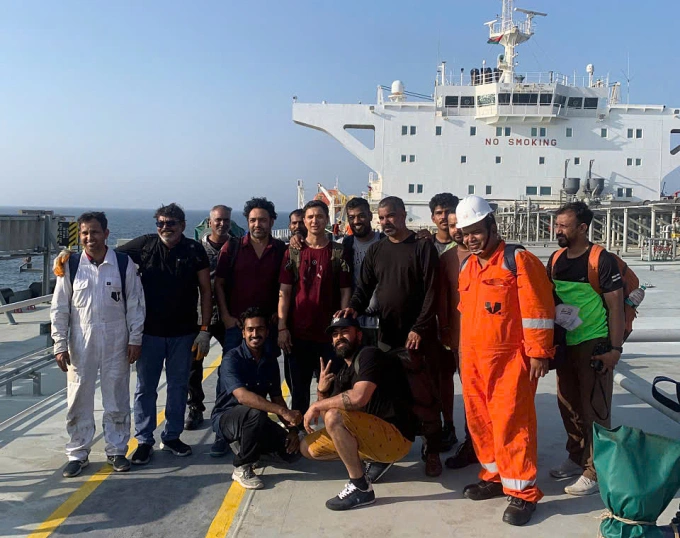 |
Crew members of the MT MKD VYOM before leaving the SAND for shore. Photo courtesy of SAND crew members |
All 21 sailors from the MKD VYOM – a Ukrainian captain, four Bangladeshi sailors, and 16 Indian crew members – were rescued safely.
According to the Ukrainian captain, the vessel had stopped about 100 nautical miles from the Strait of Hormuz and was drifting when it was believed to have been struck by either a torpedo or a drone on the starboard side behind the bridge. One crew member was killed in the incident, while the remaining sailors were unharmed.
Chief officer Bui Van Luong said the rescued sailors were exhausted and shaken after hours of battling the fire and then drifting at sea in lifeboats. Only two of them had enough strength to climb aboard using the ladder, while the others had to be lifted with cargo equipment.
The Vietnamese crew provided water, milk, and instant noodles, though many of the survivors were too tired to eat.
Following instructions from Muscat Port authorities in Oman, the SAND sailed toward waters off Muscat. At 6 p.m. on March 2, all rescued sailors were transferred to an Omani rescue vessel and taken ashore.
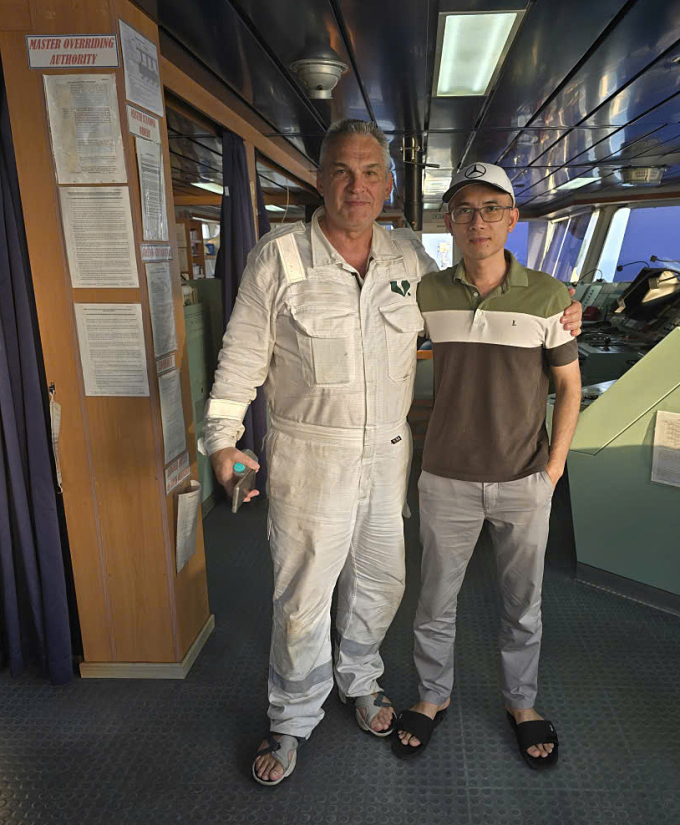 |
Captain Bui Duc Tuan (R) and the Ukrainian captain of the MKD VYOM. Photo courtesy of Bui Duc Tuan |
The SAND has since left the Gulf of Oman and is drifting in a safe area of the Indian Ocean while awaiting new cargo instructions. However, Tuan said the crew remains uneasy as they occasionally hear drones flying overhead. The ship has strengthened watch duties at the bow, bridge wings, and during nighttime hours to detect unusual objects and respond quickly to potential threats.
After 16 years at sea, Tuan said this was the first time he had faced the risks of operating in a conflict zone and conducting a rescue following an apparent attack on a vessel.
“We hope ships and sailors operating in the Middle East will try to stay away from conflict zones to ensure safety for both people and vessels,” he said.
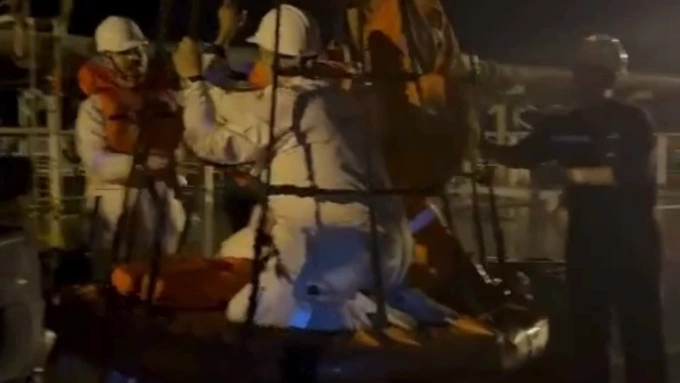
Rescue of the MKD VYOM crew members. Video courtesy of SAND
The Middle East tension has escalated since Feb. 28 when the U.S. and Israeli forces launched attacks on Iran targeting defense and intelligence facilities as well as senior officials. Iran responded with large-scale ballistic missile and drone strikes, targeting Israel and countries hosting U.S. military bases in the Middle East such as Jordan, the United Arab Emirates, and Bahrain.
The Strait of Hormuz, located between Oman and Iran, is a vital maritime route through which more than 14 million barrels of crude oil pass each day, accounting for about one-third of global seaborne fuel exports.
According to the Vietnam Maritime and Inland Waterways Administration, eight vessels with around 160 Vietnamese sailors are operating in the Persian Gulf region, including waters near the UAE, Iraq, and Saudi Arabia.

Comments are closed.