
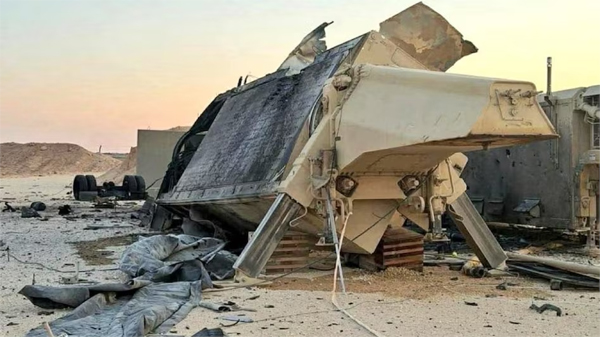

Tehran. Iran has caused significant damage to US-made radar systems by carrying out precision strikes on several key military bases in the Arabian Peninsula. According to satellite images, the radar of the US THAAD missile battery stationed at Muwaffaq Salti Air Base in Jordan has been completely destroyed. Radar buildings at military bases in the United Arab Emirates (UAE) and Saudi Arabia have also been targeted. Iran’s main objective is to destroy air defense systems by eliminating these advanced radars that detect incoming missiles and drones.
The attack on Jordan’s Muwaffaq Salti Air Base has been the most devastating. Located about 500 miles from Iran, the base has been a major hub for the US. Photos taken before the fighting began showed more than 50 jets, drones, and transport aircraft parked on the runway. However, satellite images now show two large, 13-foot-deep craters near the radar, suggesting an attempt to destroy it.
The radar system for the THAAD missiles destroyed is the AN/TPY-2 portable radar, manufactured by Raytheon Company. The system cost approximately half a billion dollars ($500 million). The radar system was spread across five 40-foot-long trailers, which are now completely damaged or reduced to rubble.
The report claims that these radars and Thar batteries were deployed in February and it appears that these radars were attacked on March 1 or 2.
The attacks are not limited to Jordan
. The report states that the attacks are not limited to Jordan. Satellite images from March 1 showed smoke rising from a radar site near Saudi Arabia’s Prince Sultan Air Base. However, US officials have declined to officially comment on the damage due to security reasons.
Military installations near Ruwais and Sader in the United Arab Emirates were also targeted between February 28 and March 1. At least three buildings in Ruwais and four in Sader were damaged.
According to a CNN report, Thar batteries and radar systems were stored at these locations. Satellite footage shows damage to the sheds where the radar systems were stored. The UAE has two of its own Thar batteries, while the US also operates units there, but it is currently unclear which has suffered the most damage.
According to weapons expert N.R. Jenzen-Jones, the AN-TPY/2 radar is essentially the heart of the Thar battery. It helps launch interceptor missiles and provide a clear picture of aerial threats. He added that the loss of even one radar is a significant operational event, as it cannot be easily replaced. Procuring a replacement unit from elsewhere would require considerable time and effort. While the system is not completely useless without the radar, its ability to protect and defend a large area is severely diminished.
‘Early Warning also suffered heavy damage’
It is being said that not only THAAR, but there are reports of damage to the American-made ‘Early Warning’ radar system located in Umm Dahl, Qatar.
Experts believe that Iran deliberately targeted communications, radar and intelligence equipment to cut off US bases from the outside world.
A Pentagon spokesperson declined to comment on the status of specific capabilities, citing operational security. These radars, which were the first line of defense for the US and its allies in the Middle East, are now at risk.
Meanwhile, fighter jet activity has increased in the UAE skies amid the airstrikes. French Foreign Minister Jean-Noël Barrot confirmed that France has deployed Rafale fighter jets to protect its military bases in the UAE.
137 missiles fired at UAE
The UAE reported that 137 missiles were fired on Saturday, the first day of the war, which had dropped to just seven by Thursday. Although the number of ballistic missiles has decreased, drone attacks are still ongoing. Iran has so far fired 1,072 drones and 196 ballistic missiles at the UAE.
Experts say that systems like the Thar, combined with the Patriot missile defense system, create layers of security. Iran’s current strategy is to penetrate these layers; if the radar network collapses, the missile defense system becomes unresponsive. This move by Iran has put the US on the defensive. The challenge now is how quickly these expensive and scarce radar systems can be replaced, as the war is likely to drag on and airstrikes are showing no signs of stopping.

Comments are closed.