
Ho Chi Minh City eyes resurrection of stalled development projects in central area, including slum once notorious for drugs

Local authorities in Ben Thanh and Cau Ong Lanh wards have been instructed to find out the needs of affected people living in the two areas while the city reviews building heights and road infrastructure to make the projects more attractive to investors, city Party Secretary Tran Luu Quang said Thursday at a meeting between voters and candidates for the National Assembly’s 2026-2031 term.
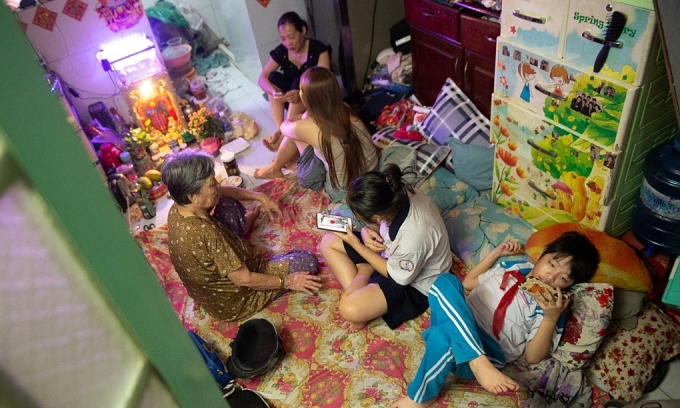
A family shares a small space in the Ma Lang slum in downtown Ho Chi Minh City in 2023. Photo by Read/Thanh Tung |
The two long-delayed projects are located in central areas and affect a large number of citizens.
Ga-Gao, a traditional market in Cau Ong Lanh Ward between Nguyen Thai Hoc, Vo Van Kiet, Co Giang, and Yersin streets has existed since before 1975, when the country was reunified.
The market has narrow walkways about a meter wide. The small stalls serve both as shops and living quarters for vendors and their families. Over time they have deteriorated, becoming damp and failing to meet fire safety standards.
Ma Lang is a 6.8-hectare (16.8-acre) area bounded by Nguyen Trai, Cong Quynh, Nguyen Cu Trinh, and Tran Dinh Xu streets.
Before 1975 it used to be a cemetery.
That changed in 1980-82 when people who had left for new economic zones in rural and mountainous areas returned to the city due to extreme poverty there.
Many of them settled in Ma Lang in makeshift tents and houses.
In the late 1990s and early 2000s the neighborhood became notorious for drugs, and the name Ma Lang became synonymous with some of the most feared gangsters in HCMC.
It now has 530 tenements each measuring less than 20 square meters and housing street vendors, scrap collectors, motorbike taxi drivers, masons, and other manual workers.
Quang is running for election in HCMC Constituency No. 6 against four other candidates.
After the candidates presented their action plans, voters raised several concerns.
Trinh Van Thanh, a resident of Cau Ong Lanh Ward, said many development projects remain stalled for long in his area.
A man named Pham Thanh Trieu highlighted the severe overcrowding in Ma Lang, where some families of nine or 10 people have to take turns sleeping in homes measuring just 10-15 sq.m. There are more than 1,400 households there.
The voters urged the candidates, particularly Quang, to develop policies and mechanisms to address the problems if elected.
Quang said the situation in Ma Lang and the Ga-Gao Market has long concerned him.
“I had a university friend whose home was only a few square meters. When he slept, his body was inside the house but his legs stuck out into the alley. He stayed awake all night worrying a vehicle might run over them.”
He said the city must take the responsibility for improving such areas.
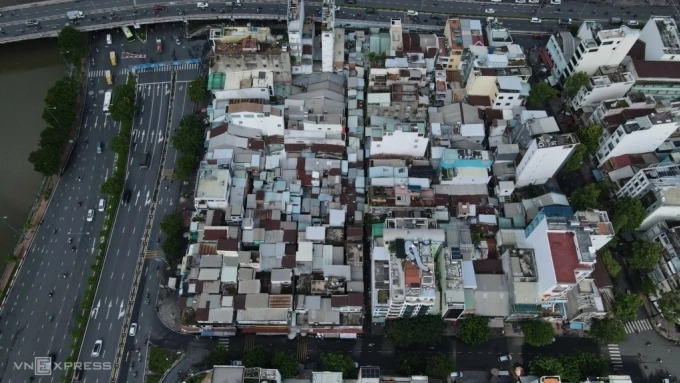 |
The Ga-Gao market in HCMC viewed from above. Photo by Read/Dinh Van |
Quang instructed ward authorities to compile a full list of households in both the areas and submit it to the city Party Committee for further assessment and planning.
Investors had been found and work had begun in both places before being halted.
To revive the projects, Quang said the city must reconsider traffic capacity and planning regulations, including allowing taller buildings.
If a residential complex is to be built in Ma Lang with around eight floors for resettling its inhabitants, investors would possibly require an additional 10 floors to build commercial housing to make the project financially feasible, he pointed out.
But a building of 18 floors could place pressure on the existing road network, he said.
So the development requires a coordinated approach that includes adjusting building height limits, upgrading transport infrastructure and revising planning indicators to make the project more appealing to investors, he said.
“I promise that we will carefully study this issue.”
Meanwhile, Ga-Gao Market is earmarked for development into a tower with a maximum height of 50 meters (10-14 floors) to house around 700 people, but for years has struggled to attract investors.
Some 290 households with 1,173 members currently living in the area are expected to be affected by the work.

Comments are closed.